书单
尼古拉斯·卡尔
- 生卒
- 1959 –
- 国籍
- 美国
- 外文名
- Nicholas G. Carr
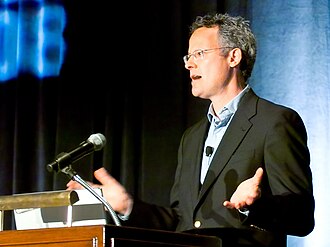
照片:Sandy Fleischmann,CC BY 2.0,来自维基共享资源「Nicholas Carr at the Telecosm Conference in 2008 crop.jpg」(经缩小)。
生平与创作
尼古拉斯·卡尔(英语:Nicholas G. Carr,1959年1月7日—)是美国作家及记者,其著作主要是关于科技、商业以及文化方面。毕业于达特茅斯大学及哈佛大学。
主要著作
1.《数字化企业》Digital Enterprise : How to Reshape Your Business for a Connected World (2001) ISBN 1-57851-558-0
2.《IT无足轻重?》Does IT Matter? (2004) ISBN 1591394449
3.《大转变》The Big Switch: Rewiring the World, from Edison to Google (2008, W. W. Norton) ISBN 978-0-393-06228-1
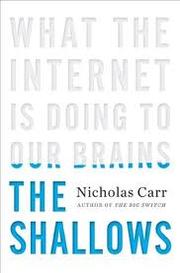
4.《互联网如何毒化了我们的大脑》The Shallows: What the Internet Is Doing to Our Brains (2010, W. W. Norton)
以上文字摘自维基百科「尼古拉斯·卡尔」(去掉了参考文献等尾部小节),按 CC BY-SA 4.0 使用,作者为维基百科的各位编者。
中文维基百科的条目比较短,下面附上英文维基百科的内容(英文原文):
Nicholas G. Carr (born 1959) is an American journalist and writer who has published books and articles on technology, business, and culture. His book The Shallows: What the Internet Is Doing to Our Brains was a finalist for the 2011 Pulitzer Prize in General Nonfiction.
Career
Nicholas Carr originally came to prominence with the 2003 Harvard Business Review article "IT Doesn't Matter" and the 2004 book Does IT Matter? Information Technology and the Corrosion of Competitive Advantage (Harvard Business School Press). In these widely discussed works, he argued that the strategic importance of information technology in business has diminished as IT has become more commonplace, standardized and cheaper. His ideas roiled the information technology industry, spurring heated outcries from executives of Microsoft, Intel, Hewlett-Packard and other leading technology companies, although the ideas got mixed responses from other commentators.
In 2005, Carr published the controversial article "The End of Corporate Computing" in the MIT Sloan Management Review, in which he argued that in the future companies will purchase information technology as a utility service from outside suppliers. Carr's second book, The Big Switch: Rewiring the World, From Edison to Google, was published in January 2008 by W. W. Norton. It examines the economic and social consequences of the rise of Internet-based cloud computing, comparing the consequences to those that occurred with the rise of electric utilities in the early 20th century.
In the summer of 2008, The Atlantic published Carr's article "Is Google Making Us Stupid?" as the cover story of its annual Ideas issue. Highly critical of the Internet's effect on cognition, the article has been read and debated widely in both the media and the blogosphere. Carr's main argument is that the Internet may have detrimental effects on cognition that diminish the capacity for concentration and contemplation.
Carr's 2010 book, The Shallows, develops this argument further. Discussing various examples ranging from Nietzsche's typewriter to London cab drivers' GPS navigators, Carr shows how newly introduced technologies change the way people think, act and live. The book focuses on the detrimental influence of the Internet—although it does recognize its beneficial aspects—by investigating how hypertext has contributed to the fragmentation of knowledge. When users search the Web, for instance, the context of information can be easily ignored. "We don't see the trees," Carr writes. "We see twigs and leaves." One of Carr's major points is that the change caused by the Internet involves the physical restructuring of the human brain, which he explains using the notion of "neuroplasticity." In addition to being a Pulitzer Prize nominee, the book appeared on the New York Times nonfiction bestseller list and has been translated into 17 languages.
In 2014, Carr published his fourth book, The Glass Cage: Automation and Us, which presents a critical examination of the role of computer automation in contemporary life. Spanning historical, technical, economic, and philosophical viewpoints, the book has been widely acclaimed by reviewers, with the New York Times Sunday Book Review terming it "essential."
In 2016, Carr published Utopia Is Creepy: and Other Provocations, a collection of blog posts, essays, and reviews from 2005 to 2016. The book provides a critique of modern American techno-utopianism, which TIME magazine said "punches a hole in Silicon Valley cultural hubris." In 2025, Carr published Superbloom: How Technologies of Connection Tear Us Apart, which presents a critique of social media's impact on contemporary society.
Carr has been executive editor of the Harvard Business Review. He has also served as a member of the editorial board of advisors of Encyclopædia Britannica. In 2019, Carr was the Richmond Visiting Professor of Sociology at Williams College.
以上文字摘自英文维基百科「Nicholas G. Carr」(有删节,去掉了参考文献等尾部小节),按 CC BY-SA 4.0 使用,作者为维基百科的各位编者。
资料卡
- 出生
- 1959 年 1 月 7 日
- 出生地
- 辛辛那提
- 职业
- 作家、新闻工作者、采编
- 使用语言
- 英语
- 就读学校
- 达特茅斯学院、哈佛大学
资料卡来自 Wikidata Q137642(CC0),众包数据,个别字段可能不全。