 书单
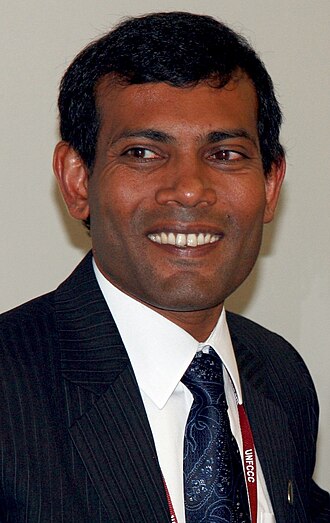
穆罕默德·纳希德
- 生卒
- 1967 –
- 国籍
- 马尔代夫
- 外文名
- Mohamed Nasheed
照片:UNDP,CC BY 2.0,来自维基共享资源「Mohamed Nasheed by UNDP.jpg」(经缩小)。
生平与创作
穆罕默德·纳希德(迪维希语:މުހައްމަދު ނަޝީދު ,拉丁转写:Mohamed Nasheed,1967年5月17日—),马尔代夫共和国前任总统。
纳希德1989年毕业于英国利物浦约翰摩尔斯大学,1991年因批评当局而遭逮捕下狱,次年被判处三年有期徒刑,1993年出狱后又多次遭到当局逮捕。2000年,纳希德曾一度代表马累而当选为马尔代夫国会议员,但六个月后因被指控曾偷盗过国家文件而再次接受当局的处罚。2003年,纳希德流亡海外,积极组建马尔代夫民主党。
2004年,纳希德获得英国政治避难权,次年回到马累。他的到来使得马尔代夫民主党人气大增,因此在2005年,他又再一次被下狱,被认定为恐怖分子。
2008年,在总统大选中一举击败加尧姆,当选马尔代夫第三任民选总统。
2012年2月7日,在国内爆发警察叛变及持续数周的群众示威后,纳希德在电视记者会上宣布辞去马尔代夫总统,并将总统职权移交给副总统穆罕默德·瓦希德·哈桑。但辞职之后不久,纳希德突然公开宣称“辞职是被人用枪顶着头的强迫辞职”。
2015年,法院判决纳希德犯有恐怖主义罪行。次年当局准许他离境到英国治病,而他在英国再次获得政治避难权。2018年11月,马尔代夫最高法院判决纳希德的定罪无效,他的13年有期徒刑获得取消。2019年议会选举后当选人民议会议长。2021年5月6日他在住所外被炸弹炸至重伤,他的2名保镖亦受伤。3名疑犯被捕。
以上文字摘自维基百科「穆罕默德·纳希德」(去掉了参考文献等尾部小节),按 CC BY-SA 4.0 使用,作者为维基百科的各位编者。
中文维基百科的条目比较短,下面附上英文维基百科的内容(英文原文):
Mohamed Nasheed (Dhivehi: މުހައްމަދު ނަޝީދު; born 17 May 1967), also known as Anni (Dhivehi: އަންނި), is a Maldivian politician and activist who served as the fourth president of the Maldives from 2008 until his controversial resignation in 2012. A founding member of the Maldivian Democratic Party, he subsequently served as the 19th speaker of the People's Majlis from 2019 until his resignation in 2023. He is the first democratically elected president of the Maldives and the only president to resign from office.
Born in Malé, Nasheed was educated overseas before returning to the Maldives and becoming involved in political activism. He was first elected to Parliament in 1999 but was later removed from office, and was arrested and imprisoned several times during his early career. His arrest in 2005 prompted civil unrest. In the first round of the 2008 presidential election, he won 25% of the votes and later defeated incumbent President Maumoon Abdul Gayoom.
As the President, Nasheed played a role in drawing international attention to the threat of climate change to the Maldives. His government focused on anti-corruption measures, free healthcare, political and press freedom.
On 7 February 2012, Nasheed resigned amidst a political crisis. Protests by the opposition began after he allegedly ordered the arrest of Criminal Court Chief Judge Abdulla Mohamed. Nasheed characterised the circumstances of his resignation as a coup d'état. His successor, Mohamed Waheed Hassan, disputed this, saying the process was constitutional, which a Commission of National Inquiry confirmed.
Nasheed unsuccessfully ran for the presidency in 2013. In 2015, Nasheed was convicted under the Anti-Terrorism Act for ordering the arrest of Mohamed and sentenced to 13 years at Maafushi Prison. Nasheed was later granted asylum by the UK government in 2016 after he went there for medical treatment.
In November 2018, the Supreme Court overturned his conviction following Ibrahim Mohamed Solih's win in the 2018 presidential election. Nasheed returned to the Maldives and was elected to the parliament in 2019 for the Central Mahchangolhi constituency, subsequently taking office as the Speaker of the People's Majlis.
On 6 May 2021, an assassination attempt was carried out against Nasheed near his home. He sustained serious injuries after an IED bomb stuffed with bearing balls was detonated as he was getting into his car. He was treated in an intensive care unit in a German military hospital, after undergoing multiple emergency surgeries. Two were convicted for the attack.
Early life
Mohamed Nasheed was born on 17 May 1967 in Malé, Maldives, to a middle-class family. He attended Majeediyya School in the Maldives from 1971 to 1981. He then studied at the Overseas School of Colombo in Sri Lanka from 1981 until 1982, when he moved to England and completed his secondary education at Dauntsey's School. Straight after his GCE A Levels, Nasheed moved north to Liverpool, where he spent the next three years reading maritime studies at Liverpool Polytechnic, before graduating in 1989.
Following his return to the Maldives in the late 1980s, he founded the Sangu magazine, which published a series of investigative reports about President Maumoon Abdul Gayoom's regime. On 24 November 1990, Nasheed was arrested following an article he published in Sangu about the corruption of the Maldivian government and the alleged government interference in the 1989 general election. He was taken to Dhoonidhoo detention centre, where he was held in solitary confinement for eighteen months. He stated that he was tortured while in detention, including being chained to a chair outside for twelve days and forced to eat food containing crushed glass. In 1991, Nasheed was designated as a prisoner of conscience by Amnesty International.
以上文字摘自英文维基百科「Mohamed Nasheed」(有删节,去掉了参考文献等尾部小节),按 CC BY-SA 4.0 使用,作者为维基百科的各位编者。
资料卡
- 母语名
- މުހައްމަދު ނަޝީދު
- 出生
- 1967 年 5 月 17 日
- 出生地
- 马累
- 职业
- 政治人物、新闻工作者
- 使用语言
- 迪维希语、英语
- 就读学校
- 利物浦约翰摩尔斯大学、Overseas School of Colombo、Dauntsey's School、Majeedhiyya学校
- 配偶
- Laila Ali Abdulla(2008)
- 获奖
- 安娜·林德纪念基金、地球卫士奖(2010);另有 2 项只有外文名
资料卡来自 Wikidata Q152381(CC0),众包数据,个别字段可能不全。