书单
Roger Mais
- 生卒
- 1905 – 1955
- 国籍
- 牙买加
生平与创作
这个词条暂时没有中文维基百科条目,下面是英文维基百科的内容(英文原文):
Roger Mais OJ (11 August 1905 – 21 June 1955) was a Jamaican journalist, novelist, poet, and playwright. He was born to a middle-class family in Kingston, Jamaica. By 1951, he had won ten first prizes in West Indian literary competitions. His integral role in the development of political and cultural nationalism is evidenced in his being awarded the high honour of the Order of Jamaica in 1978.
Biography
Roger Mais was born in Kingston, Jamaica, where he was educated at Calabar High School.
He worked at various times as a photographer, insurance salesman, and journalist, launching his journalistic career as a contributor to the weekly newspaper Public Opinion from 1939 to 1952, which was associated with the People's National Party. He also wrote several plays, reviews, and short stories for Edna Manley's cultural journal, Focus, and the newspaper, The Daily Gleaner; his topics most frequently were the social injustice and inequality suffered by black, poor Jamaicans. He appealed to his local audience on grounds to push for a national identity and agitate against colonialism.
Mais published more than a hundred short stories, most appearing in Public Opinion and Focus. Other stories are collected in Face and Other Stories and And Most of All Man, published in the 1940s. Mais' play George William Gordon was also published in the 1940s, focusing on a politician and martyr of the Morant Bay Rebellion of 1865. It played an important role in the rehabilitation of the eponymous character. In conventional colonial history Gordon was described as a rebel and traitor, but on the centenary of the rebellion, he was declared to be a Jamaican National Hero.
On 11 July 1944, Roger Mais published an article titled "Now We Know," a denunciation of the British Empire, in Public Opinion, in which he claimed that it was now clear that the Second World War was not a fight for freedom but a war to preserve imperial privilege and exploitation:
That the sun may never set upon privilege, repression and exploitation and upon the insolence and arrogance of one race to all others... That the sun may never set upon the great British tradition of Democracy which chains men and women and little children with more than physical chains, chains of ignorance and the apathy of the underfed, and the submissiveness, which is a spiritual sickness in the thews and sinews of a man; chains them in dungeons of gold mines and silver mines and diamond mines, and upon sugar plantations, and upon rubber plantations and tea plantations. For the great idea of Democracy which relegates all "niggers" of whichever race, to their proper place in the scheme of political economy.
Accused of sedition for writing this denunciation of Churchill's declaration that the end of the Second World War would not mean the end of the British Empire, the Jamaican novelist was tried, convicted and imprisoned for six months. This period was instrumental in his development of his first novel, The Hills Were Joyful Together (1953), a work about working-class life in 1940s Kingston. "Why I Love and Leave Jamaica", an article written in 1950, also stirred emotions in readers. It characterized the bourgeoisie and the "philistines" as shallow and criticized their influential role on art and culture.
Mais wrote more than thirty stage and radio plays. The plays Masks and Paper Hats and Hurricane were performed in 1943, Atlanta in Calydon in 1950; The Potter's Field was published in Public Opinion (1950) and The First Sacrifice in Focus (1956).
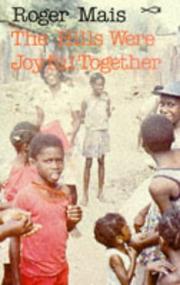
Mais left Jamaica for England in 1952. He lived in London, then in Paris, and for a time in the south of France. He took an alias, Kingsley Croft, and exhibited an art exhibition in Paris. His artwork also appeared on the covers of his novels. In 1953, his novel The Hills Were Joyful Together was published by Jonathan Cape in London. Soon afterwards, Brother Man (1954) was published, a sympathetic exploration of the emergent Rastafarian movement. The next year Black Lightning was published. While Mais' first two novels had urban settings, Black Lightning (1955) featured an artist living in the countryside. In 1955 Mais was forced to return to Jamaica after falling ill with cancer; he died that same year in Kingston at the age of 50. In 1968 he was posthumously awarded the Musgrave Gold Medal by the Institute of Jamaica.
His short stories were collected in a volume entitled Listen, The Wind, thirty-two years after his death. Mais' novels have been republished posthumously several times, an indication of his importance to Caribbean literary history. He also had an influence on younger writers of the pre-independence period, notably John Hearne. Many of Mais' manuscripts have been deposited in the library of the University of the West Indies, Jamaica and there is an online collection. The University of the West Indies, Trinidad also holds a Roger Mais Collection.
Novels
The Hills Were Joyful Together (1953) is written in the style of a narrative. It takes place in a "yard" consisting of individuals and families living in a confinement of shacks shaped squarely, leaving a yard in the center. In this yard, daily and public life of the tenement unfolds. Mais took inspiration from Trinidadian C. L. R. James's novel Minty Alley and short story "Triumph", which illustrated "yard" life. Mais's The Hills Were Joyful Together is basically a depiction of slum life, portraying the upset of poverty in these yards. Mais claimed that he was "concerned with setting down objectively the hopes, fears, [and] frustrations of these people". He wanted the novel to be "essentially realistic, even to the point of seeming violent, rude, expletive, functional, primitive, raw".
以上文字摘自英文维基百科「Roger Mais」(有删节,去掉了参考文献等尾部小节),按 CC BY-SA 4.0 使用,作者为维基百科的各位编者。
资料卡
- 出生
- 1905 年 8 月 11 日
- 出生地
- 金斯敦
- 逝世
- 1955 年 6 月 21 日
- 逝世地
- 金斯敦
- 职业
- 诗人、新闻工作者、小说家、作家、剧作家
- 使用语言
- 英语
- 就读学校
- Calabar High School
资料卡来自 Wikidata Q185333(CC0),众包数据,个别字段可能不全。