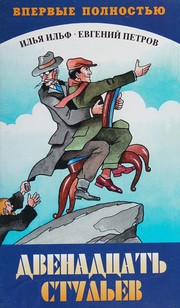
书单
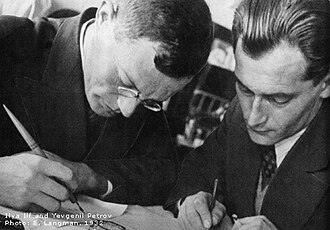
伊里夫和彼得罗夫
- 外文名
- Ilf and Petrov
照片:Eleazar Langman,公有领域,来自维基共享资源「Ilf Petrov.jpg」(经缩小)。
生平与创作
伊里夫和彼得罗夫(俄语:Ильф и Петров)是苏联作家伊利亚·伊里夫(本名伊利亚·阿尔诺多维奇·芬希尔伯格)和叶夫根尼·彼得罗夫(本名叶夫根尼·彼得罗维奇·卡塔耶夫)共用的笔名。二人都出生于乌克兰敖德萨,活跃于20世纪20年代至30年代,他们共同创作了大部分作品,其中包括长篇小说《十二把椅子》和《一层楼的美国》。1982年,小行星3668以他们的名字命名。
叶夫根尼·彼得罗夫的哥哥瓦连京·卡塔耶夫也是一位作家。
以上文字摘自维基百科「伊里夫和彼得罗夫」(去掉了参考文献等尾部小节),按 CC BY-SA 4.0 使用,作者为维基百科的各位编者。
中文维基百科的条目比较短,下面附上英文维基百科的内容(英文原文):
Ilya Ilf (Ilya Arnoldovich Feinsilberg or Russian: Илья Арнольдович Файнзильберг, 1897–1937) and Yevgeny Petrov (Yevgeniy Petrovich Katayev or Russian: Евгений Петрович Катаев, 1902–1942) were two Soviet prose authors of the 1920s and 1930s. They did much of their writing together, and are almost always referred to as "Ilf and Petrov". They were natives of Odessa.
The duo were arguably the most popular satirical writers in the Soviet period, representatives of the "Odessa School" of humorist writers, and some of the very prominent, mostly Jewish odessit (Odessa native) cultural figures along with Isaac Babel and Leonid Utesov, who moved to work in the Soviet capital after the abolition of restrictions on Jewish residence in the Pale of Settlement.
Publications
Ilf and Petrov gained a high profile for their two satirical novels: The Twelve Chairs (1928) and its sequel, The Little Golden Calf (1931). The two texts are connected by their main character, Ostap Bender, a con man in pursuit of elusive riches. Both books follow exploits of Bender and his associates looking for treasure amidst the contemporary Soviet reality. They were written and are set in the relatively liberal era in Soviet history, the New Economic Policy of the 1920s. The main characters generally avoid contact with the apparently lax law enforcement. Their position outside the organized, goal-driven, productive Soviet society is emphasized. It also gives the authors a convenient platform from which to look at this society and to make fun of its less attractive and less Socialist aspects. These are among the most widely read and quoted books in Russian culture. The Twelve Chairs was adapted for ca. twenty movies; in the Soviet Union (by Leonid Gaidai and by Mark Zakharov), in the US (in particular by Mel Brooks) and in other countries.
From the late 1920s to 1937, the co-authors wrote several theatrical plays and screenplays, as well as many humorous short stories and satirical articles in the magazines Chudak, 30 days, Krokodil and Ogoniok; and the newspapers Pravda and Literaturnaya Gazeta. In the first years of joint creativity Ilf and Petrov published their stories and satires under parodic pseudonyms: Tolstoevsky (composed of the names of writers Tolstoy and Dostoevsky), Don Busilio (from Don Basilio, a character in the opera The Barber of Seville, and the Russian verb busa – scandal, noise), Cold philosopher and others.
The two writers also traveled across the Great Depression-era United States. Ilf took many pictures throughout the journey, and the authors produced a photo essay entitled "American Photographs", published in Ogoniok magazine. Shortly after that they published the book Одноэтажная Америка (literally: "One-storied America"), translated as Little Golden America (an allusion to The Little Golden Calf). The first edition of the book did not include Ilf's photographs. Both the photo essay and the book document their adventures with their characteristic humor and playfulness. Notably, Ilf and Petrov were not afraid to praise many aspects of the American lifestyle in these works while being highly critical of others. The title comes from the following description.
America is primarily a one-and two-storey country. The majority of the American population lives in small towns of three thousand, maybe five, nine, or fifteen thousand inhabitants.
Vladimir Nabokov considered them to be "wonderfully gifted writers".
Ilf died of tuberculosis a few months after their return from the USA. Petrov became a front line correspondent during the Second World War and, after covering the fighting in Sevastopol, was killed when the airplane he was travelling in back to Moscow crashed while flying low to avoid anti-aircraft fire.
Script authors
Woman-Sycophant – comic play (1930, “Подхалимка”)
House-Barracks – screenplay (1931, “Барак”)
Strong Feeling – vaudeville (1933, “Сильное чувство”)
Under the Circus Dome – comic play (1934, with Valentin Kataev, “Под куполом цирка”)
以上文字摘自英文维基百科「Ilf and Petrov」(有删节,去掉了参考文献等尾部小节),按 CC BY-SA 4.0 使用,作者为维基百科的各位编者。
资料卡
- 出生地
- 敖德萨
- 逝世地
- 莫斯科
- 领域
- 文学
- 代表作
- 金牛犊、One-storied America、十二把椅子
资料卡来自 Wikidata Q262816(CC0),众包数据,个别字段可能不全。