书单
迈克尔·E·布朗
- 生卒
- 1965 –
- 国籍
- 美国
- 外文名
- Michael E. Brown
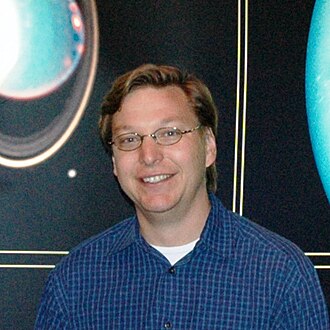
照片:Publishers: Mike Brown prefers the image on his personal website.,公有领域,来自维基共享资源「Michael E Brown 1.jpg」(经缩小)。
生平与创作
迈克尔·E·布朗(英语:Michael "Mike" E. Brown,1965年6月5日—),美国天文学家,现为加州理工学院行星天文学教授(2003年迄今),早先曾任助理教授(1997至2002年)与副教授(2002至2003年)。由于他的团队发现了阋神星等太阳系内类似冥王星的矮行星,导致它被降格成矮行星,因此被称为“冥王星杀手”(Pluto killer)。
教育
布朗来自亚拉巴马州的亨茨维尔,1983年毕业于弗吉尼亚的格里索姆高中;1987年在普林斯顿大学取得文学士学位(物理学),并于1990年在加利福尼亚大学伯克利分校取得天文学硕士学位,1994年取得博士学位。
发现
布朗以探勘围绕太阳运转的遥远天体而知名于科学界,他带领的团队发现了许多外海王星天体。特别着名的有:
阋神星:在太阳系内比冥王星还要大的矮行星。
塞德娜:远日点约为900天文单位,被认为是奥尔特云内层的天体。
亡神星:类冥天体,与海王星的轨道有3:2的共振关系。
争议
在胡斯·路易斯·奥蒂斯宣布发现妊神星(2003 EL61)之前,布朗和他的团队也曾观测该天体近半年之久。因此,谁才是发现者仍有争议。
以上文字摘自维基百科「米高·E·布朗」(去掉了参考文献等尾部小节),按 CC BY-SA 4.0 使用,作者为维基百科的各位编者。
中文维基百科的条目比较短,下面附上英文维基百科的内容(英文原文):
Michael E. Brown (born June 5, 1965) is an American astronomer, who has been professor of planetary astronomy at the California Institute of Technology (Caltech) since 2003. His team has discovered many trans-Neptunian objects (TNOs), including the dwarf planet Eris, which was originally thought to be bigger than Pluto, triggering a debate on the definition of a planet.
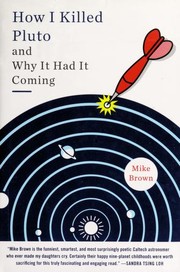
He has been referred to by himself and by others as the man who "killed Pluto", because he furthered Pluto's being downgraded to a dwarf planet in the aftermath of his discovery of Eris and several other probable trans-Neptunian dwarf planets. He is the author of How I Killed Pluto and Why It Had It Coming, published in 2010. He was awarded the Kavli Prize (shared with Jane Luu and David C. Jewitt) in 2012 "for discovering and characterizing the Kuiper belt and its largest members, work that led to a major advance in the understanding of the history of our planetary system."
Early life and education
Brown was raised in Huntsville, Alabama, and graduated from Virgil I. Grissom High School in 1983. He earned his A.B. degree in physics from Princeton University in 1987, where he was a member of the Tower Club. Brown completed his senior thesis, titled "Simulating the measurement of the correlation function of the Shane–Wirtanen galaxy counts", under the supervision of Edward J. Groth. He did his graduate studies at the University of California, Berkeley, where he earned an MA degree in astronomy in 1990 and a PhD degree in astronomy in 1994.
Career
Discoveries
Brown is credited by the Minor Planet Center with the discovery or co-discovery of 29 minor planets, not counting Haumea (see list below). He has carried out several surveys for distant objects orbiting the Sun, and his team has discovered many trans-Neptunian objects (TNOs). These include Eris, a dwarf planet and the only TNO known to be more massive than Pluto, leading directly to Pluto's demotion from planet status; Sedna, a dwarf planet thought to be the first observed body of the inner Öpik–Oort cloud; and Orcus. Brown's team initially referred to Eris and its moon Dysnomia with the informal names Xena and Gabrielle, respectively, after the two main characters of Xena: Warrior Princess. Together with Jean-Luc Margot in 2001, he also discovered Romulus and Linus, two minor-planet moons in the asteroid belt.
以上文字摘自英文维基百科「Michael E. Brown」(有删节,去掉了参考文献等尾部小节),按 CC BY-SA 4.0 使用,作者为维基百科的各位编者。
资料卡
- 出生
- 1965 年 6 月 5 日
- 出生地
- 亨茨维尔
- 职业
- 天文学家
- 使用语言
- 英语
- 就读学校
- Virgil I. Grissom High School、普林斯顿大学、加州大学伯克利分校
- 领域
- 行星科学
- 所属团体
- 美国国家科学院(2013)
- 获奖
- 哈罗德·克莱顿·尤里奖(2001);另有 1 项只有外文名
资料卡来自 Wikidata Q298913(CC0),众包数据,个别字段可能不全。