书单
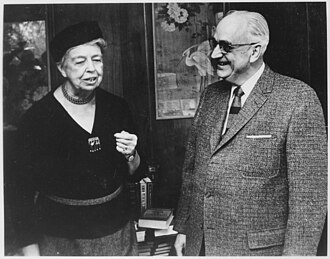
Karl Menninger
- 生卒
- 1893 – 1990
- 国籍
- 美国
照片:作者不详,公有领域,来自维基共享资源「Eleanor Roosevelt and Doctor Karl Menninger in Topeka, Kansas - NARA - 195432.jpg」(经缩小)。
生平与创作
这个词条暂时没有中文维基百科条目,下面是英文维基百科的内容(英文原文):
Karl Augustus Menninger (July 22, 1893 – July 18, 1990) was an American psychiatrist, author, and activist. He was a member of the Menninger family of psychiatrists who founded the Menninger Foundation and the Menninger Clinic in Topeka, Kansas.
He wrote many books including The Human Mind (1930), Man Against Himself (1938), Love Against Hate (1942), The Vital Balance (1963) and The Crime of Punishment (1968). During his life he advocated for a number of causes including children suffering from abuse or neglect, Native Americans, women's rights, prisoners, the elderly, the environment, wildlife, and against nuclear weapons.
Despite being one of the most famous psychiatrists during his time, he was an outsider to mainstream psychiatry, calling the DSM-II a modern "Witches Hammer Manual."
Early life
Menninger was born on July 22, 1893, in Topeka, Kansas, the son of Florence Vesta (Kinsley) and Charles Frederick Menninger. In addition to studying at Washburn University, Indiana University and the University of Wisconsin–Madison, he also studied medicine at Harvard Medical School. He graduated from the school cum laude in 1917. While at Washburn, he was a member of the Alpha Delta Fraternity, a local group. In 1960 he was inducted into the school's Sagamore Honor Society.
After his internship and his service as part of the Naval Reserve during World War I, Menninger worked at the Boston Psychopathic Hospital under Elmer Ernest Southard while also teaching neuropathology at Harvard Medical School. He would remain until the death of Southard in 1919
Menninger Clinic, Foundation and School
In 1919, he returned to Topeka where, together with his father, he founded the Menninger Clinic. By 1925, they had attracted enough investors, including brother William C. Menninger, to build the Menninger Sanitarium.
The Menninger Foundation was established in 1941. After World War II, Karl Menninger was instrumental in founding the Winter Veterans Administration Hospital, in Topeka. It became the largest psychiatric training center in the world.
While the clinic housed Freudian analysts, there was no commitment to any one form of therapy and a belief in the therapeutic value of a warm and caring environment.
In 1946 he founded the Menninger School of Psychiatry. He would serve as the dean until 1970. It was renamed in his honor in 1985 as the Karl Menninger School of Psychiatry and Mental Health Science. In 1952, Karl Targownik, who would become one of his closest friends, joined the Clinic.
Other psychiatric work
In 1930, he wrote his first book The Human Mind, where he argued that psychiatry was a science and that the mentally ill were only slightly different from healthy individuals.
While Man Against Himself is published exclusively under Menninger's name, he acknowledges significant contributions in the acknowledgements of the book by Jeanetta Lyle, the editorial secretary of the Menninger Clinic at that time. Additionally, in at least one copy of the book, he inscribed the book for Jean Lyle, referring to her as his "co-author."
From 1941-1942 he would serve a term as the president of the American Psychoanalytic Association (APsA).
In his 1963 book, The Vital Balance, he and his co-authors disagreed with diagnoses as they existed in psychiatry. While not going as far as saying mental illness is a myth, the book talked about mental disorganization as more generalized and more recoverable than was seen in mainstream psychiatry.
He was considered an outsider to mainstream psychiatry, for example calling the 1968 DSM-II a modern “Witches Hammer Manual”. He also, despite calling himself "more Freudian than Freud" was not particularly attached to doctrine from that tradition, referring to organized psychoanalysis as "the Vatican".
From 1946 to 1962 he was a professor of psychiatry at University of Kansas City Medical School Late in life he also taught criminology, mental hygiene and abnormal psychiatry at Washburn University.
In 1971, He attended a psychoanalitic congress in Vienna where he talked with Anna Freud, Sigmund Freud's daughter. They were both interested in pediatric psychiatry
Letter to Szasz
In 1988, Karl Menninger wrote a letter to Thomas Szasz, a psychiatrist who viewed mental illness to be a myth. In the letter, Menninger said that he had just read Szasz's book Insanity: The Idea and Its Consequences. Menninger wrote that neither of them liked the situation in which insanity separates men from men and free will is forgotten. After recounting the lack of scientific method in psychology over the years, Menninger expressed his regret that he did not come over to a dialogue with Szasz.
Prison reform
Karl Menninger and with his brother Will had been activists for prison reform for a while before publishing The Crime of Punishment. In the book and elsewhere, Menninger argued that current prison system was based on a "vindictive attitude" toward crime and on retributive justice and that correctional facilities did little "correcting" of behavior. He argued that crime was preventable and real rehabilitation possible through educational programs. He argues that crime was not a disease but an illness and that treatment should be psychiatric in nature. The book's reception may have been coloured by the fact that he was considered an "outsider" by specialists.
Activism for children
In 1964 Topeka, Kansas, Karl Menninger founded The Villages, group homes for youth. Later in life he would spend a third of the year doing preventative psychiatry for the foster children.
Criticisms
While parts of his correspondence seem to describe him as sympathetic to Jewish refugees and Black people, other facts add nuance. He favored a quota on Jewish refugees, and did nothing to alter segregation in the Menninger Foundation.
He also called homosexuality an evil and a sin in a 1963 introduction to the American edition of the Wolfenden Report
以上文字摘自英文维基百科「Karl Menninger」(有删节,去掉了参考文献等尾部小节),按 CC BY-SA 4.0 使用,作者为维基百科的各位编者。
资料卡
- 出生
- 1893 年 7 月 22 日
- 出生地
- 托皮卡
- 逝世
- 1990 年 7 月 18 日
- 逝世地
- 托皮卡
- 职业
- 精神科医师、学者、非虚构文学作家、商人
- 使用语言
- 英语
- 就读学校
- 哈佛医学院、威斯康星大学麦迪逊分校、瓦希巴大学、印第安纳大学布卢明顿分校、Topeka High School
- 获奖
- 总统自由勋章(1981);另有 1 项只有外文名
资料卡来自 Wikidata Q3080926(CC0),众包数据,个别字段可能不全。