书单
达尼洛·基什
- 生卒
- 1935 – 1989
- 国籍
- 南斯拉夫社会主义联邦共和国、南斯拉夫王国
- 外文名
- Danilo Kiš
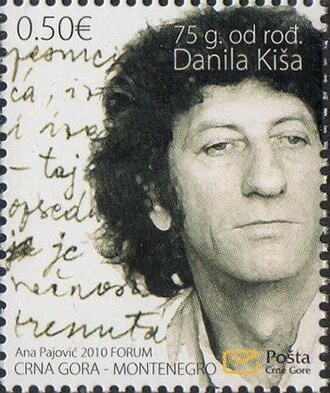
照片:作者不详,公有领域,来自维基共享资源「Danilo Kiš 2010 Montenegro stamp.jpg」(经缩小)。
生平与创作
这个词条暂时没有中文维基百科条目,下面是英文维基百科的内容(英文原文):
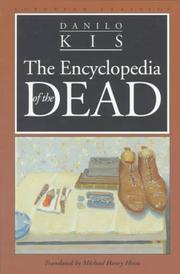
Danilo Kiš (Serbian Cyrillic: Данило Киш; born Dániel Kiss; 22 February 1935 – 15 October 1989) was a Yugoslav and Serbian novelist, short story writer, essayist and translator. His best known works include Hourglass, A Tomb for Boris Davidovich and The Encyclopedia of the Dead.
Life and work
Early life
Danilo Kiš was born in Subotica, Danube Banovina, Kingdom of Yugoslavia (present-day Serbia). His parents were Eduard Kiš (Hungarian: Kis Ede), a Hungarian-speaking Jewish railway inspector, and Milica (née Dragićević), a Montenegrin Serb from Cetinje. His father was born in Austria-Hungary with the surname Kohn, but changed it to Kis as part of Magyarization, a widely implemented practice at the time. Kiš's parents met in 1930 in Subotica and married the following year. Milica gave birth to a daughter, Danica, in Zagreb in 1932 before the family relocated to Subotica.
Kiš's father was an unsteady and often absent figure in Danilo's childhood. Eduard Kiš spent time in a psychiatric hospital in Belgrade in 1934 and again in 1939. Kiš visited his father in the hospital during one of his later stays. This visit, in which, Kiš recalled his father asking his mother for a pair of scissors with which to commit suicide, made a strong impression on young Danilo. For many years, Kiš believed that his father's psychological troubles stemmed from alcoholism. Only in the 1970s did Kiš learn that his father had suffered from anxiety neurosis. Between stays in the hospital, Eduard Kiš edited the 1938 edition of the Yugoslav National and International Travel Guide. Young Danilo saw his father as a traveller and a writer. Eduard Scham, the eccentric father of the protagonist of Early Sorrows, Garden, Ashes, and Hourglass is largely based on Kiš's own father.
World War II
Kiš's parents were concerned with the rising tide of anti-Semitism all around Europe in the late 1930s. In 1939, they oversaw three-year-old Danilo's baptism into the Eastern Orthodox Church in Novi Sad, where the Kiš family resided at the time. Kiš later acknowledged that this action likely saved his life, since as the son of a Jewish convert to Christianity, Danilo would probably have been subject to persecution without definitive proof of his Christian faith.
In April 1941, Hungarian troops, in alliance with Nazi Germany, invaded the northern Yugoslavian province of Vojvodina. After Hungary declared war on the Allied powers in 1941, territory was annexed and officials began to persecute Jews in the region. On 20 January 1942, gendarmes and troops invaded Novi Sad, and two days later, gendarmes massacred thousands of Serbs and Jews in their homes and around the city. Eduard Kiš was among a large group of people rounded up and taken by the gendarmes to the banks of the frozen Danube to be shot. Eduard managed to survive, only because the hole in the ice where the gendarmes were dumping the bodies of the dead became so clogged with bodies that the commanders called for the officers to stop the killing. Kiš later described the massacre as the start of his "conscious life".
Following the massacre, Eduard relocated his family to Kerkabarabás, a town in southwest Hungary. Danilo attended primary school in Kerkabarabás. Through 1944, Hungarian Jews were largely safe, as compared to Jews in other Axis-occupied countries since Hungarian officials were reluctant to hand over Jews to the Nazis. However, in mid 1944 authorities began to deport Jews en masse to concentration camps. Eduard Kiš was sent to a ghetto in Zalaegerszeg in April or May 1944, then was deported to Auschwitz on 5 July. Eduard, along with many of his relatives, was murdered in Auschwitz. Danilo, Danica, and Milica, perhaps owing to Danilo and Danica's baptism certificates, were saved from deportation.
Kiš's father's murder had a massive impact on his work. Kiš crafted his own father into Eduard Scham, the father of the protagonist of Early Sorrows, Garden, Ashes, and Hourglass. Kiš described his father as a "mythical figure," and would continually claim that his father had not been murdered in Auschwitz but had "disappeared."
Post-war life
After the end of the war, the family moved to Cetinje, Montenegro, Yugoslavia, where Kiš graduated from high school in 1954. Kiš studied literature at the University of Belgrade. He was an excellent student, receiving praise from students and faculty members alike. He graduated in 1958 as the first student at the University of Belgrade to be awarded a degree in comparative literature. After graduating, Kiš stayed on for two years of postgraduate research.
Career
While doing research at the University of Belgrade, Kiš was a prominent writer for Vidici magazine, where he worked until 1960. In 1962 he published his first two novels, Mansarda (translated as The Garret) and Psalm 44. He then took up a position as a lector at the University of Strasbourg. He held the position until 1973. In that period, he translated several French books into Serbo-Croatian. He also wrote and published Garden, Ashes (1965), Early Sorrows (1969), and Hourglass (1972). For his novel Peščanik (Hourglass), Kiš received the prestigious NIN Award, but returned it a few years later due to a political dispute. He was awarded the Andrić Prize for Enciklopedija mrtvih in 1983.
Kiš was influenced by James Joyce, Marcel Proust, Bruno Schulz, Vladimir Nabokov, Jorge Luis Borges, Boris Pilnyak, Ivo Andrić and Miroslav Krleža among other authors.
Plagiarism controversy
In 1976, A Tomb for Boris Davidovich was published. Kiš drew inspiration for the novel from his time as a lecturer at the University of Bordeaux.
Kiš returned to Belgrade that year only to be hit by claims that he plagiarized portions of the novel from any number of authors. Critics also attacked the novel for its alleged anti-communist themes.
以上文字摘自英文维基百科「Danilo Kiš」(有删节,去掉了参考文献等尾部小节),按 CC BY-SA 4.0 使用,作者为维基百科的各位编者。
资料卡
- 母语名
- Danilo Kiš
- 出生
- 1935 年 2 月 22 日
- 出生地
- 苏博蒂察
- 逝世
- 1989 年 10 月 15 日
- 逝世地
- 巴黎第十区
- 职业
- 诗人、小说家、编剧、文学编辑、译者、作家
- 使用语言
- 塞尔维亚语、匈牙利语、法语、俄语
- 就读学校
- University of Belgrade Faculty of Philology
- 所属团体
- 塞尔维亚科学与艺术学院(1988)
- 配偶
- Mirjana Miočinović
- 获奖
- 艺术与文学勋章骑士勋位(1984);另有 3 项只有外文名
资料卡来自 Wikidata Q310562(CC0),众包数据,个别字段可能不全。