 书单
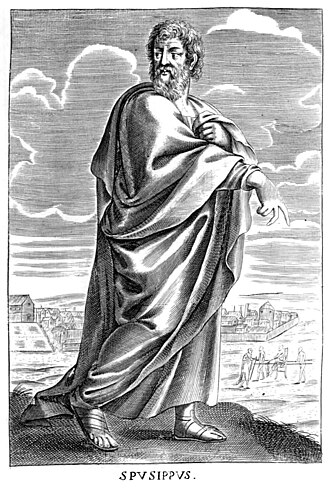
斯珀西波斯
- 生卒
- 公元前 407 – 公元前 339
- 国籍
- 古雅典
- 外文名
- Speusippus
照片:作者不详,公有领域,来自维基共享资源「Speusippus in Thomas Stanley History of Philosophy.jpg」(经缩小)。
生平与创作
斯珀西波斯(Speusippus,—前338年)是位古希腊哲学家。前347年柏拉图去世后,斯珀西波斯成为柏拉图学院(前387年建立)的继承者。
他居住在那八年之久,并以过着放荡浪费的生活闻名。柏拉图本试图遏止他的恶习,但并没成功。后来其是死于自杀或是某种慢性萎缩病。
他认为没有意识到其他所有的知识要懂得每件事物是不可能的,反对怀疑主义。
虽然其支持柏拉图的论述,但根据希腊作家第欧根尼·拉尔修的记载,他反对柏拉图理论的形式。
以上文字摘自维基百科「斯珀西波斯」(去掉了参考文献等尾部小节),按 CC BY-SA 4.0 使用,作者为维基百科的各位编者。
中文维基百科的条目比较短,下面附上英文维基百科的内容(英文原文):
Speusippus (Ancient Greek: Σπεύσιππος; c. 408 – 339/8 BC) was an ancient Greek philosopher. Speusippus was Plato's nephew by his sister Potone. After Plato's death, c. 348 BC, Speusippus inherited the Academy, near age 60, and remained its head for the next eight years. However, following a stroke, he passed the chair to Xenocrates. Although the successor to Plato in the Academy, Speusippus frequently diverged from Plato's teachings. He rejected Plato's Theory of Forms, and whereas Plato had identified the Good with the ultimate principle, Speusippus maintained that the Good was merely secondary. He also argued that it is impossible to have satisfactory knowledge of any thing without knowing all the differences by which it is separated from everything else.
The standard edition of the surviving fragments and testimonies is Leonardo Tarán's Speusippus of Athens: A Critical Study with a Collection of the Related Texts and Commentary (1982).
Life
Speusippus was a native of Athens, and the son of Eurymedon and Potone, a sister of Plato, he belonged to the deme of Myrrhinus. The pseudonymous Thirteenth Letter of Plato claims that Speusippus married his niece (his mother's granddaughter). We hear nothing of his life until the time when he accompanied his uncle Plato on his third journey to Syracuse (Italy), where he displayed considerable ability and prudence, especially in his amicable relations with Dion. His moral worth is recognised even by Timon, though only that he may heap the more unsparing ridicule on his intellect.
The report about his sudden fits of anger, his greed, and his debauchery, are probably derived from a very impure source: Athenaeus and Diogenes Laërtius can adduce as authority for them scarcely anything more than the abuse in some spurious letters of Dionysius the Younger, who was banished by Dion, with the cooperation of Speusippus. Having been selected by Plato as his successor as the leader (scholarch) of the Academy, he was at the head of the school for only eight years (348/7–339/8 BC). He died, it appears, of a lingering paralytic illness, presumably a stroke. He was succeeded as the head of the school by Xenocrates.
Philosophy
Diogenes Laërtius gives us a list of some of the titles of the many dialogues and commentaries of Speusippus, which is of little help in determining their contents, and the fragments provided by other writers provide us with only a little extra.
Epistemology
Speusippus was interested in bringing together those things which were similar in their philosophical treatment, and in the derivation, and laying down, of the ideas of genera and species: for he was interested in what the various sciences had in common, and how they might be connected. Thus he furthered the threefold division of philosophy into Dialectics, Ethics, and Physics, for which Plato had laid the foundation, without losing sight of the mutual connection of these three branches of philosophy. Speusippus maintained that no one could arrive at a complete definition who did not know all the differences by which a thing which was to be defined was separated from the rest.
Like Plato, Speusippus distinguished between that which is the object of thought, and that which is the object of sensuous perception, between the cognition of the reason and sensuous perception. He tried, however, to show how perception can be taken up and transformed into knowledge, by the assumption of a perception, which, by participation in rational truth, raises itself to the rank of knowledge. By this he seems to have understood an immediate (in the first instance aesthetic) mode of conception; since he appealed, in support of this view, to the consideration that artistic skill has its foundation, not in sensuous activity, but in an unerring power of distinguishing between its objects, that is, in a rational perception of them.
以上文字摘自英文维基百科「Speusippus」(有删节,去掉了参考文献等尾部小节),按 CC BY-SA 4.0 使用,作者为维基百科的各位编者。
资料卡
- 出生
- 公元前 407 年
- 出生地
- 古雅典
- 逝世
- 公元前 339 年
- 职业
- 哲学家、数学家
- 使用语言
- 古希腊语
- 写作语言
- 古希腊语
- 文学运动 / 流派
- 柏拉图主义
资料卡来自 Wikidata Q325955(CC0),众包数据,个别字段可能不全。