书单
“富力威”里克·罗斯
- 生卒
- 1960 –
- 国籍
- 美国
- 外文名
- "Freeway" Rick Ross
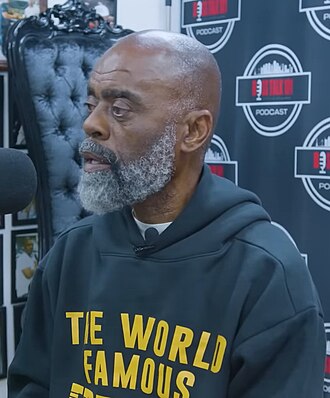
照片:BOSS TALK 101,CC BY 3.0,来自维基共享资源「Freeway Ricky 2025.jpg」(经缩小)。
生平与创作
这个词条暂时没有中文维基百科条目,下面是英文维基百科的内容(英文原文):
Ricky Donnell "Freeway Ricky" Ross (born January 26, 1960) is an American author and former drug lord best known for the drug empire he established in Los Angeles, California, in the early-to-mid 1980s. He was sentenced to life in prison, though the sentence was shortened on appeal and Ross was released in 2009.
Biography
Ross was born on January 26, 1960, in Terrell, Texas. He attended school at Susan Miller Dorsey High School in Los Angeles. He played for the tennis team but was unable to get the college tennis scholarship he aspired to because he was illiterate.
Ross has said that when he first saw crack cocaine as a teenager in 1979, he did not immediately believe it was a drug because it looked different from other drugs he had seen.
The nickname Freeway came from Ross owning properties along Los Angeles' Interstate 110, also known as the Harbor Freeway. According to an October 2013 Esquire magazine article, "Between 1982 and 1989, federal prosecutors estimated, Ross bought and resold several metric tons of cocaine," with Ross' gross revenue claimed to be more than $900 million (equivalent to $2.7 billion in 2025) and profits of almost $300 million ($1.172 billion in 2025). During the height of his drug dealing, Ross was said to have sold "$3 million in one day." According to the Oakland Tribune, "In the course of his rise, prosecutors estimate that Ross exported several tons of cocaine to New York, Ohio, Pennsylvania and elsewhere, and made more than $500 million between 1983 and 1984."
In 1996, Ross was sentenced to life imprisonment under the three-strikes law after being convicted for purchasing more than 100 kilograms of cocaine from a federal agent in a sting operation. Later that year, a series of articles by journalist Gary Webb in the San Jose Mercury News revealed a connection between one of Ross's cocaine sources, Danilo Blandón, and the CIA as part of the Iran–Contra affair. Having learned to read at the age of 28, during his first stint in prison, Ross spent much of his time behind bars studying the law. He eventually discovered a legal loophole that would lead to his release. Ross's case was brought to a federal court of appeals which found that the three-strikes law had been erroneously applied and ordered that he be resentenced. His sentence was reduced to 20 years; he was released from Federal Correctional Institution, Texarkana on September 29, 2009.
Ross was arrested in October 2015 on suspicion of possessing cash related to the sales of illegal drugs when police discovered $100,000 in his possession during a traffic stop. Ross later alleged that he had been racially profiled and stated that he was carrying a large amount of cash for the purchase of a home. Charges were ultimately dropped, and Ross explained he had earned the cash from book sales and speaking fees.
Cocaine business
Cocaine introduction
Ross began his cocaine empire after his illiteracy prevented him from earning a tennis scholarship for college. He began spending time with an upholstery teacher at a Los Angeles community college who revealed he dealt cocaine and offered Ross a small amount to sell. Ross used his profit to purchase more cocaine to sell, expanding his small operation. Ross eventually began to ask for quantities to sell that exceeded what the teacher was willing to procure, so he turned to find a dealer.
The teacher referred Ross to his supplier, Ivan Arguellas, who offered to keep Ross supplied. Arguellas was able to provide larger quantities at a better price, and Ross quickly went from dealing in grams of cocaine to dealing in ounces. About eight months after becoming Ross's supplier, Arguellas was shot in the spine, resulting in months of hospitalization that forced him out of the cocaine business. His brother-in-law Henry Corrales took over the business, but was not enthusiastic about the trade and had failed to make any connections of his own to suppliers.
A Nicaraguan exile and cocaine distributor named Danilo Blandón was acquainted with Arguellas and Corrales, and although he did not know him personally, was impressed with the amount of cocaine that Ross was moving. Blandón offered to supply cocaine to Corrales to sell to Ross, for a fifty-fifty split of the profit. Eventually, Corrales lost his appetite for the cocaine business and retired, at which point Ross became a direct customer of Blandón.
Through his connection to Blandón, and Blandón's supplier Norwin Meneses Cantarero, Ross was able to purchase Nicaraguan cocaine at significantly reduced rates. Ross began selling cocaine at $10,000 per kilo, a price well below average, while also distributing it to the Bloods and Crips street gangs. By 1982, Ross had received his moniker of "Freeway Ricky" and claimed to have sold up to US$3 million worth of cocaine per day, purchasing 1,000 pounds (454 kilos) of cocaine a week.
Ross initially invested most of his profits in houses and businesses, because he feared his mother would catch on to what he was doing if he started spending lavishly on himself. In a jailhouse interview with reporter Gary Webb, Ross said, "We were hiding our money from our mothers." He invested a portion of the proceeds from his drug dealing activities in Anita Baker's first album.
Drug empire
With thousands of employees, Ross has said he operated drug sales not only in Los Angeles but in places across the country including St. Louis, New Orleans, Texas, Kansas City, Oklahoma, Indiana, Cincinnati, North Carolina, South Carolina, Baltimore, Cleveland, and Seattle. He has said that his most lucrative sales came from the Ohio area. He made similar claims in a 1996 PBS interview.
Federal prosecutors estimated that between 1982 and 1989 Ross bought and resold several metric tons of cocaine. In 1980, his gross earnings were said to be in excess of $900 million – with a profit of nearly $300 million. As his distribution empire grew to include forty-two cities, the price he paid per kilo of powder cocaine dropped from as much as $60,000 to as low as $10,000."
以上文字摘自英文维基百科「Freeway Ricky Ross」(有删节,去掉了参考文献等尾部小节),按 CC BY-SA 4.0 使用,作者为维基百科的各位编者。
资料卡
- 本名
- Richard Donnel Ros
- 出生
- 1960 年 1 月 26 日
- 出生地
- Troup
- 职业
- 毒枭
- 就读学校
- 苏珊·米勒·多西高中
- 领域
- 非法毒品贸易
资料卡来自 Wikidata Q606032(CC0),众包数据,个别字段可能不全。