书单
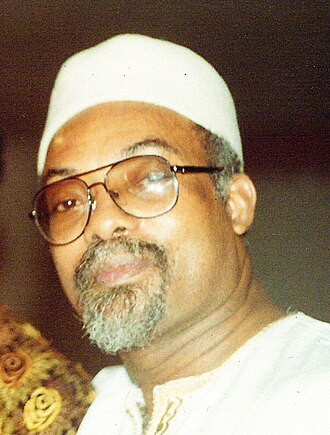
Lindsay Barrett
- 生卒
- 1941 –
- 国籍
- 尼日利亚、牙买加
照片:Margaret Busby,CC BY-SA 4.0,来自维基共享资源「Lindsay Barrett (Ogidi, Nigeria, 1983).jpg」(经缩小)。
生平与创作
这个词条暂时没有中文维基百科条目,下面是英文维基百科的内容(英文原文):
Carlton Lindsay Barrett (born 15 September 1941), also known as Eseoghene, is a Jamaican-born poet, novelist, essayist, playwright, journalist and photographer, whose work has interacted with the Caribbean Artists Movement in the UK, the Black Arts Movement in the US, and pan-Africanism in general. Leaving Jamaica in the early 1960s, he moved to Britain, where he freelanced as a broadcaster and journalist, also travelling and living elsewhere in Europe, before deciding to relocate to West Africa. Since the latter 1960s he has been based mainly in Nigeria, of which country he became a citizen in the mid-1980s, while continuing his connection to cultural ventures in the UK and US.
Barrett initially drew critical attention for his debut novel, Song for Mumu, which on its London publication in 1967 was favourably noticed by such reviewers as Edward Baugh and Marina Maxwell (who respectively described it as "remarkable" and "significant"); more recently it has been commended for its "pervading passion, intensity, and energy", referred to as a classic, and features on "must-read" lists of Jamaican books.
Particularly during the 1960s and 1970s, Barrett was a participant in significant drama and film projects in Britain, and became well known as an experimental and progressive essayist, his work being concerned with issues of black identity and dispossession, the African Diaspora, and the survival of descendants of black Africans, now dispersed around the world.
One of his sons is the Nigerian writer A. Igoni Barrett, with whom he has also worked professionally.
Life in Jamaica
Lindsay Barrett was born in Lucea, Jamaica, into an agricultural family. His mother died giving birth to him. His father, Lionel Barrett, was a lifelong farmer and senior agriculturist with the Jamaican Ministry of Agriculture; his great-uncle, A. P. Hanson, founded the Jamaica Agricultural Society in the early 1930s. When he was five years old, Lindsay went to live with his grandparents, Joseph and Ella Barrett, because his father had to go on an assignment to another part of the Caribbean. In a 2025 interview, Barrett said:My grandfather was a remarkable influence on me because very early in life he told me that we Jamaicans, especially Jamaicans of African descent, should always strive to remember our African heritage. He told me that we should regard ourselves as Africans first, not Jamaicans. ... So, all my adolescence in Jamaica, I was closely attracted to the African aspects of Jamaica's culture, the Rastafarianism. ... I was also deeply influenced by the thoughts of the great Marcus Garvey, who said that we are Africans first and Jamaicans second. But most importantly, probably because I grew up without my mother, I had always felt that we should keep close attachment to our roots, whatever roots we felt attracted to. And that has been the direction of my life.
Barrett attended Clarendon College in Jamaica, and he has written that he was inspired to decide to live in Africa by a visit that pan-Africanist Dudley Thompson paid to the school in 1957: "In that visit he spoke eloquently of the cultural links that existed between Africa, especially Ghana, and Jamaica. He told us that the future held great potential for the restoration of our souls if we found ways to renew our links with the continent."
After graduating from high school in 1959 Barrett worked as an apprentice journalist at the Daily Gleaner newspaper and for its sister afternoon tabloid The Star, gaining popularity as a columnist writing on entertainment and the music business. In early 1961, he became a news editor for the Jamaica Broadcasting Corporation, where his mentor was the Jamaican journalist and political analyst John Maxwell.
Move to Europe: 1962–66
Less than a year later, Barrett moved to England, where he worked as a freelancer for the BBC World Service in London and for the Transcription Centre, an organisation that recorded and broadcast the works of African writers in Europe and Africa.
In 1962, Barrett went to France, and during the next four years travelled throughout Europe and North Africa as a journalist and feature writer. While in Paris, he was associated with many notable black poets and artists, including Langston Hughes, Lebert "Sandy" Bethune, Ted Joans, Beauford Delaney and Herb Gentry. In 1966, Barrett's booklet The State of Black Desire (three poems and three essays "focusing on the theme of black alienation, exile, and black art"), illustrated by St. Kitts painter Larry Potter, was one of the first publications of the press of the Paris bookshop Shakespeare and Company. Referencing this debut work by Barrett, South African poet Keorapetse Kgositsile wrote in Black World that the language here "is part of the creation, a concrete vehicle carrying this big chunk of history smoking red straight from life.... Here are emotional, memorial, ideological attitudes which, if you want to commit to language, you have to go way beyond the limitations of English to embrace and sing...."
Barrett's first novel, Song for Mumu, was written between April 1962 and October 1966, and published in London by Longman in 1967.
Writing in 2023 at the age of 82, Barrett would say: "I left Jamaica without informing any member of my family that I would do so in my nineteenth year and so my twenties were spent in absolute exile from the heart of my upbringing. Whenever anyone asked me then what my objective for the future was I always told them I would be going to Africa to find out what the true character of my history really was. I must admit that the decision to do so at that time was based on romantic assumptions and naivete rather than on any well considered realistic plan of action, However, in the five years that I spent in Europe at that time I underwent an apprenticeship in feature writing and freelance broadcasting that was unparalleled. Instead of pursuing formal academic training as most of my peers were doing at that time I became a fanatic devotee of creative writing."
以上文字摘自英文维基百科「Lindsay Barrett」(有删节,去掉了参考文献等尾部小节),按 CC BY-SA 4.0 使用,作者为维基百科的各位编者。
资料卡
- 笔名
- Eseoghene
- 出生
- 1941 年 9 月 15 日
- 出生地
- 卢西
- 职业
- 新闻工作者、小说家、摄影师、诗人、剧作家
- 使用语言
- 英语、尼日利亚皮钦语
- 就读学校
- Clarendon College
- 代表作
- Song for Mumu
资料卡来自 Wikidata Q6552650(CC0),众包数据,个别字段可能不全。