 书单
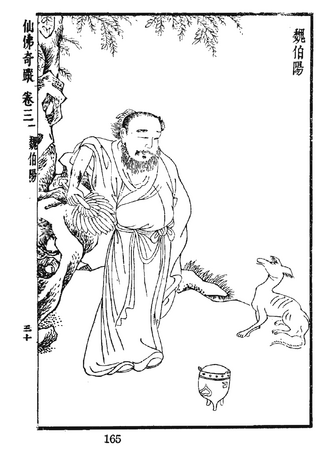
魏伯阳
- 生卒
- 2 世纪 –
- 国籍
- 中国
- 外文名
- Wei Boyang
照片:Hong Zicheng,公有领域,来自维基共享资源「仙佛奇蹤 卷三 魏伯陽.png」(经缩小)。
生平与创作
魏伯阳(151年—221年),名翱,字伯阳,号云牙子,会稽上虞(今属浙江)人,东汉炼丹家,是中国已知最早一位有著作传世的炼丹家。
生平
魏伯阳的生平事迹未见于正史。仅知出身于高门望族,一说是尚书魏朗之子。汉桓帝元嘉元年(151年)出生。汉灵帝建宁二年(169年),魏朗因党祸被害致死,时人尊其为“八俊”之一。魏伯阳被迫隐遁山林修道,专心修道炼丹。曾率三弟子周燮、冯良、虞翻入上虞凤鸣山凤鸣洞炼丹服食。授青州徐从事《参同契》及古歌。汉桓帝时,传术于同郡淳于翼(淳于叔通)。魏曹丕黄初二年(221年)魏伯阳去世。
关于魏伯阳的著述,葛洪在《神仙传》中说:“伯阳作《参同契》、《五相类》,凡二卷。”后晋开运二年(公元945年)编成的《旧唐书》著录有魏伯阳撰《周易参同契》2卷、《周易五相类》1卷。
魏伯阳认为修丹与天地造化是同一个道理。认为万物的产生和变化都是“五行错王,相据以生”,是阴阳相须,彼此交媾,使精气得以舒发的结果。《周易参同契》被称为“万古丹经王”。《周易参同契》全书共约六千余字,基本是用四字一句、五字一句的韵文及少数长短不齐的散文体和离骚体写成的。该书“词韵皆古,奥雅难通”,并采用许多隐语。历代有很多注本行世,仅《正统道藏》就收入唐宋以后注本11种。《参同契》是一部用《周易》理论、道家哲学与炼丹术(炉火)三者参合而成的炼丹修仙著作。
凤鸣山坐落于上虞市丰惠镇东南4公里,距上虞市区17公里,有魏伯阳炼丹遗址。
以上文字摘自维基百科「魏伯阳」(去掉了参考文献等尾部小节),按 CC BY-SA 4.0 使用,作者为维基百科的各位编者。
中文维基百科的条目比较短,下面附上英文维基百科的内容(英文原文):
Wei Boyang (traditional Chinese: 魏伯陽; simplified Chinese: 魏伯阳; pinyin: Wèi bóyáng) was a Chinese writer and Taoist alchemist of the Eastern Han dynasty. He is the author of The Kinship of the Three (also known as Cantong Qi), and is noted as the first person to have documented something like the chemical composition of gunpowder in 142 AD. As someone or him, only mixed the chemical compound of Sulphur and Saltpetre.
Wei Boyang is considered a semi-legendary figure who represented a "collective unity." His Cantong Qi was probably written in stages from the Han dynasty onward until it approached its current form, before 450 AD.
Biography
Wei Boyang was born in a prominent family. One theory claims that he was the son of a minister named Wei Lang (魏朗). In the second year of Jianning (169 AD), Wei Lang was killed due to political trouble. Wei Boyang was forced to hide in the mountains, there he focused on studying Taoism and refining elixirs.
Wei Boyang died in the second year of Huangchu of Cao Pi (221 AD).
Legend
According to a hagiographical account in the Shenxian zhuan (神仙传; 'Biographies of the Divine Immortals'), a work attributed to Ge Hong (283–343), he and three disciples retired to a mountain and compounded an elixir for immortality:
The hearts of his disciples were not settled. [They attempt to test the elixir on a dog to see its effects.] Wei Boyang then leaves and returns with a white dog. The white dog is then fed the pill and promptly dies. Despite this, Wei Boyang claims: "Fear has no place in practicing alchemy. The dog died because it did not have a clear mind, if one takes the pill while afraid like the dog, wouldn't that produce the same result?"
The disciples then ask whether their master would take it or not, after which Wei Boyang says: "We went against society's customs and left our homes to practice in the mountains, without obtaining the way to immortality, we vow to never return. [...]" He swallows the pill and promptly dies.
The disciples discuss why practice alchemy for longevity when one dies after taking the elixir, whereas one would live for decades more without it. One of them then refuses to take the pill. The second disciple rebukes that Wei Boyang is no ordinary man, taking the elixir and dying must have been intentional. The second disciple then takes the pill and dies.
The remaining disciple leaves the mountain to purchase coffin wood. Afterwards, Wei Boyang sprangs ups and comes to life again. He gave the elixir into the mouths of the dead disciple and the dog, and they also revived. [...] Thus Wei Boyang and his faithful disciple attained immortality. Upon realizing this, the other disciple is full of regret.
Teachings
Regarding Wei Boyang's writings, Ge Hong wrote in the Shenxian zhuan: "Boyang produced Cantong Qi (参同契) and Wuxianglei (五相类), of two volumes."
Wei Boyang believed that cultivating elixirs and the creation of heaven and earth were based on the same principles.
Historical sites of Wei Boyang's work in chinese alchemy are located in the Fengming Mountains (凤鸣山) located 4 kilometers southeast of Fenghui (丰惠), and 17 kilometers away from Shangyu City.
以上文字摘自英文维基百科「Wei Boyang」(去掉了参考文献等尾部小节),按 CC BY-SA 4.0 使用,作者为维基百科的各位编者。
资料卡
- 出生
- 2 世纪
- 出生地
- 上虞区
- 职业
- 作家
- 代表作
- 周易参同契
资料卡来自 Wikidata Q911053(CC0),众包数据,个别字段可能不全。