 书单
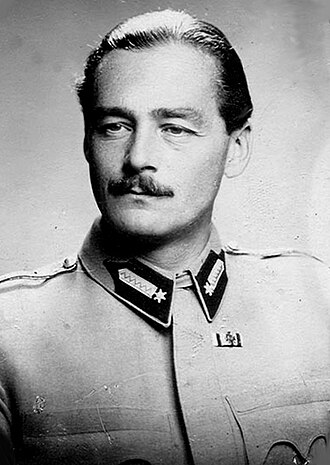
Albert Wass
- 生卒
- 1908 – 1998
- 国籍
- 罗马尼亚、匈牙利
照片:作者不详,公有领域,来自维基共享资源「Wass Albert foto.jpg」(经缩小)。
生平与创作
这个词条暂时没有中文维基百科条目,下面是英文维基百科的内容(英文原文):
Count Albert Wass de Szentegyed et Czege (Hungarian: gróf szentegyedi és cegei Wass Albert; January 8, 1908 – February 17, 1998) was a Hungarian nobleman, forest engineer, novelist, poet, member of the Wass de Czege family.
Wass was born in Válaszút, Austria-Hungary (now Răscruci, Cluj County, Romania) in 1908. In 1944, he fled from Hungary and then joined the fleeing forces of the Third Reich and ended up in Germany, then emigrated to the U.S. after World War II. He was condemned as a war criminal by the Romanian People's Tribunals, however, United States authorities refused to extradite Wass to Romania claiming the lack of solid evidence.
The works of Albert Wass first gained recognition within Hungarian literature from Transylvania in the 1940s. In 1944, he moved to Germany and later in 1952 to the United States and lived there until his 1998 death in Astor Park, Florida. During the communist regime, his books were banned both in Hungary and in Romania. Part of his works was published in Hungary after the change of political system in 1989, however, before this time, his works were unknown to the Hungarian public.
He was popular among the Hungarian minority in Romania and has growing popularity in Hungary. In 2005, in a public assessment (Nagy Könyv), he was found to be one of the most popular Hungarian authors: his book "A funtineli boszorkány" (The Witch of Funtinel) was named the 12th most popular book; two more books were named in the top 50 ranking, including the family saga "Kard és kasza" (Sword and Scythe).
Family
The Wass family has traced its descent from the age of Árpád, and is one of the oldest noble families in Transylvania. The family received the title of count from Maria Theresia in 1744.
His grandfather, Béla Wass, was a parliamentarian and Lord Lieutenant (főispán) of Szolnok-Doboka county. His father was Count Endre Wass (1886–1975), his mother Baroness Ilona Bánffy de Losonc (1883–1960).
He has six sons: Vid Wass de Czege, Csaba Wass de Czege, Huba Wass de Czege, Miklós Wass de Czege, Geza Wass de Czege and Endre (Andreas) Wass von Czege.
His great-grandson, Jacob Roberts, teaches history at Florida State University Schools.
Youth
Albert Wass was born in Válaszút (today Răscruci) at the Bánffy mansion of Válaszút, distinct from the nearby Bánffy castle of Bonchida. His parents divorced early, and he was mostly brought up by his grandfather, Béla Wass. He graduated from the Reformed Church Secondary School in Cluj on Farkas Street and subsequently earned a diploma in forestry from the Academy of Economics in Debrecen, Hungary. He continued his studies of forestry and horticulture in Hohenheim, Germany, and Sorbonne, Paris, where he received additional diplomas. He returned to Transylvania in 1932, as his father fell ill. He had to attend obligatory military service in the Romanian Army and later settled to run the family estate in the Transylvanian Plain.
His first wife was his cousin Baroness Éva Siemers (1914–1991) of Hamburg. "Due to pressure from my family, I had to marry my cousin in 1935 (...) this was the only way to avoid bankruptcy of the family lands", Wass wrote later.
He had six children (Vid, Csaba, Huba, Miklós, Géza, Endre); Csaba died at age three. Huba Wass de Czege, born in 1941 in Kolozsvár (now Cluj-Napoca, Romania) had a significant career in the U.S. Army, achieving the rank of brigadier general. He is known as a principal designer of the "AirLand Battle" military doctrine and took part in the planning of Desert Storm against Iraq in 1991.
Wass started to write poems, short stories, and articles. His first books were published in 1927 and 1929 in Cluj. In 1934, his novel Farkasverem (Wolfpit) was published by the Transylvanian Guild of Arts. In 1935, he was accepted member of the Transylvanian Guild of Arts, and at the same time he was the first young Transylvanian to be awarded the Baumgarten Prize.
After the Second Vienna Award (30 August 1940), northern Transylvania was reassigned to Hungary, so in 1941, Wass was nominated as the primary forest monitor in the Ministry of Agriculture for the area near Dés (now Dej).
During World War II
From May 1942, he took part in military training with the Hungarian Cavalry as a reserve officer, achieving rank of ensign. In his memoirs, Wass claims to have become chief editor of Ellenzék in May 1943, as his boss was drafted into the army. He writes:
two soldiers of Gestapo entered the editorial, showing the order they have to monitor the newspaper. I simply left the building, and walked up the mountains. Two weeks later, my father sent me a message that the Germans are looking for me. To avoid conflict, General Veress, the commander of military troops in North Transylvania has given me a uniform, and as master sergeant he sent me to Ukraine with 9th Hungarian Cavalry, from which I returned only at Christmas.
Wass became the aide-de-camp of General Lajos Veress in 1944. As the war was drawing to an end and the Soviet (and later Romanian) troops were drawing forward into Transylvania, as an officer, he did not wait for the occupation of North Transylvania, but on Easter 1945, crossed the border and chose emigration.
以上文字摘自英文维基百科「Albert Wass」(有删节,去掉了参考文献等尾部小节),按 CC BY-SA 4.0 使用,作者为维基百科的各位编者。
资料卡
- 母语名
- Wass Albert
- 出生
- 1908 年 1 月 8 日
- 出生地
- Răscruci
- 逝世
- 1998 年 2 月 17 日
- 逝世地
- 阿斯托
- 职业
- 诗人、作家
- 使用语言
- 匈牙利语
- 获奖
- 鲍姆嘉腾奖(1934)、鲍姆嘉腾奖(1940)
资料卡来自 Wikidata Q959096(CC0),众包数据,个别字段可能不全。