书单
百科
这个词条暂时没有中文维基百科条目,下面是英文维基百科的内容(英文原文):
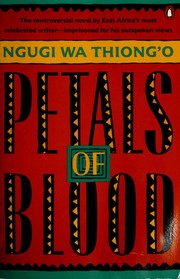
Petals of Blood is a 1977 novel by Kenyan writer Ngũgĩ wa Thiong'o. Set in Kenya just after independence, the story follows four characters – Munira, Abdulla, Wanja, and Karega – whose lives are intertwined due to the Mau Mau rebellion. In order to escape city life, each retreats to the small, pastoral village of Ilmorog. As the novel progresses, the characters deal with the repercussions of the Mau Mau rebellion as well as with a new, rapidly westernizing Kenya.
The novel largely deals with the scepticism of change after Kenya's independence from colonial rule, questioning to what extent free Kenya merely emulates, and subsequently perpetuates, the oppression found during its time as a colony. Other themes include the challenges of capitalism, politics, and the effects of westernization. Education, schools, and the Mau Mau rebellion are also used to unite the characters, who share a common history with one another.
Background
Petals of Blood was Ngũgĩ's first novel to have been written while he was not in full-time education, instead being written over a five-year period. Initially begun during his time teaching at Northwestern University in 1970, Ngũgĩ continued to work on the novel after his return to Kenya, finally finishing the novel in Yalta, where he was a guest of the Soviet Writers' Union. Ngũgĩ was inspired to write the novel as a way of synthesizing the notion of a postcolonial nation, and a willingness to portray the agents of social change present in Kenya's change from its colonial past. Petals of Blood was the last of Ngũgĩ's novels to be written first in English.
On 30 December 1977, shortly after the release of his play I Will Marry When I Want, Ngũgĩ was taken into custody by law enforcement officials and held without charges for questioning. According to Patrick Williams, Ngũgĩ was often criticized by detractors for "dragging politics into art".
Despite the political tone to his novels, including Petals of Blood, Ngũgĩ had avoided government interference until deciding to write in his native language Gikuyu. After the release of Petals of Blood, Ngũgĩ wrote and began work on a Gikuyu language play called 'Ngaahika Ndeenda' (I Will Marry When I Want). He was then arrested and detained on 30 December 1977, for crimes relating to his "literary-political" background. After this period, all of his novels would be written first in Gikuyu and later translated into English, a move understood to be a conscious decision to focus more strongly on the peasant workers of Kenya as inspiration for his novels.
Plot summary
The book begins by describing the four main characters – Munira, Karega, Wanja, and Abdulla – just after the revelation that three prominent Kenyans, two businessmen and one educator, have been killed in a fire. The next chapter moves back in the novel's timeline, focusing on Munira's move to Ilmorog, to begin work as a teacher. He is initially met with suspicion and poor classroom attendance, as the villagers think he will give up on the village soon, in much the same way previous teachers have done. However, Munira stays and, with the friendship of Abdulla, another immigrant to Ilmorog who owns a small shop and bar, carves out life as a teacher.
Soon Wanja arrives, the granddaughter of the town's oldest and most revered lady. She is an attractive, experienced barmaid whom Munira begins to fall in love with, despite the fact he is already married. She too is escaping the city and begins to work for Abdullah, quickly reshaping his shop, and expanding its bar. Karega arrives in Ilmorog to seek Munira to question him about their old school Syriana. After a brief relationship with Munira, Wanja once again grows disillusioned and leaves Ilmorog. The year of her departure is not good for the village as the weather is harsh and no rain comes, making for a poor harvest. In an attempt to enact changes, the villagers are inspired by Karega to journey to Nairobi in order to talk to their Member of Parliament.
The journey is very arduous and Joseph, a boy whom Abdullah had taken in as his brother and who had worked in his shop, becomes ill. When they arrive in Nairobi, the villagers seek help from every quarter. They are turned away by a reverend who thinks they are merely beggars, despite their pleas of help for the sick child. Trying at another house, some of the villagers are rounded up and forced into the building where they are questioned by Kimeria, a ruthless businessman who reveals that he and their MP are in league with one another. He blackmails Wanja and subsequently rapes her. Upon arriving in Nairobi and speaking to their MP, the villagers realise that nothing will change, as he is little more than a demagogue. However, they do meet a lawyer who wishes to help them and others in the same predicament and through a court case highlights Ilmorog's plight. This draws attention from national press and donations and charities pour into Ilmorog.
以上文字摘自英文维基百科「Petals of Blood」(有删节,去掉了参考文献等尾部小节),按 CC BY-SA 4.0 使用,作者为维基百科的各位编者。
资料卡
- 原题
- Petals of Blood
- 原作语言
- 英语、基库尤语
- 首次出版
- 1977 年
- 作品形式
- 长篇小说
- 体裁
- 虚构作品
- 主题
- 谋杀
- 故事发生地
- 肯尼亚
资料卡来自 Wikidata Q7171660(CC0),众包数据,个别字段可能不全。