书单
百科
这个词条暂时没有中文维基百科条目,下面是英文维基百科的内容(英文原文):
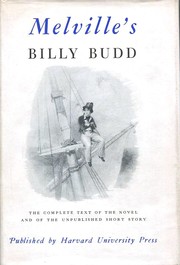
Billy Budd, Sailor (An Inside Narrative), formerly known as Billy Budd, Foretopman, is a novella by American writer Herman Melville, left unfinished at his death in 1891. Acclaimed by critics as a masterpiece when a hastily transcribed version was finally published in 1924, it quickly took its place as a classic second only to Moby-Dick among Melville's works. Billy Budd is a "handsome sailor" who strikes and inadvertently kills his false accuser, the master-at-arms, John Claggart. The ship's captain, Edward Vere, recognizes Billy's lack of intent, but claims that the law of mutiny requires him to sentence Billy to be hanged.
Melville began work on the novella in November 1886, revising and expanding it from time to time, but he left the manuscript in disarray. His widow Elizabeth began to edit the manuscript for publication, but was not able to discern her husband's intentions at key points, even as to the book's title. Raymond M. Weaver, Melville's first biographer, was given the manuscript and published the 1924 version, which was marred by misinterpretation of Elizabeth's queries, misreadings of Melville's difficult handwriting, and even inclusion of a preface Melville had cut. Melville scholars Harrison Hayford and Merton M. Sealts Jr. published what is considered the best transcription and critical reading text in 1962. In 2017, Northwestern University Press and the Newberry Library published a "new reading text" based on a "corrected version" of Hayford and Sealts' genetic text prepared by G. Thomas Tanselle.
Billy Budd has been adapted into film, a stage play, and an opera.
Plot summary
Billy Budd is an English seaman impressed into service aboard the Royal Navy warship HMS Bellipotent in 1797, when the Navy was reeling from the Spithead and Nore mutinies and threatened by the French First Republic's military ambitions. He is impressed onto Bellipotent from the British merchant ship The Rights of Man (named after the book by Thomas Paine).
Billy, a foundling from Bristol, has an innocence, good looks and a natural charisma that make him popular with the crew. He has a stutter, which becomes more noticeable when under intense emotion. He arouses the antagonism of the ship's master-at-arms, John Claggart. Claggart, while not unattractive, seems somehow "defective or abnormal in the constitution", possessing a "natural depravity." Envy is Claggart's explicitly stated emotion toward Budd, foremost because of his "significant personal beauty," and also for his innocence and general popularity. This leads Claggart to falsely charge Billy with conspiracy to mutiny. When the captain, Edward Fairfax "Starry" Vere, is presented with Claggart's charges, he summons Claggart and Billy to his cabin for a private meeting. Claggart makes his case and Billy, astounded, is unable to respond, due to his stutter. In his extreme frustration he strikes out at Claggart, killing him instantly.
Vere convenes a drumhead court-martial. He acts as convening authority, prosecutor, defense counsel and sole witness (except for Billy). He intervenes in the deliberations of the court-martial panel to persuade them to convict Billy, despite their and his beliefs in Billy's moral innocence. (Vere says in the moments following Claggart's death, "Struck dead by an angel of God! Yet the angel must hang!") Vere claims to be following the letter of the Mutiny Acts and the Articles of War.
Although Vere and the other officers did not believe Claggart's charge of conspiracy and think Billy justified in his response, they find that their own opinions matter little. The martial law in effect states that during wartime the blow itself, fatal or not, is a capital crime. The court-martial convicts Billy following Vere's argument that any appearance of weakness in the officers and failure to enforce discipline could stir more mutiny throughout the Royal Navy. Condemned to be hanged the morning after his attack on Claggart, Billy's last words prior to his execution are "God bless Captain Vere!", which are repeated by the gathered crew in a "resonant and sympathetic echo."CH 26
The novel closes with three short chapters that present ambiguity:
Chapter 28 describes the death of Captain Vere. In a naval action against the French ship Athée (the Atheist), Captain Vere is mortally wounded. His last words are "Billy Budd, Billy Budd."
Chapter 29 presents an extract from an official naval gazette purporting to give the facts of the fates of John Claggart and Billy Budd aboard HMS Bellipotent, but the "facts" offered turn the facts that the reader learned from the story upside down. The gazette article describes Budd as a conspiring mutineer likely of foreign birth and mysterious antecedents who is confronted by John Claggart. The master-at-arms, loyally enforcing the law, is fatally stabbed by Budd. The gazette concludes that the crime and weapon used suggest a foreign birth and subversive character; it reports that the mutineer was executed and nothing is amiss aboard HMS Bellipotent.
Chapter 30 is a cheaply printed ballad, "Billy in the Darbies", written by one of Billy's shipmates as an elegy. The adult, experienced man represented in the poem is not the innocent youth portrayed in the preceding chapters.
Composition history
Composed fitfully over the last five years of his life, the novella Billy Budd represents Melville's return to prose fiction after three decades of only writing poetry. Melville had a difficult time writing, describing his process with Moby-Dick as follows: "And taking a book off the brain is akin to the ticklish and dangerous business of taking an old painting off a panel—you have to scrape off the whole brain in order to get at it with due safety—and even then the painting may not be worth the trouble...."
The "scrapings" of Billy Budd lie in the 351 leaves of manuscript now in the Houghton Library at Harvard University.
以上文字摘自英文维基百科「Billy Budd」(有删节,去掉了参考文献等尾部小节),按 CC BY-SA 4.0 使用,作者为维基百科的各位编者。
资料卡
- 原题
- Billy Budd, Sailor
- 原作语言
- 英语
- 首次出版
- 1924 年
- 作品形式
- 长篇小说
资料卡来自 Wikidata Q863037(CC0),众包数据,个别字段可能不全。
改编作品
电影2
舞台剧 / 歌剧 / 芭蕾1
- 《比利·巴德》Billy Budd
取材于它的书1
名单来自 Wikidata(CC0):只列条目里写明「改编自 / 取材于」这本书的作品,不按名字猜;众包数据,可能不全。