书单
百科
这个词条暂时没有中文维基百科条目,下面是英文维基百科的内容(英文原文):
The Diary of Anaïs Nin is the published version of Anaïs Nin's own private manuscript diary, which she began at age 11 in 1914 during a trip from Europe to New York with her mother and two brothers. Nin would later say she had begun the diary as a letter to her father, Cuban composer Joaquín Nin, who had abandoned the family a few years earlier.
Over the years, the diary would become Nin's best friend and confidante. Despite the attempts of her mother, therapists Rene Allendy and Otto Rank, and writer Henry Miller, to break Nin of her dependence on the diary, she would continue to keep a diary up until her death in 1977.
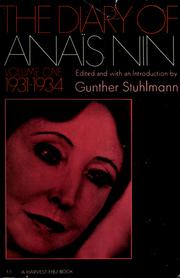
As early as the 1930s Nin had sought to have the diary published. Due to its size (in 1966, the diary contained more than 15,000 typewritten pages in some 150 volumes) and literary style, she would not find a publisher until 1966, when the first volume of her diary would be published, covering the years 1931–1934 in her life. The published version of her diary would be very popular among young women, making Nin a feminist icon in the 1960s. Six more volumes of her diary would follow.
Expurgated diaries
The series of published diaries that made their appearance starting in 1966 are now sometimes referred to as the "expurgated" editions. This is because in 1986, Rupert Pole, Nin's widower and literary executor, began to publish what are now termed the "unexpurgated" versions of the diary. The "unexpurgated" versions of the diaries are more sexually frank than the versions published in the 1960s and 1970s.
Volume I (1931–1934)
First published in 1966, it depicts Nin living in Louveciennes, just outside Paris, with her husband, banker Hugh Parker Guiler. Guiler's name is not once mentioned in this volume. Volume One covers the most important years of her relationship with Henry Miller. Many of the early entries deal with Henry and his fascinating wife June. She discusses her psychoanalytic sessions with Rene Allendy and Otto Rank at length. During this period, her father re-enters her life. By the end of this volume, Henry has published Tropic of Cancer and she had completed House of Incest (published, 1936) and Winter of Artifice (published 1939). During his time, Henry Miller started to influence the writings published in Louveciennes in 1966. Nin's impression of Miller was rather startling, as she fell in contemplation of his literacy.
Volume V (1947–1955)
Volume V was published in 1974, describes her first trip to Acapulco, the beginning of her double life in Sierra Madre, California as well as in New York, the death of her mother and the progress of her feelings and career. Her love life, including the existence of both her husbands, is still deleted.
Volume VI (1955–1966)
Volume VI was published in 1976, and was edited by Gunther Stuhlmann. It was dedicated to the team of doctors who saved her life in January 1975. It opens with her description of the aftereffects of having taken LSD, and closes with her mentioning the publication of Volume I of her diaries and her belated recognition as a writer. Other subjects include a debate with Aldous Huxley over psychedelics, a visit to the Brussels World's Fair of 1958, and working as an editor for the magazine Eve. She was a witness to the Caresse Crosby incident at Delphi, when the Greek government arrested Crosby for trying to build a geopolitical community counter to established Greek sovereignty.
Unexpurgated diaries
In 1986, Rupert Pole, Nin's surviving widower and literary executor, began to publish what are now termed the "unexpurgated" versions of the diary. The "unexpurgated" versions of the diaries are more sexually frank than the versions published in the 1960s and 1970s. The unexpurgated editions were published by Harcourt Brace Jovanovich and by Swallow Press, an imprint of Ohio University Press that was the original US publisher of Nin's work.
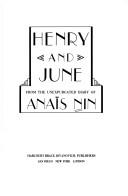
Henry and June: From "A Journal of Love" – The Unexpurgated Diary of Anais Nin (1931–1932)
Henry and June spans a single year in Nin's life when she discovers love and torment in one insatiable couple. From late 1931 to the end of 1932, Nin falls in love with Henry Miller's writing and his wife June's striking beauty. When June leaves Paris for New York, Henry and Nin begin a fiery affair that liberates her sexually and morally, but also undermines her marriage and eventually leads her into psychoanalysis. As she grapples with her own conscience, a single question dominates her thoughts: What will happen when June returns to Paris? An intimate account of one woman's sexual awakening, Henry and June exposes the pain and pleasure felt by a single person trapped between two loves.
Incest: From "A Journal of Love" – The Unexpurgated Diary of Anaïs Nin (1932–1934)
Published in 1993, This is the continuation of the story begun in Henry and June, exposing the shattering psychological drama that drove Nin to seek absolution from her psychoanalysts for the ultimate transgression. This portion of Nin's diary, which was cut from the expurgated editions published in her lifetime, records her steamy love affair with Henry Miller in Paris, but here her intense adoration gives way to disillusionment. She describes Miller as crude, egotistic, imitative, childishly irresponsible, "a madman." Her real focus, however, is her father, Joaquin Nin, a Spanish pianist and aristocratic Don Juan who seduced her after a 20-year absence. Her graphic account of their lovemaking and of her incestuous romantic feelings is fairly shocking. Nin sought absolution from her psychiatrist and lover, Otto Rank, who advised her to bed her father, then dump him as punishment for abandoning her when she was 10. Nin's ornate, hothouse prose is much rawer than the chiseled style of the expurgated diaries. She seethes with jealousy at Miller's wife June, swoons over poet and actor Antonin Artaud, neglects her protective husband, Hugh Guiler, and describes her traumatic delivery of a stillborn child. Her extraordinary, tangled self-analysis is a disarming record of her emotional and creative growth.
以上文字摘自英文维基百科「The Diary of Anaïs Nin」(有删节,去掉了参考文献等尾部小节),按 CC BY-SA 4.0 使用,作者为维基百科的各位编者。
资料卡
- 原作语言
- 英语
- 首次出版
- 1966 年
- 体裁
- 日记
资料卡来自 Wikidata Q3706810(CC0),众包数据,个别字段可能不全。