书单
百科
这个词条暂时没有中文维基百科条目,下面是英文维基百科的内容(英文原文):
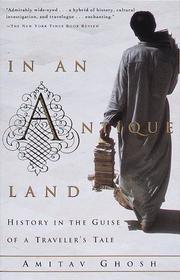
In an Antique Land is a 1992 book written in first-person by Indian writer Amitav Ghosh recounting his experiences in two Egyptian villages attempting to retrace accounts of an unknown Indian slave, as well as a reconstruction of the life of a 12th-century Jewish merchant in the area. It describes a variety of characters, going into great detail regarding their lives and Ghosh's interactions with them.
The book has been noted for its difficulty to categorise in traditional genres and its themes regarding postcolonialism, the possibility of synthesising cultures, and Western knowledge systems, particularly with regards to anthropology. Reception towards the book is generally positive.
Synopsis
The book contains two narratives. The first, an anthropological narrative, revolves around two visits made by Ghosh to two villages in the Nile Delta, while he was writing his doctoral dissertation (1980–81) and again a few years later (1988). In the second narrative, presented parallel to the first one in the book, Ghosh reconstructs the history of a 12th-century Jewish merchant, Abraham Ben Yiju, and his slaves Ashu and Bomma, using documents from the Cairo Geniza.
In an Antique Land begins in the small Egyptian village of Lataifa in 1980, where the then-graduate student Amitav Ghosh writes his doctoral thesis and begins his investigation into the lives of 12th century Jewish merchant Abraham Ben Yiju and Ben Yiju's anonymous Indian slave. Eventually, Ghosh moves to the larger village of Nashawy. He details the numerous people he meets within the town, their lives and relationships, as well as their attempts to convert him to Islam.
Ghosh leaves Egypt in 1981, spending time during the next several years honing his Arabic and learning the dialect Ben Yiju uses in his own documents. In 1988, he returns to the two villages. To Ghosh's relief, this dialect is similar to the spoken language within Lataifa and Nashawy.
Ghosh recounts the series of events that led to a storehouse of documents – dubbed the Cairo Geniza – belonging to Ben Yiju's synagogue being preserved for seven centuries, after which it was brought to the attention of the wider world by a variety of interested scholars. As he studies these documents, Ghosh refamiliarizes himself with the people he met during his first visit, noting many that have left to other countries in order to find work. Ghosh also meets several new people.
His research leads Ghosh to the belief that Ben Yiju fled to India in order to escape a blood feud, freeing and marrying a slave girl named Ashu, eventually traveling back to his homeland years later, then moving back to Egypt. Ghosh investigates the unnamed slave once more, surmising that his name was Bomma and that he acted as an apprentice to Ben Yiju, eventually taking over the merchant's business.
Characters
20th Century
Amitav Ghosh - Anthropologist researching his doctoral thesis and tracing the journey of Abraham Ben Yiju and his slaves. The narrator of the story.
Abu-'Ali - Ghosh's initial landlord; obese, unlikeable, and well-off. The owner of a shop that sells government-subsidized goods.
Shaikh Musa - An elderly fellah who befriends Ghosh during his stay. He is kind and companionable, and a font of knowledge for Ghosh's research. His son dies during one of Ghosh's trips to Cairo.
'Amm Taha - The caretaker of the second house Ghosh stays in. He is called 'Uncle' by the villagers, and performs many odd jobs - making him knowledgeable about the lives of many of the villagers.
Ustaz Sabry - A scholar and a teacher, who is greatly respected amongst the villagers for his learning and many arguments about Islam.
Zagloul - A self-admittedly poor weaver, but an excellent storyteller.
Khamees 'the Rat' - A childless fellah, of the Jammal lineage, which had its fortunes improved in the redistribution of land from the Egyptian revolution of 1952. Witty, with a keen sense of humor.
Nabeel - A quiet, contemplative young man usually found in the company of Isma'il. He is a Ministry of Agriculture student who, after his draft, goes to Iraq.
Isma'il - A loquacious young man, usually found in the company of Nabeel. He is a Ministry of Agriculture student who, after his draft, goes to Iraq.
12th Century
Abraham Ben Yiju - The Jewish merchant whose life Ghosh attempts to trace. A man with literary leanings who lives a tumultuous life.
Madmun ibn Bundar - A wealthy trader who becomes Ben Yiju's mentor.
Major Themes
Postcolonialism
Many scholars make note of the postcolonial aspect of In an Antique Land. The book's title is a reference to the opening line of the poem Ozymandias, which was written by an English poet. This serves to put the postcolonial aspects of the story into focus; a decision that Srivastava sees as ironic, given that most of the narrative revolves around Eastern modes of living.
Ghosh's narration often characterizes the inhabitants of Egypt as somewhat innocent, being relatively ignorant of war, violence, and fear, as well as somewhat backwater in their day-to-day household appliances. Smith characterises this as ironic, given that Ghosh, as an Indian, is coming from a postcolonial society. In this characterization, Ghosh bestows upon himself a position of somewhat condescending authority, mimicking the perspective of a colonizer – this operates as a reflection on Ghosh's own position as an interloper within the village. Similarly, Ghosh's access to Ben Yiju's story is reliant upon documents extracted by colonial authorities, a fact which makes Ghosh's role as an anthropologist cruelly ironic. His implication within the colonial narrative puts his identity as an anthropologist and an Indian in sharp contrast.
以上文字摘自英文维基百科「In an Antique Land」(有删节,去掉了参考文献等尾部小节),按 CC BY-SA 4.0 使用,作者为维基百科的各位编者。
资料卡
- 原题
- In an Antique Land
- 原作语言
- 英语
- 首次出版
- 1994 年
- 作品形式
- 长篇小说
- 续作
- Dancing in Cambodia and At Large in Burma
- 主题
- 人口迁徙、古埃及
资料卡来自 Wikidata Q6011521(CC0),众包数据,个别字段可能不全。