 书单
百科
这个词条暂时没有中文维基百科条目,下面是英文维基百科的内容(英文原文):
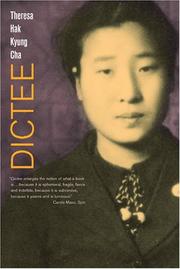
Dictée is a 1982 book by Korean American author Theresa Hak Kyung Cha. Considered to be Cha's magnum opus, the book, a genre-bending poetry collection, focuses on several women: the Korean revolutionary Yu Gwan Soon, Joan of Arc, Saint Thérèse of Lisieux, Demeter and Persephone, Cha's mother Hyun Soon Huo, and Cha herself. All these women are linked by their struggles and the way that nations have affected and twisted their lives.
Publication history
The book was first published in 1982, the year Cha was murdered. The book was out of print for a while, but due in part to the publication of an edited collection on her novel, Writing Self, Writing Nation (1994), Cha's work began to receive critical attention. In 1997, with the resurgence of Asian American studies and Third-wave feminism, the book was brought back into print by Norma Alarcón and Third Woman Press.
— (1982). Dictee (1st, pb ed.). New York: Tanam Press. ISBN 9780934378109.
— (1994). Dictee. Berkeley: Third Woman Press. ISBN 978-0-943219-12-7.
— (2001). Dictee. Berkeley: University of California Press. ISBN 978-0-520-23112-2.
— (2009). Dictee (2nd ed.). Berkeley: University of California Press. ISBN 978-0-520-26129-7.
Genre
Critics contend that Dictée, though considered a novel, is difficult to define by genre. It has an unorthodox structure, and consists of descriptions of the struggle to speak, uncaptioned photographs, tellings of the lives of saints and patriots, and mysterious letters that seem not to relate to the other material. Cha "borrows from avant garde and film editing techniques such as jagged cuts, jump shots, and visual exposition", based on her experience in the video and performing arts. The work "deviates from genres, themes, and styles" and fails to fit a single descriptor or label with clarity. It has been described as auto-ethnography, due to its highly subjective view of heritage and the past. "It is part autobiography, part biography, part personal diary, part ethnography, part auto-ethnography, part translation. And all these genres are presented with an intertextual mix of photographs, quotations, translations, and language so as to create a history. Cha's move in Dictée is to collage multiple voices American, European, and Asian---so as to build a history". Cha uses a lot of photographs to engage the reader and create a certain atmosphere. Dictee is composed of various genres, such as autobiography, fiction, history, and poetry and this diversity not only reflects on genre, but also on culture and language.
Cha criticizes the prejudice towards and oppression of women, which greatly affects the genre. She “not only challenge[s] the traditional autobiographic ethnic mode," but "also disturbs the reader’s expectations by breaking down the boundaries between genres and playing with them”. The narrator's fragmented memories suggest an ambiguous Korean identity contending with the presence of an awkwardly fashioned American one.
Structure and critical observations
Dictée is organized into nine parts, a structure that arises from the nine Greek muses. These include Clio, Calliope, Urania, Melpomene, Erato, Elitere, Thalia, Terpischore, and Polymnia. The nine muses are the titles of nine chapters of Dictee. Cha's use of nine muses is derived from Hesiod, who first used them. But Cha's employment is a subversive revision because of her "feminist intervention and patriarchal order." The catalogue of nine muses Cha examines with nine women characters, vary widely from "Greek goddesses to a Korean shamanistic matriarch and from historical figures to fictional ones". The meaning of the muses is shown with nine women who all reject patriarchal roles and cannot have a voice for themselves for different reasons, because of unhappy marriage, exile, turbulence and immigration. At the end of chapter "POLYMNIA SACRED POETRY", Cha writes "Tenth, a Circle within a circle, a series of concentric circles"(Cha 175). Cha uses this image to describe how the women always come together and the child becomes the mother and the mother will have a child and it is like a circle, a life circle for women. At the same time, trauma from the mother's generation is always passed on to the next generation. So this circle is both physical and mental.
The novel is mainly written in English and French, but some Korean and Chinese characters can be seen in the pictures posed to support the text. Unexplained Chinese characters as well as Korean words lead to incomprehension visually and linguistically. Cha wants to keeps a realist ideal of equivalence and deliberately get rid of the sense of foreignness without extra translation, though these characters stand outside the textual order, instead, they create "self-contained diatinction and feeling of otherness".
Cha didn't want to disturb readers’ reading experience by doing this—on the contrary, she wanted the readers to join her. For the Korean people, the process of reading this book was to call on them to resist the colonial ambitions of Japan. So this book could be called a book with a history of blood and tears.
以上文字摘自英文维基百科「Dictee」(有删节,去掉了参考文献等尾部小节),按 CC BY-SA 4.0 使用,作者为维基百科的各位编者。
资料卡
- 原作语言
- 英语
- 首次出版
- 1982 年
- 体裁
- 自传
资料卡来自 Wikidata Q5273943(CC0),众包数据,个别字段可能不全。