书单
百科
这个词条暂时没有中文维基百科条目,下面是英文维基百科的内容(英文原文):
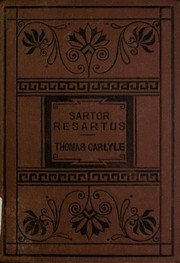
Sartor Resartus: The Life and Opinions of Herr Teufelsdröckh in Three Books is a novel by the Scottish essayist, historian and philosopher Thomas Carlyle, first serialised in Fraser's Magazine from November 1833 to August 1834. It purports to be a commentary on the thought and early life of a German philosopher called Diogenes Teufelsdröckh (which translates as 'Zeus-born Devil's-dung'), author of a tome entitled Clothes: Their Origin and Influence. Teufelsdröckh's transcendentalist musings are mulled over by a skeptical English Reviewer (referred to as Editor) who also provides fragmentary biographical material on the philosopher. The work is a parody, in part of Georg Wilhelm Friedrich Hegel and more generally of German idealism.
Background
Archibald MacMechan surmised that the novel's invention had three literary sources. The first of these was A Tale of a Tub by Jonathan Swift, whom Carlyle intensely admired in his college years, even going by the nicknames "Jonathan" and "The Dean". In that work, the three main traditions of Western Christianity are represented by a father bestowing his three children with clothes they may never alter, but proceed to do so according to fashion. Carlyle's second influence, according to MacMechan, was his own work in translating works by Johann Wolfgang von Goethe, particularly Wilhelm Meister's Apprenticeship, The Sorrows of Young Werther, and Faust, all of which Carlyle quotes and explicitly refers to, especially when Teufelsdröckh names his own crisis "The Sorrows of Young Teufelsdröckh". The third major influence was Laurence Sterne's Tristram Shandy, from which Carlyle quotes many phrases, and to which he had referred in earlier letters.
Carlyle worked on an earlier novel, Wotton Reinfred, which MacMechan refers to as "[t]he first draft of Sartor." Carlyle finished seven chapters of the semi-autobiographical novel depicting a young man of deeply religious upbringing being scorned in love, and thereafter wandering. He eventually finds at least philosophical consolation in a mysterious stranger named Maurice Herbert, who invites Wotton into his home and frequently discusses speculative philosophy with him. At this point, the novel abruptly shifts to highly philosophical dialogue revolving mostly around Immanuel Kant. Though the unfinished novel deeply impressed Carlyle's wife Jane, (née Welsh) Carlyle never published it and its existence was forgotten until long after Carlyle's death. MacMechan suggests that the novel provoked Carlyle's frustration and scorn due to the "zeal for truth and his hatred for fiction" he speaks of in his letters of the time. Numerous parts of Wotton appear in the biographical section of Sartor Resartus, where Carlyle humorously turns them into Teufelsdröckh's autobiographical sketches, which the Editor constantly complains are overly fragmented or derivative of Goethe. Though widely and erroneously reported as having been burned by Carlyle, the unfinished novel is still extant in draft form; several passages were moved verbatim to Sartor Resartus, but with their context radically changed.
Carlyle had difficulty finding a publisher for the novel, and he began composing it as an article in October 1831 at Craigenputtock. Fraser's Magazine serialised it in 1833–1834. The text first appeared in volume form in Boston, United States, in 1836, its publication arranged by the philosopher Ralph Waldo Emerson, who much admired the book and Carlyle. Emerson's savvy dealing with the overseas publishers ensured Carlyle received high compensation, which the novel did not attain in Britain. The first British edition was published in London in 1838.
Title
"Sartor Resartus" is usually translated as "The Tailor Re-tailored"; it has also been rendered as "The Tailor Repatched", "The Tailor Patched", "The Clothes Volume Edited", and as "The Tailor Made Whole Again".
There is a song called "The Taylor Done Over" which was published in London in 1785. It has been suggested that a Scottish variant was popular in Carlyle's day and may have inspired his choice of title. Another source might have been Lord Byron's play The Deformed Transformed (1824). The play, based on Goethe's Faust, was admired by Goethe, who was a friend and mentor of Carlyle, and Carlyle referenced Byron in his writings from the late 1820s.
Plot
The novel takes the form of a long review by a somewhat cantankerous unnamed Editor for the English publication Fraser's Magazine (in which the novel was first serialised without any distinction of the content as fictional) who is, upon request, reviewing the fictional German book Clothes, Their Origin and Influence by the fictional philosopher Diogenes Teufelsdröckh (Professor of "Things in General" at Weissnichtwo—i.e., "Know-not-where"—University). The Editor is clearly flummoxed by the book, first struggling to explain it in the context of contemporary social issues in England, some of which he knows Germany to be sharing, then conceding that he knows Teufelsdröckh personally, but that even this relationship does not explain the curiosities of the book's philosophy. The Editor remarks that he has sent requests to Teufelsdröckh's office in Germany for more biographical information, hoping for further explanation, and the remainder of Book One contains summaries of Teufelsdröckh's book, including translated quotations, accompanied by the Editor's many objections, many of them buttressed by quotations from Goethe and William Shakespeare. The review becomes longer and longer due to the Editor's frustration at the philosophy, and his desire to expose its outrageous nature. At the final chapter of Book One, the Editor has received a reply from Teufelsdröckh's office in the form of several bags of paper scraps (rather esoterically organised according to the signs of the Zodiac) on which are written autobiographical fragments.
以上文字摘自英文维基百科「Sartor Resartus」(有删节,去掉了参考文献等尾部小节),按 CC BY-SA 4.0 使用,作者为维基百科的各位编者。
资料卡
- 原题
- Sartor Resartus
- 原作语言
- 英语
- 首次出版
- 1833 年
- 体裁
- 喜剧
- 首发于
- 弗雷泽杂志
- 故事发生地
- 德国
资料卡来自 Wikidata Q1134140(CC0),众包数据,个别字段可能不全。
更多资料与书评
在哪读
托马斯·卡莱尔 的其他作品
作者页 ›