 书单
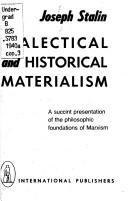
论辩证唯物主义和历史唯物主义 (1938)
- 作者
- 约瑟夫·斯大林
- 首版
- 1938 年
- 国家/地区
- 苏联
- Open Library
- 25 个版本
百科
《论辩证唯物主义和历史唯物主义》(俄语:О диалектическом и историческом материализме)是《联共(布)党史简明教程》的第四章第二节,由斯大林撰写。
内容
斯大林将辩证法概括为“四个基本特征”,将唯物主义概括为“三个基本特征”,论述了历史唯物主义,认为生产发展有“三个特点”:
同形而上学相反,马克思主义辩证法认为:
把自然界看作有联系的统一的整体
把自然界看作不断运动和变化、不断更新和发展的状态
把发展过程看作从量变到质变的过程
从低级到高级的发展过程是通过这些矛盾基础上活动的对立倾向的“斗争”进行的
同唯心主义相反,马克思主义哲学唯物主义认为:
世界本质是物质的
物质是第一性的;意识是第二性的,是物质的反映;思维是物质的产物,即人脑的产物世界及其规律完全可以认识,没有不可认识的东西;关于自然界规律的知识,经过经验和实践检验,是具有客观真理意义的、可靠的从哲学唯物主义原理推广去研究社会生活和社会历史,历史唯物主义认为:
决定社会面貌、决定社会制度性质、决定社会从这一制度发展到另一制度的主要力量是物质资料的生产方式生产方式的变化必然引起全部社会制度、社会思想、政治观点和政治设施的变化人们的生产关系依赖社会生产力而变化,与这些变化相适应地发生变化。与生产力发展相适应,“历史上有五种基本类型的生产关系:原始公社制的,奴隶制占有制的,封建制的,资本主义的,社会主义的。”
以上文字摘自维基百科「论辩证唯物主义和历史唯物主义」(去掉了参考文献等尾部小节),按 CC BY-SA 4.0 使用,作者为维基百科的各位编者。
中文维基百科的条目比较短,下面附上英文维基百科的内容(英文原文):
Dialectical and Historical Materialism (Russian: О диалектическом и историческом материализме), attributed to Joseph Stalin, is a central text within the Soviet Union's political theory Marxism–Leninism.
The work first appeared as a chapter in the Short History of the Communist Party of the Soviet Union, which drew heavily from the philosophical works of Georg Wilhelm Friedrich Hegel, Karl Marx, Friedrich Engels, and Vladimir Lenin. It describes the Bolshevik Party's official doctrine on dialectical materialism and historical materialism.
Background
This chapter was written by Stalin's secretaries under his personal guidance during his consolidation of power in the party through the purging of party members, and implementing structural changes by introducing a new constitution in 1936. Anton Donoso notes that "there is disagreement as to whether Stalin even wrote the work. Soviet and East-European Marxists, from what has been told to me, think Mitin himself is the author." Following these measures, Stalin decided to develop a new history of the Bolshevik Party corresponding to the Moscow Trials narrative in order to further consolidate and legitimize his regime. While the other chapters of a Short History of the Communist Party of the Soviet Union were written by a committee under the guidance of Stalin, Anton Donoso argues that it was imperative that Stalin himself write the chapter on dialectical and historical materialism, for "it would have been the most dangerous portion of the history to have been entrusted to a subordinate."
Stalin's contributions to Marxist philosophy prior to this chapter were scant. His previous notable works were Anarchism or Socialism? in 1906/7, as well as his more popular Marxism and the National Question, also known as The National Question and Social Democracy in 1913. After Lenin's death, Stalin also delivered lectures on Leninism in 1924, which were then developed into the work Foundations of Leninism.
In 1929 Stalin was first concerned with the interpretation of dialectical materialism, when, according to Donoso, he complained in a speech that theoreticians "had not kept pace with the practical developments of Marxism in the Soviet Union," and "accused philosophers in general of dragging their feet in the battle on the two fronts against Rightist and Leftist deviation." In 1931, Stalin was successful in having the Central Committee condemn differing interpretations of Marxist philosophy, marking a decisive turning point in Soviet philosophy and thus abolishing any opposition to the official party line. Additionally, included in the 1936 constitution was a criticism of philosophy as being out of date, abstract, and too "polluted" with quotations from "deviationists," such as Trotsky.
Synopsis
Stalin's writing is systematically presented and divided into three parts:
Part I: outline of the Marxist dialectical method, in contrast to metaphysics
a) Nature is a unified whole.
b) Nature is in perpetual motion.
c) Natural quantitative change leads to qualitative change.
d) Natural phenomena possess internal contradictions as part of their struggle, leading to revolutionary rather than reformist change. He relates this to capitalism by stating that "the transition from capitalism to socialism and the liberation of the working class from the yoke of capitalism cannot be effected by slow changes, by reforms, but only by a qualitative change of the capitalist system, by revolution".
Part II: outline of the Marxist philosophical materialism in contrast to idealism
a) The world is materialistic in nature.
b) Being is objective reality because it is material, thus thinking is a reflection of matter, contributing ideas back to being.
c) The world and its laws are knowable as they can be examined by practice, challenging Kant's idea of "things in themselves." Because of this, Stalin argues that there are laws of social development and that socialism is a science.
以上文字摘自英文维基百科「Dialectical and Historical Materialism」(有删节,去掉了参考文献等尾部小节),按 CC BY-SA 4.0 使用,作者为维基百科的各位编者。
资料卡
- 原题
- О диалектическом и историческом материализме
- 原作语言
- 俄语
- 首次出版
- 1938 年
- 主题
- 斯大林主义、辩证唯物主义、历史唯物主义
资料卡来自 Wikidata Q330910(CC0),众包数据,个别字段可能不全。