书单
百科
这个词条暂时没有中文维基百科条目,下面是英文维基百科的内容(英文原文):
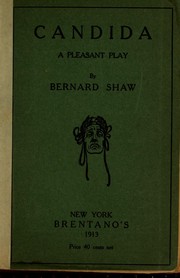
Candida (Shavian: 𐑒𐑩𐑯𐑛𐑦𐑛𐑳), a comedy by playwright George Bernard Shaw, was written in 1894 and first published in 1898, as part of his Plays Pleasant. The central characters are clergyman James Morell, his wife Candida and a youthful poet, Eugene Marchbanks, who tries to win Candida's affections. The play questions Victorian notions of love and marriage, asking what a woman really desires from her husband. The cleric is a Christian Socialist, allowing Shaw (who was a Fabian Socialist) to weave political issues, current at the time, into the story.
Shaw attempted but failed to have a London production of the play put on in the 1890s, but there were two small provincial productions. However, in late 1903 actor Arnold Daly had such a great success with the play that Shaw would write by 1904 that New York was seeing "an outbreak of Candidamania". The Royal Court Theatre in London performed the play in six matinees in 1904. The same theatre staged several of Shaw's other plays from 1904 to 1907, including further revivals of Candida.
Characters
In order of appearance
Candida
Miss Proserpine Garnett—Morell's secretary
The Reverend James Mavor Morell—a clergyman and Candida's husband
The Reverend Alexander (Lexy) Mill
Mr Burgess
Eugene Marchbanks
Plot
The play is set in the northeast suburbs of London in the month of October. It tells the story of Candida, the wife of a famous clergyman, the Reverend James Mavor Morell. Morell is a Christian Socialist, popular in the Church of England, but Candida is responsible for much of his success. Candida returns home briefly from a trip to London with Eugene Marchbanks, a young poet who wants to rescue her from what he presumes to be her dull family life.
Marchbanks is in love with Candida and believes she deserves something more than just complacency from her husband. He considers her divine, and his love eternal. In his view, it is quite improper and humiliating for Candida to have to attend to petty household chores. Morell believes Candida needs his care and protection, but the truth is quite the contrary. Ultimately, Candida must choose between the two gentlemen. She reasserts her preference for the "weaker of the two" who, after a momentary uncertainty, turns out to be her husband Morell.
Early productions and Candidamania
The play was first performed at the Theatre Royal, South Shields on 30 March 1895. It was revived by the Independent Theatre Company, at Her Majesty's Theatre, Aberdeen on 30 July 1897. It was first performed in London at the Stage Society, The Strand, on 1 July 1900. However, it was not until late 1903, when Arnold Daly mounted a production at the Princess Theatre in New York that the play became a success. Daly's production was quickly followed by one in London. The first public performance in London was on 26 April 1904, at the Royal Court.
The play was so popular in 1904 that the phenomenon was referred to as "Candidamania". In the words of The New York Sun, A new complaint has become widespread. It may be described as 'Candidamania.' It is a contagious disease, frequently caught in street cars, elevated trains, department stores, restaurants, and other places where people talk about what they did the night before. 'Have you seen Candida?' is the question of the hour. Thousands are dragging their friends to see Mr. Shaw's play." Shaw himself adopted the term, as have later writers. Shaw felt that the play was misinterpreted by some of its public. He wrote his short 1904 comedy How He Lied to Her Husband, in part as a kind of reply to Candida. The play depicts a farcical version of the same situation. Shaw's friend Archibald Henderson described it as "the reductio ad absurdum of the Candidamaniacs".
Criticism and interpretation
In Bernard Shaw and the Aesthetes, Elsie Bonita Adams has given this assessment of Marchbanks, comparing him to two real-life artists: Though Marchbanks has many of the external characteristics and some of the attitudes of the aesthete-artist such as Sholto Douglas or Adrian Herbert, he does not pay mere lip-service to art, his sensitivity is no pose, and he tries to rid himself of illusions.
Shaw himself describes Eugene's story-arc as a realization that Candida is not at all what he wants from life, that the kind of domestic love she could provide "is essentially the creature of limitations which are far transcended in his own nature". When Eugene departs into the night, it is not "the night of despair and darkness but the free air and holy starlight which is so much more natural an atmosphere to him than this stuffy fireside warmth of mothers and sisters and wives and so on". Eugene, according to Shaw, "is really a god going back to his heaven, proud, unspeakably contemptuous of the 'happiness' he envied in the days of his blindness, clearly seeing that he has higher business on hand than Candida". For her part, Candida is "very immoral" and completely misreads Eugene's transformation over the course of the play.
Andy Propst of Time Out listed Candida as the 25th greatest play of all time, arguing that it "bristles with Shavian wit and pointed political and social debate, ultimately shimmering as a shrewd consideration of love and marriage in Victorian England – or really any period."
以上文字摘自英文维基百科「Candida (play)」(有删节,去掉了参考文献等尾部小节),按 CC BY-SA 4.0 使用,作者为维基百科的各位编者。
资料卡
- 原作语言
- 英语
- 作品形式
- 剧作
- 体裁
- 喜剧
- 故事发生地
- 伦敦
资料卡来自 Wikidata Q3509127(CC0),众包数据,个别字段可能不全。