书单
百科
这个词条暂时没有中文维基百科条目,下面是英文维基百科的内容(英文原文):
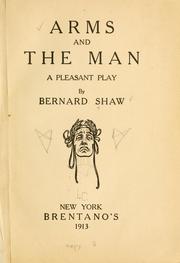
Arms and the Man is a comedy by Bernard Shaw. Its title comes from the opening words of Virgil's Aeneid, Arma virumque cano (Of arms and the man I sing).
The play was first produced on 21 April 1894 at the Avenue Theatre in London and published in 1898 as part of Shaw's Plays Pleasant volume, which also included Candida, You Never Can Tell, and The Man of Destiny. Arms and the Man was one of Shaw's first commercial successes. He humorously exposes the futility of war and the hypocrisies of human nature.
Characters and original cast
Major Paul Petkoff – James Welch
Major Sergius Saranoff – Bernard Gould
Captain Bluntschli – Yorke Stephens
Major Plechanoff – A. E. W. Mason
Nicola – Orlando Barnett
Catherine Petkoff – Mrs Charles Calvert
Raïna Petkoff – Alma Murray
Louka – Florence Farr
Source: The Stage.
Plot summary
The play takes place during the 1885 Serbo-Bulgarian War. Its heroine, Raina Petkoff, is a young Bulgarian woman engaged to Sergius Saranoff, a battlefield hero whom she idolizes. On the night after the Battle of Slivnitza, Captain Bluntschli, a Swiss mercenary in the defeated Serbian army, climbs in through her bedroom balcony and threatens her not to give the alarm. When Russian and Bulgarian troops burst in to search for him, Raina hides him. He tells her that "nine soldiers out of ten are born fools". Bluntschli's businesslike attitude to war shocks the idealistic Raina, especially after he admits that he uses his ammunition pouches to carry chocolates rather than pistol cartridges. When the search dies down, Raina and her mother Catherine sneak him out of the house, disguised in one of Raina's father's old coats.
The war ends and Raina's father, Major Paul Petkoff, returns home with Sergius. Raina begins to find Sergius bombastic and tiresome, but she hides it. Sergius also finds Raina's romantic ideals tiresome, and flirts with Raina's insolent servant girl Louka (a soubrette role), who is engaged to the Petkoffs' manservant Nicola. Bluntschli unexpectedly returns to give back the old coat, but also to see Raina. Raina and her mother are shocked when Major Petkoff and Sergius reveal that they have met Bluntschli before and invite him to lunch (and to help them figure out how to send the troops home).
Left alone with Bluntschli, Raina realizes that though he sees through her romanticism, he respects her, as Sergius does not. She reveals that she left a photograph of herself in a pocket of the coat, inscribed "To my chocolate-cream soldier", but Bluntschli says he did not find it, and it must still be in the coat. Bluntschli gets a telegram informing him of his father's death: he must now take over the family's luxury hotels in Switzerland.
Louka gossips to Sergius that Raina had protected Bluntschli and is in love with him. Sergius challenges Bluntschli to a duel, but Bluntschli evades it. Sergius and Raina break off their engagement, with some relief on both sides. Major Petkoff discovers the photograph in the pocket of his old coat; Raina and Bluntschli try to dispose of it, but Petkoff is determined to learn the truth and claims that the "chocolate-cream soldier" is Sergius. After Bluntschli confesses the whole story to Major Petkoff, Sergius proposes marriage to Louka (to Major Petkoff and Catherine's horror); the manservant Nicola quietly and gallantly lets Sergius have her; and Bluntschli, recognising Nicola's merits, offers him a job as hotel manager.
While Raina is now unattached, Bluntschli protests that—being 34 and believing she is 17—he is too old for her. On learning that she is actually 23, he immediately proposes and shows her the telegram announcing his inheritance. Raina, realizing the hollowness of her romantic ideals, protests that she would prefer him as a poor "chocolate-cream soldier" than as a wealthy businessman. Bluntschli protests that he is still the same person, and she proclaims her love for him. The play ends as Bluntschli, with Swiss precision, arranges the major's troop movements and informs them he will return to marry Raina in exactly two weeks.
Reception
Shaw was called onstage after the curtain, where he received enthusiastic applause. Amid the cheers, one audience member booed. Shaw riposted, "My dear fellow, I quite agree with you, but what are we against so many?" George Orwell said that Arms and the Man was written when Shaw was at the height of his powers as a dramatist. "It is probably the wittiest play he ever wrote, the most flawless technically, and in spite of being a very light comedy, the most telling." His other plays of the period, equally well written, were about issues that, according to Orwell, were no longer controversial at the time Orwell was writing. For example, the theme of Mrs. Warren's Profession, which so shocked audiences at the time, was that the causes of prostitution are mainly economic, which was already a common opinion in Orwell's time, and the play Widowers' Houses was an attack on slum landlords, who had since become stock villains.
In 2024, an attempt to stage John Malkovich's production of the play at Ivan Vazov National Theatre of Bulgaria was targeted by nationalist protesters that considered it a calumny of Bulgaria. The mob surrounded the theatre, threw smoke bombs, prevented the visitors that had bought tickets from entering the theatre hall, accusing them of being traitors and threatening them, and physically assaulted the director of the play and the director of the theatre.
Revivals
New York
The Internet Broadway Database lists seven productions of the play:
September 1894, presented by Richard Mansfield and his company.
November 1899, at the Garden Theatre.
April 1906, produced by and starring Arnold Daly.
May 1915, again featuring Arnold Daly, with Montagu Love.
September 1925, presented by the Theatre Guild, with Alfred Lunt as Bluntschli, Pedro De Cordoba as Sergius, Lynn Fontanne as Raina and Ernest Cossart as Petkoff. The production ran for 180 performances.
以上文字摘自英文维基百科「Arms and the Man」(有删节,去掉了参考文献等尾部小节),按 CC BY-SA 4.0 使用,作者为维基百科的各位编者。
资料卡
- 原题
- Arms and the Man
- 原作语言
- 英语
- 首次出版
- 1898 年
- 作品形式
- 剧作
- 体裁
- 喜剧
- 前作
- 华伦夫人的职业
资料卡来自 Wikidata Q2646905(CC0),众包数据,个别字段可能不全。
改编作品
电影2
- Arms and the Man
- 《英雄们》Arms and the Man
名单来自 Wikidata(CC0):只列条目里写明「改编自 / 取材于」这本书的作品,不按名字猜;众包数据,可能不全。