书单
百科
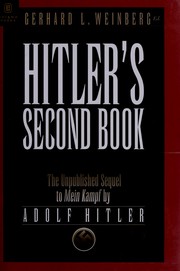
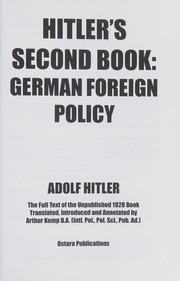
《第二本书》(德语:Zweites Buch,德语:[ˈtsvaɪ̯təs buːχ])是纳粹德国元首希特勒于1928年所写的关于其外交思想的原稿。此书写于《我的奋斗》之后。在希特勒的有生之年未得发表。
这本书贯穿种族主义和种族歧视,体现了希特勒本人的强烈的极端主义思想和称霸世界的构想。
该书当时并没有完全完稿,书稿中很多需要填数字之处,都用“_”留空。第五部分“国家社会主义德国工人党”这一节,最后一段只有开头一句“对于我们来说,”后面就没写下去。
这本书后来希特勒成为国家元首之后,没有继续完成和出版,更大的可能原因是:作为在野党时所写的外交政策,和作为德国元首时已经不同,或有些作为在野党可以公开讲出来的外交思路,作为元首时就不适合再讲出来了。这本书更真实地反映了希特勒的外交思路。
但这本书对了解二战时期德国联盟政策是一份重要资料,比如他对结盟意大利的思考,对墨索里尼的好感,在这本书里有充分体现。
本书的原稿1945年被美军掳获。1958年,德裔美籍历史学者格哈特·温伯格在美国国家档案和记录管理局位于弗吉尼亚州亚历山德里亚的库房中发现这份手稿,并于1961年将它整理出版。
以上文字摘自维基百科「第二本书」(去掉了参考文献等尾部小节),按 CC BY-SA 4.0 使用,作者为维基百科的各位编者。
中文维基百科的条目比较短,下面附上英文维基百科的内容(英文原文):
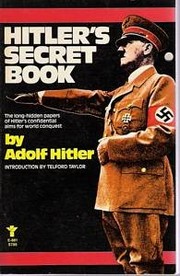
Hitlers Zweites Buch (German: [ˈtsvaɪ̯təs buːx], "Second Book"), published in English as Hitler's Secret Book and later as Hitler's Second Book, consists of Adolf Hitler's unedited thoughts on foreign policy in 1928. Written after Mein Kampf, it was not published in his lifetime.
Gerhard Weinberg – who edited and annotated the original German edition, and one of the two published English editions – speculates that the Zweites Buch was not published in 1928 because Mein Kampf did not sell well at that time and Hitler's publisher, the Franz-Eher-Verlag, may have told Hitler that a second book would hinder sales even more. Zweites Buch was written after the Nazi Party's poor showing in the 1928 German elections, which Hitler believed was caused by the public's misunderstanding of his ideas.
Contents
War and Peace
The Necessity of Strife
Race and Will in the Struggle for Power
Elements of Foreign Policy
National Socialist Foreign Policy
German Needs and Aims
Policies of the Second Reich
Military Power and Fallacy of Border Restoration as Goal
Hopelessness of an Economic Situation
On Necessity for an Active Foreign Policy
Germany and Russia
German Foreign Policy
German Goals
England as an Ally
Italy as an Ally
Summary
Zweites Buch and Mein Kampf
There are a number of similarities and differences between Zweites Buch and Mein Kampf. As in Mein Kampf, Hitler declared that the Jews were his eternal and most dangerous opponents. As in Mein Kampf, Hitler outlined what the German historian Andreas Hillgruber has called his Stufenplan ("stage-by-stage plan"). Hitler himself never used the term Stufenplan, which was coined by Hillgruber in his 1965 book Hitlers Strategie. Briefly, the Stufenplan called for three stages. In the first stage, there would be a massive military build-up, the overthrow of the shackles of the Treaty of Versailles, and the forming of alliances with Fascist Italy and the British Empire. The second stage would be a series of fast, "lightning wars" in conjunction with Italy and the United Kingdom against France and whichever of her allies in Eastern Europe—such as Czechoslovakia, Poland, Romania and Yugoslavia—chose to stand by her. The third stage would be a war to obliterate what Hitler considered to be the "Judeo-Bolshevik" regime in the Soviet Union.
The "fourth stage"
In contrast to Mein Kampf, in Zweites Buch Hitler added a fourth stage to the Stufenplan. He insinuated that in the far future a struggle for world domination might take place between the United States and a European alliance comprising a new association of nations, consisting of individual states with high national value. Zweites Buch also offers a different perspective on the U.S. than that outlined in Mein Kampf. In Mein Kampf Hitler declared that Germany's most dangerous opponent on the international scene was the Soviet Union; in Zweites Buch, Hitler declared that, for immediate purposes, the Soviet Union was still the most dangerous opponent, but that, in the long term, the most dangerous potential opponent was the United States.
Habitat argument
In the first two chapters Hitler claims the balance between population and natural resources to be the main focus of any nation.
The starting point of his analysis is the "struggle for daily bread" (food production) as the basis of human society. From this need for self-preservation, he develops his central idea of the relationship between the population and the size of the habitat of a people. If the habitat cannot provide sufficient resources for survival, degeneration and a decline of the nation results. Hitler raises the struggle for adequate habitat to a central principle of human history. Hitler points out that this battle is often enforced militarily, as history has adequately demonstrated.
以上文字摘自英文维基百科「Hitlers Zweites Buch (1928)」(有删节,去掉了参考文献等尾部小节),按 CC BY-SA 4.0 使用,作者为维基百科的各位编者。
资料卡
- 原题
- Hitlers Zweites Buch
- 原作语言
- 德语
- 首次出版
- 1961 年
- 体裁
- 政治哲学
- 前作
- 我的奋斗
- 续作
- 希特勒的桌边谈话
资料卡来自 Wikidata Q706852(CC0),众包数据,个别字段可能不全。
更多资料与书评
在哪读
阿道夫·希特勒 的其他作品
作者页 ›