书单
百科
这个词条暂时没有中文维基百科条目,下面是英文维基百科的内容(英文原文):
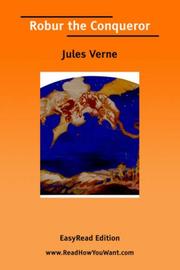
Robur the Conqueror (French: Robur-le-Conquérant) is a science fiction novel by Jules Verne, published in 1886. It is also known as The Clipper of the Clouds. A sequel was published in 1904 as Master of the World.
Plot summary
The story begins with strange lights and sounds, including blaring trumpet music, reported in the skies all over the world. Then black flags with gold suns mysteriously appear atop tall historic landmarks such as the Statue of Liberty in New York, the Great Pyramid of Giza in Egypt, and the Eiffel Tower in Paris. These events are all the work of the mysterious Robur (the specific epithet for the English oak (Quercus robur) and figuratively taken to mean "strength"), a brilliant inventor who intrudes on a meeting of a flight-enthusiasts' club called the Weldon Institute in Philadelphia, Pennsylvania.
Members of the Weldon Institute are all firm believers that mankind shall master the skies using "lighter than air" craft, and that "heavier than air" craft such as airplanes and helicopters would be unfeasible. The institute has been constructing a giant dirigible called the Go-ahead. During a heated discussion over where to place its propeller (in front to pull it, or behind to push it), Robur appears at the meeting and is admitted to speak. He chastises the group for being balloon-boosters when "heavier than air" flying apparatuses are the future. When asked if Robur himself has "made conquest of the air", he states that he has, leading to him accepting the title "Robur the Conqueror". During his short time at the Weldon Institute, Robur so incites the members that they chase him outside. Just as they are about to attack him, Robur appears to vanish into the mob, but he has actually been borne away by a flying machine.
Later that night Robur kidnaps the Weldon Institute's president, Uncle Prudent; his secretary, Phil Evans; and valet, Frycollin. He takes them on board his ship, a huge, battery-powered "aeronef" called the Albatross, which has many vertical airscrews to provide lift, and two horizontal airscrews in a push-pull configuration to drive the vessel forward. It bears the same black flag with golden sun that has been sighted on many landmarks, and a crewmen playing a trumpet accounts for the music in the sky. To demonstrate the vessel's superiority, Robur takes his captives around the world in the course of three weeks. Prudent and Evans are angry at Robur for kidnapping them and unwilling to admit that the Albatross is a fantastic vessel, or that their notions of "lighter than air" superiority are wrong. They demand that Robur release them, but he is aloof and always says that they shall remain as long as he desires it. Fearing they will be held captive forever, the two formulate plans both to escape and to destroy the Albatross.
After the horizontal propellers are damaged in a storm, the Albatross anchors over the Chatham Islands for repairs. While the crew is busy at work, Prudent and Evans light a fuze and make their escape. They try to bring Frycollin with them but cannot find him, only later discovering that he had already escaped without them. The Albatross explodes and its wreckage, along with Robur and his crew, plunges towards the ocean. Meanwhile, the three escapees are safe on a small but inhabited island and are later rescued by a ship; they then make a long journey back to Philadelphia.
The Weldon Institute members return, and rather than describe their adventures or admit that Robur had created a flying machine greater than their expectations of the Go-ahead, they simply conclude the argument the group was having during their last meeting. Rather than have only one propeller to their dirigible, they decide to have one propeller in front and another behind, similar to Robur's design.
Seven months after their return the Go-ahead is completed and making its maiden voyage with the president, secretary, and an aeronaut. The speed and maneuverability of the dirigible impress a huge crowd, but are trivial compared to Robur's Albatross. Suddenly, out of the sky there appears the Albatross. It is revealed that when the Albatross exploded, enough of it was intact so that at least some of the propellers operated and slowed its descent, saving the crew. The crew used the remains of the Albatross as a raft until they were rescued by a ship. Later, Robur and the crew made it back to his secret X Island, where the original Albatross had been built. Robur has built a new Albatross and now intends to exact revenge by showing that it is superior to the Weldon Institute's Go-ahead.
The entirety of the final scene is described from the crowd's point of view. The Albatross begins circling the Go-ahead; the Go-ahead drops ballast and rises to fourteen thousand feet. The Albatross follows, still a circling menace. The Go-ahead is at the mercy of the Albatross because the Albatross is both faster and more maneuverable. Finally, the Go-ahead exceeds her pressure-height limit, whereupon her gas bags rupture. Losing her buoyant gases, the Go-ahead drops out of the sky like a rapidly descending kite. The Albatross stays alongside of the Go-ahead as she falls, signalling the pilot and passengers of the Go-ahead to come on board the Albatross. They refuse, but then the crew of the Albatross seizes them and brings them aboard.
Having demonstrated his rule over the skies, Robur returns the three men to the ground. In a short speech, Robur says that nations are not yet fit for union. He cautions the crowd that it is evolution, not revolution, that they should be seeking. He leaves with the promise that he will one day return to reveal his secrets of flight. The people of Philadelphia subject Prudent and Evans to unrelenting ridicule for the rest of their lives.
Influences
Film
The story was adapted into a 1961 film, Master of the World, starring Vincent Price as Robur. The film retained the novel's basic concept but added elements of intrigue and a romantic subplot.
以上文字摘自英文维基百科「Robur the Conqueror」(有删节,去掉了参考文献等尾部小节),按 CC BY-SA 4.0 使用,作者为维基百科的各位编者。
资料卡
- 原题
- Robur le Conquérant
- 插图
- Léon Benett
- 原作语言
- 法语
- 首次出版
- 1886 年
- 作品形式
- 长篇小说
- 体裁
- 科学幻想
- 首版出版社
- Hetzel éds
- 所属系列
- 非凡旅程系列
- 前作
- Mathias Sandorf
- 续作
- The Lottery Ticket
- 故事发生地
- 纽约、巴黎
资料卡来自 Wikidata Q978723(CC0),众包数据,个别字段可能不全。
改编作品
电影1
- 《大地之王》Master of the World
名单来自 Wikidata(CC0):只列条目里写明「改编自 / 取材于」这本书的作品,不按名字猜;众包数据,可能不全。