书单
幻兽辞典 (1957)
- 作者
- 豪尔赫·路易斯·博尔赫斯、Margarita Guerrero
- 首版
- 1957 年
- 国家/地区
- 阿根廷
- Open Library
- 41 个版本
百科
《想像的动物》(El libro de los seres imaginarios)是由阿根廷作家豪尔赫·路易斯·博尔赫斯与玛格丽塔·盖雷洛(Margarita Guerrero)两人共同著作的文学作品。
概要
本书的第1版书名原为《幻兽动物指南》(Mannal de zoologia fantástica),于1957年发表。1967年的第2版增订本开始则改名为《想像的动物》,之后则因应改版而陆续扩充内容,目前广为人知者则为1969年所发行的版本。在此版本中,包含了关于民间传说和文学中多达116种想像动物的描述。
以上文字摘自维基百科「幻兽辞典」(去掉了参考文献等尾部小节),按 CC BY-SA 4.0 使用,作者为维基百科的各位编者。
中文维基百科的条目比较短,下面附上英文维基百科的内容(英文原文):
The Book of Imaginary Beings was written by Jorge Luis Borges with Margarita Guerrero and published in 1957 under the original Spanish title Manual de zoología fantástica ("Handbook of fantastic zoology"). It contains descriptions of mythical beasts from folklore and literature. In 1967 the authors published an expanded edition retitled as El libro de los seres imaginarios. Borges collaborated on the first English translation, which was praised upon its publication in 1969.
Contents
Although a work of fiction, the book is situated in a tradition of paper museums, bestiaries, and natural history writing. In the preface, Borges states that the book is to be read "as with all miscellanies... not... straight through... Rather we would like the reader to dip into the pages at random, just as one plays with the shifting patterns of a kaleidoscope"; and that "legends of men taking the shapes of animals" have been omitted.
Though Borges conducted research for the book, he also fabricated sources and invented details (and in the case of the peryton, a whole creature). As translator Andrew Hurley writes, "The nature of Borges’ erudition, creativity, and sense of fun is such that it has been simply impossible to ferret out all the originals, where originals in fact ever existed (some of his “quotations” are almost certainly apocrypha, put-ons)."
Versions
The original 1957 publication of Manual de zoología fantástica contained eighty-two entries. Thirty-four additional entries were added to the retitled second edition. While collaborating on the 1969 English translation, Borges revised many of the original entries and added another four, bringing the total count to 120.
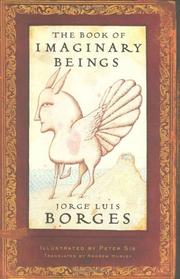
In 2005, Penguin published an illustrated edition with a new English translation of the 116 entry 1967 edition as part of its series of Classics Deluxe editions.
Original editions
Manual de zoología fantástica. Mexico D.F.: Fondo de Cultura Económica, 1957
El libro de los seres imaginarios. Buenos Aires: Editorial Kier, S.A., 1967
English translations
The Book of Imaginary Beings. Norman Thomas di Giovanni (tr.). E.P. Dutton, 1969.
The Book of Imaginary Beings. Andrew Hurley (tr.), Peter Sís (illus.). Viking Penguin, 2005.
Reception
A review from Publishers Weekly praised the book, describing it as "perfect foils for classic Borgesian musings on everything from biblical etymology to the underworld, giving the creatures particularly vivid and perfectly scaled shape". Reviewing the book for The Guardian, Caspar Henderson stated that the book was brief but also a "map of the endless labyrinth of human imagination and its contents" that was "dense and deep". The reviewer also commented that the entries on legends were "delightful". Benjamin DeMott in The New York Times also complimented the book, stating that it was "an amusing tribute to the human gift for seeing the invisible and debating whether it whistles". An article in Journal of Modern Literature, written by Melanie Nicholson, reported that some critics described the book as a "curious but unoriginal compilation of already-told tale". However, Nicholson stated that it was also "one worthy of serious consideration".
Influence
Many writers have been influenced by The Book of Imaginary Beings; this is especially apparent in the way that many of Borges's fabrications are repeated as accurate representations of folklore in later bestiaries and books on fantastical creatures.
British weird fiction author China Miéville credits Borges for inspiring The Tain, his 2002 fantasy novella, which features "imagos" that resemble the Fauna of Mirrors entry in The Book of Imaginary Beings.
The title of Caspar Henderson's 2012 book The Book of Barely Imagined Beings is a reference to Borges's book. Cuban composer and classical guitarist Leo Brouwer also titled a 2018 album El Libro de los Seres Imaginarios after Borges's book.
以上文字摘自英文维基百科「Book of Imaginary Beings」(去掉了参考文献等尾部小节),按 CC BY-SA 4.0 使用,作者为维基百科的各位编者。
资料卡
- 原题
- El libro de los seres imaginarios 等 2 项
- 原作语言
- 南美西班牙语
- 首次出版
- 1957 年
- 体裁
- 百科全书、动物寓言
- 首版出版社
- 经济文化基金
- 主题
- 传说生物、母题
资料卡来自 Wikidata Q2529048(CC0),众包数据,个别字段可能不全。