书单
百科
这个词条暂时没有中文维基百科条目,下面是英文维基百科的内容(英文原文):
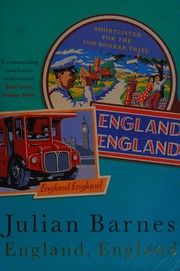
England, England is a satirical postmodern novel by Julian Barnes, published and shortlisted for the Booker Prize in 1998. While researchers have also pointed out the novel's characteristic dystopian and farcical elements, Barnes himself described the novel as a "semi-farce".
Plot summary
England, England is divided into three parts entitled "England", "England, England" and "Anglia". The first part focuses on the protagonist Martha Cochrane and her childhood memories. Growing up in the surrounding of the English countryside, her peaceful childhood is disrupted when her father leaves the family. Martha's memories of her father are closely related to playing a Counties of England jigsaw puzzle with him.
The second part, "England, England", is set in the near future. Martha is now in her forties and is employed by the entrepreneur Sir Jack Pitman for a megalomaniacal project: Sir Jack aims to turn the Isle of Wight into a gigantic theme park which contains everything that people, especially tourists, consider to be quintessentially English, selected according to what Sir Jack himself approves of. The theme park − called "England, England" − thus becomes a replica of England's best known historical buildings, figures and sites. Popular English tourist attractions and icons of "Englishness" are crammed together to be easily accessible without having to travel the whole of "real" England.
While working on the set-up of the project, Martha starts an affair with one of her colleagues, Paul Harrison. They discover Sir Jack's adult baby fetish and blackmail him with incriminating evidence when Sir Jack wants to dismiss Martha. She thus becomes CEO of the Island project, which turns out to be a highly popular tourist attraction. As a consequence of the huge success, "England, England" becomes an independent state and part of the European Union, while the real, "Old England" suffers a severe decline and increasingly falls into international irrelevance. After a major scandal in the theme park, however, Martha is eventually expelled from the island.
The third part of the novel, "Anglia", renamed "Albion" in later editions, is set decades later and depicts Martha who has returned to a village in Old England after many years of wandering abroad. The original nation has regressed into a vastly de-populated, agrarian and pre-industrial state without any international political influence, while "England, England" continues to prosper.
Themes
Beyond the basic twin plots surrounding Pitman and Cochrane, England, England is a novel of ideas – mainly ideas that correspond to the criticism of society voiced by French philosophers of the second half of the 20th century. The seminal work in this respect is Jean Baudrillard's (b. 1929) L'échange symbolique et la mort (1976), in which Baudrillard claims that in the course of the 20th century reality has been superseded by "simulacra", by representations of the original which – in a world where technology has developed the means to replicate each and everything, including works of art (cf. Walter Benjamin's 1936 essay "Das Kunstwerk im Zeitalter seiner technischen Reproduzierbarkeit") and humans (by means of cloning) – acquire an independent and increasingly higher status than the original: because they are safer, easier to handle, more cost-effective, ubiquitous and thus more easily accessible, renewable, and predictable. (Cf. "postmodernism" and also US sociologist George Ritzer's "McDonaldization" thesis of the 1990s, in particular his discussion of tourism).
This is exactly the purpose of Pitman's final project: he wants his island to epitomise everything that is truly English. As a fervent patriot, he wants to put England in a nutshell for all the world to see and to cash in on England at the same time: he does not mind that the real thing takes a turn for the worse and eventually deteriorates.
The two strands of action – Martha Cochrane's rise to fame and her subsequent downfall on the one hand and the launching of the project and its continuing success on the other – are intertwined when Martha applies for a job as Special Consultant in Pitman's personal staff, which she gets. Martha has acquired all the professional skills necessary to succeed in our post-industrialist society, yet she has retained from her childhood at least some of her emotional and sentimental inclinations. Although she has become scheming, calculating and ruthless in her professional life, she is still able, at times, to listen to her heart – especially in her relationship with Paul Harrison, the "Ideas Catcher". This ability of hers also helps her cope with old age back in rural Anglia.
By having his characters uninhibitedly subvert all of England's long-standing customs and traditions, Barnes inadvertently also collects, registers and critically assesses these myths. For the sake of simplification, however, in the novel old English folklore, customs and legends, but also historical facts, are altered to fit the overall purpose of the Project. As the whole island is supposed to be fit for family consumption, history has to be rewritten and bowdlerised (to pay lip service to political correctness and avoid sexual harassment actions). As they are paying high prices, mainly in advance, the visitors to the island are supposed never to be faced with anything incomprehensible or illogical because that would spoil the fun for them and could even give rise to complaints.
以上文字摘自英文维基百科「England, England」(有删节,去掉了参考文献等尾部小节),按 CC BY-SA 4.0 使用,作者为维基百科的各位编者。
资料卡
- 原题
- "England, England"
- 原作语言
- 英语
- 首次出版
- 1998 年 8 月 27 日
- 作品形式
- 长篇小说
- 体裁
- 闹剧
- 首版出版社
- 乔纳森·凯普
资料卡来自 Wikidata Q138046(CC0),众包数据,个别字段可能不全。