书单
百科
这个词条暂时没有中文维基百科条目,下面是英文维基百科的内容(英文原文):
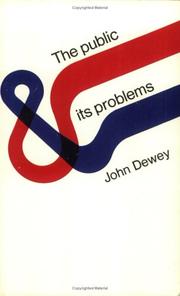
The Public and Its Problems is a 1927 book by American philosopher John Dewey. In his first major work on political philosophy, Dewey explores the viability and creation of a genuinely democratic society in the face of the major technological and social changes of the 20th century, and seeks to better define what both the 'public' and the 'state' constitute, how they are created, and their major weaknesses in understanding and propagating their own interests and the public good. Dewey rejects a then-popular notion of political technocracy as an alternative system of governing an increasingly complex society, but rather sees democracy as the most viable and sustainable means to achieving the public interest, albeit a flawed and routinely subverted one. He contends that democracy is an ethos and an ongoing project that requires constant public vigilance and engagement to be effective, rather than merely a set of institutional arrangements, an argument he would later expand upon most influentially in his essay "Creative Democracy: The Task Before Us". The Public and its Problems is a major contribution on pragmatism in political philosophy and continued to promote discussion and debate long after its publication.
Background
The Public and Its Problems was Dewey's first major work concerned exclusively with political philosophy, though he had both commented and written on politics frequently for much of his career, and made forays into the subject as it related to education in Democracy and Education in 1916, and would go on to publish numerous works on the subject, including Individualism: Old and New (1930) and Liberalism and Social Action (1935) and Freedom and Culture (1939). Dewey was an ardent democrat who while still at university in 1888 had contended "Democracy and the one, ultimate, ethical ideal of humanity are to my mind synonymous."
Dewey was moved to write in defence of democracy in the wake of two widely read and influential works written by journalist Walter Lippmann in the 1920s which echoed a rising intellectual trend both in the United States and Europe that was critical of the potential for self-governing democratic societies. In the first, Public Opinion (1922), Lippmann contends that public opinion suffers from two major problems – that regular citizens have insufficient access to or interest in the facts of their environment, and that what information they receive is heavily distorted by cognitive biases, manipulation by the media, inadequate expertise and cultural norms. Lippmann contends that citizens construct a pseudo-environment that is a subjective, biased, and necessarily abridged mental image of the world, and to a degree, everyone's pseudo-environment is a fiction. Subsequently, because of the near impossibility of developing an adequately informed public that a democracy requires to make effective public policy in a world of increasingly complex policy problems, Lippmann contends that a technocratic elite is better placed to work for the public interest without necessarily undermining the notion of consent of the governed. Lippmann expanded upon his critiques of democracy and the public as an illusory and often dangerous force in The Phantom Public (1925), contending famously that "the public must be put in its place...so that each of us may live free of the trampling and the roar of a bewildered herd." He dismisses the notion of the existence of "the public" as used in democratic theory, and advances again a notion that elites are the only force capable of effectively achieving something akin to the 'public interest' in practice.
Dewey saw Lippmann's work as "perhaps the most effective indictment of democracy as currently conceived ever penned" but felt compelled to come to the defence of democratic theory and to reject what he saw as argumentation on the part of Lippmann that was particularly doctrinaire and absolutist in its judgements, and saw his own philosophical pragmatism as a means by which a more accurate and realistic conception of what the public and democracy was capable of it, and its limitations.
The spirit of Lippmann's critique of democracy was not new to Dewey. One of his first essays, "The Ethics of Democracy," was a response to the jurist and historian Sir Henry Maine, whose Popular Government anticipated many of Lippmann's critique. Written in 1888 at the age of twenty-nine, "The Ethics of Democracy" was Dewey's first defence of democracy, one that can be read as a direct predecessor of The Public and Its Problems.
Overview
Part I: Origins of the Public, Society, and "The State"
Dewey opens with a critique of abstract accounts of the state’s origins — be it the Aristotelian idea that man is a political animal or social contract theories – which, he argues, devolve into "mythology" and "story-telling." Instead, Dewey thinks of the state as a way to respond to human actions and their consequences: “We take our point of departure from the objective fact that human actions have consequences upon others, that some of these consequences are perceived, and that their perception leads to subsequent effort to control action so as to secure some consequences and avoid others.” Certain actions merely affect the parties involved in a specific exchange, transaction, or arrangement; but others affect people with no direct involvement in the action itself. For Dewey, this distinction between direct and indirect consequences underpins the public-private distinction: “The public consists of all those who are affected by the indirect consequences of transactions to such an extent that it is deemed necessary to have those consequences systematically cared for.” There, Dewey argues, lies the nature and office of the state. The res publica, or commonwealth, is the aggregation of the funds, buildings, and institutions required to manage the consequences of actions that affect the public at large.
以上文字摘自英文维基百科「The Public and Its Problems」(有删节,去掉了参考文献等尾部小节),按 CC BY-SA 4.0 使用,作者为维基百科的各位编者。
资料卡
- 原题
- The Public and its Problems 等 2 项
- 原作语言
- 英语
- 首次出版
- 1927 年
- 体裁
- 非虚构作品
- 首版出版社
- 亨利·霍尔特出版公司
- 主题
- 政治哲学
资料卡来自 Wikidata Q10855412(CC0),众包数据,个别字段可能不全。