书单
百科
这个词条暂时没有中文维基百科条目,下面是英文维基百科的内容(英文原文):
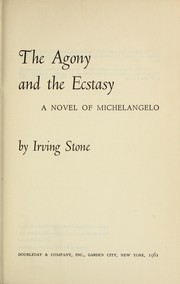
The Agony and the Ecstasy (1961) is a biographical novel of Michelangelo Buonarroti written by American author Irving Stone. Stone lived in Italy for years visiting many of the locations in Rome and Florence, worked in marble quarries, and apprenticed himself to a marble sculptor. A primary source for the novel is Michelangelo's correspondence, all 495 letters of which Stone had translated from Italian by Charles Speroni and published in 1962 as I, Michelangelo, Sculptor. Stone also collaborated with Canadian sculptor Stanley Lewis, who researched Michelangelo's carving technique and tools. The Italian government lauded Stone with several honorary awards for his cultural achievements highlighting Italian history.
Stone wrote a dozen biographical novels, but this one and Lust for Life (1934) are best known, in large part because both had major Hollywood film adaptations.
Part of the 1961 novel was adapted to film in The Agony and the Ecstasy (1965), starring Charlton Heston as Michelangelo and Rex Harrison as Pope Julius II.
Plot
Sections
The book is divided into eleven sections, each detailing a distinct period of Michelangelo's life.
The Studio: Michelangelo studies under Ghirlandaio at his studio
The Sculpture Garden: Michelangelo studies under Bertoldo in the sculpture garden of Lorenzo de' Medici, culminating in his first sculpture, Head of a Faun
The Palace: Michelangelo lives in the palace of Lorenzo de' Medici, where he befriends Lorenzo's daughter Contessina, learns from Bertoldo and the Platonic scholars, and produces his first two reliefs, Madonna of the Steps and Battle of the Centaurs. Savonarola turns Florence against the Medici family, and ultimately Lorenzo passes away from illness.
The Flight: Michelangelo returns to his parents' home. He begins dissecting bodies at Santo Spirito to further his understanding of the human form while starting work on a sculpture of Hercules in memory of Lorenzo, as well as a Crucifix for the church. He is invited to live at the Medici palace once more by Piero de' Medici, but when the people of Florence become disenchanted by the lavishness of Contessina's wedding celebrations Savonarola turns the city against the Medici family and the palace is attacked. Michelangelo flees to Bologna, where he stays with Aldovrandi, becomes romantically involved with a woman named Clarissa, and creates the sculptures St. Proclus and St. Petronius. He returns to Florence once the political situation has calmed and is commissioned to create a sculpture of a young St. John the Baptist and a counterfeit Cupid. The fraudulence of the Cupid is discovered by its ultimate owner, Cardinal Raffaele Riario, who is nevertheless impressed and invites Michelangelo to live in Rome for a time to sculpt something new.
The City: Michelangelo travels to Rome and stays at the palace of Cardinal Riario, then at the home of his new friend Jacopo Galli, and finally in his own studio with his new apprentice Argiento. While in Rome he sculpts his Bacchus and his Pietà, and then he returns to Florence with Argiento to enter a sculpting competition.
The Giant: Michelangelo wins the Duccio competition by sculpting his David and competes with Leonardo da Vinci by painting the Battle of Cascina, and is then summoned to Rome by Pope Julius II.
The Pope: After resisting his summons by Pope Julius II for as long as possible, Michelangelo ultimately relents and returns to Rome. Michelangelo's and Julius' hot tempers cause tension, but ultimately Michelangelo is commissioned to carve Julius' tomb (which is repeatedly put on hold) and paint the Sistine Chapel ceiling.
The Medici: Upon Pope Julius II's passing, the new Pope Leo X pulls Michelangelo from his work on Julius' tomb to create a façade for the Medici family church in Florence. Michelangelo first travels to Carrara to buy marble, but is then instead tasked with creating roads and a quarry to mine marble from Pietrasanta. While he succeeds in this endeavor, his marble is used for other projects and Michelangelo, dejected, returns to Florence.
The War: While Michelangelo is living in Florence, Pope Leo dies and is replaced rapidly first by Adrian VI and then by Pope Clement VII. The Medici are ousted by the citizens of Florence who restore the republic, and Michelangelo assists in their defense against the pope by helping construct defensive walls. Although the city ultimately falls to papal forces and Michelangelo flees to Rome, he is nevertheless welcomed to Rome by Clement who wants to give him a new commission.
Love: Michelangelo paints The Last Judgment first for Clement and then, upon his passing, Pope Paul III. He also begins deep friendships with both Vittoria Colonna and Tommaso dei Cavalieri.
The Dome: Michelangelo finally finishes his tomb for Julius and is named architect of St. Peter's Basilica despite opposition from other architects and artists. With the help of Urbino and Tommaso the plans for the dome of the basilica are executed to such a degree that its completion is inevitable. Michelangelo's strength wanes and his friends visit him to say their goodbyes, while Tommaso vows to finish St. Peter's. Michelangelo passes away while reminiscing on his body of work.
Characters
Buonarroti Family
Michelangelo Buonarroti, the protagonist
Ludovico, Michelangelo's father who is obsessively focused on money and his family's fortunes
Bugiardini, Michelangelo's brother who helps manage his money
Lionardo, Michelangelo's brother who joins the church and follows Savonarola
Giovansimone, Michelangelo's brother who becomes part of Savonarola's Army of Boys
Michelangelo's Teachers
Ghirlandaio, Michelangelo's first master, a fresco painter who runs his own studio
Bertoldo, Michelangelo's master in sculpture, who lives and works with him in the Medici palace
Michelangelo's Friends
Francesco Granacci, Michelangelo's first and closest friend
Gianfrancesco Aldovrandi, who hosts Michelangelo in Bologna
Giuliano da Sangallo, a Florentine architect
以上文字摘自英文维基百科「The Agony and the Ecstasy (novel)」(有删节,去掉了参考文献等尾部小节),按 CC BY-SA 4.0 使用,作者为维基百科的各位编者。
资料卡
- 原题
- The Agony and the Ecstasy
- 原作语言
- 英语
- 首次出版
- 1961 年
- 作品形式
- 长篇小说
- 体裁
- 传记体小说、历史类虚构作品
- 首版出版社
- 双日出版社
- 主题
- 米开朗琪罗
资料卡来自 Wikidata Q2525525(CC0),众包数据,个别字段可能不全。
改编作品
电影1
- 《戴茜·克洛弗的内心》The Agony and the Ecstasy
名单来自 Wikidata(CC0):只列条目里写明「改编自 / 取材于」这本书的作品,不按名字猜;众包数据,可能不全。