书单
百科
这个词条暂时没有中文维基百科条目,下面是英文维基百科的内容(英文原文):
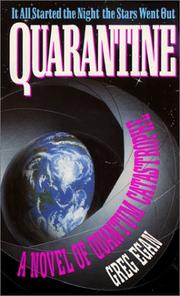
Quarantine is a 1992 hard science fiction novel by Greg Egan.
Within a detective fiction framework, the novel explores the consequences of the Copenhagen interpretation of quantum mechanics (or rather of its consciousness causes collapse variant), which Egan acknowledges was chosen more for its entertainment value than for its likelihood of being correct.
Plot summary
The novel is set in the near future (2034–2080), after the Solar System has been surrounded by an impenetrable shield known as the Bubble, presumably by an extraterrestrial civilization for unknown reasons. The Bubble permits no light to enter the Solar System, and as a consequence the stars can no longer be seen, causing widespread societal panic, 'claustrophobia', and terrorist action. Neural mods are commonplace, designed pathways in the brain that are created with engineered, programmable microorganisms to produce a variety of effects, such as implanting skillsets, emotions, altered states of awareness or, illegally, forcing and controlling thoughts.
The narrator, Nick, contains a suite of tactical mods that allow him to suppress emotions and enhance tactical and analytical thought. Nick is a private eye forced to quit the police force after the death of his wife, the trauma of which caused him to activate his emotional suppression mod, which further prompted him to purchase a mod that simulates the feeling of love and wellbeing of his wife still being alive, logically solving the problem of grief.
Nick accepts a case to investigate Laura, a woman who has vanished from a psychiatric institute, after several instances of her escaping. The institute staff insist that short of walking through a wall, it should not have been possible to escape the previous times, though it comes to light that she was kidnapped in this instance.
Investigation in New Hong Kong leads Nick to the group responsible, the Ensemble, but causes him to be captured. Nick is implanted with an illegal 'Loyalty Mod', which causes him to earnestly and truly believe in the goals of the Ensemble. Nick is used as a security guard for the project the Ensemble is working on, a new neural mod perfected by studying Laura. This mod, called the Eigenstate Mod or 'Eigenmod', allows the brain to consciously control the physical process that is responsible for wave function collapse. This feature of neurology is present in several animal species, and one of the researchers responsible for the mod, Po-kwai, suspects that the Bubble may exist because humanity may have been aggressively collapsing the wave functions of alien civilizations that did not have the ability to do so, causing them harm. When using the mod, the user becomes 'Smeared', existing within a superposition of states constantly, therefore every possible set of actions they take being equally 'real'. When one version of the user succeeds in whatever they want to do, they deactivate the mod, collapsing the eigenstates into that one subjective reality. This allows the mod to seemingly control probability to do anything, though raises questions of morality and philosophy to the narrator, who considers deactivating the mod equivalent to murdering the other equally real versions of the user.
Nick eventually meets a group of Ensemble members who like him are under the control of the Loyalty mod. They explain to him that the loyalty mod only specifies their loyalty to the Ensemble, but fails to specify what the Ensemble actually is. Therefore, via logical argument, the group (calling itself the Canon) decides that as by definition the most loyal members of the Ensemble, what the Ensemble is is up to their personal interpretations.
The Canon has Nick steal and apply the eigenstate mod to himself, which he uses for various purposes before eventually meeting with a strangely coherent Laura after bypassing otherwise impregnable security with the mod. Laura explains that she is naturally capable of smearing, and that she is one of the aliens who created the Bubble. The true alien consists of an emergent being composed of all the eigenstates of Laura at once, that dies when she stops smearing, but captures a holographic representation of itself within her mind that rebuilds the alien mind when she begins smearing again. Laura explains that life on earth developed the ability to collapse wave functions by chance, which eventually spread via pure natural selection. As smeared intelligence cannot survive in a single, unique state of the universe, they erected the bubble, preventing humanity from seeing and thus deciding the state of anything outside it, while simultaneously protecting humanity from the starkly alien nature of outside reality. Laura finishes by explaining her role as an observer, there to offer humanity a way to join the rest of the universe, if they choose to. She also warns Nick of his Smeared self, which she describes as a child and unsure of its abilities, but which is becoming increasingly aware that its goals do not align with that of Nick's, who she describes as a single cell to a much larger, complex and much more alien Smeared Nick.
以上文字摘自英文维基百科「Quarantine (Egan novel)」(有删节,去掉了参考文献等尾部小节),按 CC BY-SA 4.0 使用,作者为维基百科的各位编者。
资料卡
- 原题
- Quarantine
- 原作语言
- 澳大利亚英语
- 首次出版
- 1992 年
- 作品形式
- 长篇小说
- 体裁
- 科学幻想、硬科幻
资料卡来自 Wikidata Q2392641(CC0),众包数据,个别字段可能不全。