 书单
百科
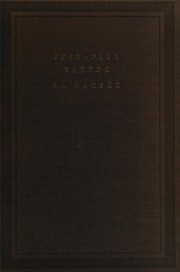
《恶心》(法语:La Nausée,又译《呕吐》)是法国存在主义哲学家与作家萨特的作品,小说在1938年出版,当时作者还是一个中学老师,是萨特最为人所知的作品之一。
《恶心》这部作品存在主义小说的影响,故事主角罗昆丁(Roquentin)是历史学家,在虚构城市“布维尔”生活。他透过事物、过去体现自我。他深信别的东西不能赋予自己的本质,而后发现自己拥有绝对的自由,陆续唤起一阵一阵的恶心感觉。
这个故事被认为是存在主义文学的经典之作,萨特更于1964年获得诺贝尔文学奖。诺贝尔评审委员会认为萨特的作品“具有原创性、充满自由及探求真理的精神,为这个世代立下深远的影响。
以上文字摘自维基百科「恶心 (小说)」(去掉了参考文献等尾部小节),按 CC BY-SA 4.0 使用,作者为维基百科的各位编者。
中文维基百科的条目比较短,下面附上英文维基百科的内容(英文原文):
Nausea (French: La Nausée) is a philosophical novel by the existentialist philosopher Jean-Paul Sartre, published in 1938. It is Sartre's first novel.
The novel takes place in 'Bouville' (homophone of Boue-ville, literally, 'Mud town') a town similar to Le Havre. It comprises the thoughts and subjective experiences—in a personal diary format—of Antoine Roquentin, a melancholic and socially isolated intellectual who is residing in Bouville ostensibly for the purpose of completing a biography on a historical figure. Roquentin's growing alienation and disillusionment coincide with an increasingly intense experience of revulsion, which he calls "the Nausea", in which the people and things around him seem to lose all their familiar and recognizable qualities. Sartre's original title for the novel before publication was Melancholia.
The novel has been translated into English by Lloyd Alexander as The Diary of Antoine Roquentin and by Robert Baldick as Nausea.
Characters
Antoine Roquentin – The protagonist of the novel, Antoine is a former adventurer who has been living alone in Bouville for three years. He has no friends and is out of touch with family, and often resigns himself to eavesdropping on other people's conversations and examining their actions from a distance. He settles in the seaport town of Bouville to finish his research on the life of an 18th-century political figure, the Marquis de Rollebon. During the winter of 1932 a "sweetish sickness," which he calls "the nausea", increasingly impinges on almost everything he does or enjoys. He tries to find solace in the presence of others, but exhibits signs of boredom and lack of interest when interacting with them. Because of his aloofness to the world and the people around him, he starts to doubt his own existence.
Anny – An English woman who was once Antoine's lover. After Antoine arranges to meet with her hoping it will ameliorate his condition, Anny makes clear to him she has changed considerably and must get on with her life.
Ogier P. – Generally referred to as "the self-taught man" or the Autodidact, he is a bailiff's clerk and an acquaintance of Antoine's. Ogier lives for the pursuit of knowledge and love of humanity, which inspires in Antoine much criticism and mockery, although he develops a strange compassion for him. Highly disciplined, he has spent hundreds of hours reading at the local library. He often speaks to Antoine and confides to him that he is a socialist.
Literary genre and style
Like many Modernist novels, La Nausée is a "city-novel", encapsulating experience within the city. It is widely assumed that Bouville in the novel is a fictional portrayal of Le Havre, where Sartre was living and teaching in the 1930s as he wrote it.
The critic William V. Spanos has used Sartre's novel as an example of "negative capability", a presentation of the uncertainty and dread of human existence so strong that the imagination cannot comprehend it.
The Cambridge Companion to the French Novel places La Nausée in a tradition of French activism: "Following on from Malraux, Sartre, Beauvoir, and Camus among others were all able to use the writing of novels as a powerful tool of ideological exploration." Although novelists like Sartre claim to be in rebellion against the 19th Century French novel, "they in fact owe a great deal both to its promotion of the lowly and to its ambiguous or 'poetic' aspects."
In his essay What Is Literature?, Sartre wrote, "On the one hand, the literary object has no substance but the reader's subjectivity ... But, on the other hand, the words are there like traps to arouse our feelings and to reflect them towards us ... Thus, the writer appeals to the reader's freedom to collaborate in the production of the work."
The novel, according to Sartre, is an intricate formal achievement modeled on much 18th-century fiction that was presented as a "diary discovered among the papers of...".
以上文字摘自英文维基百科「Nausea (novel)」(有删节,去掉了参考文献等尾部小节),按 CC BY-SA 4.0 使用,作者为维基百科的各位编者。
资料卡
- 原题
- La Nausée
- 译者
- 洛伊·亚历山大
- 原作语言
- 法语
- 首次出版
- 1938 年
资料卡来自 Wikidata Q658288(CC0),众包数据,个别字段可能不全。
