书单
百科
这个词条暂时没有中文维基百科条目,下面是英文维基百科的内容(英文原文):
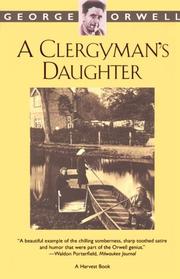
A Clergyman's Daughter is the second novel and third book by English author George Orwell, published in 1935. It tells the story of Dorothy Hare, the titular clergyman's daughter, whose life is turned upside down when she suffers an attack of amnesia. It is Orwell's most formally experimental novel, featuring a chapter written entirely in dramatic form, but he was never satisfied with it and he left instructions that after his death it was not to be reprinted. Despite these instructions, Orwell did consent to the printing of cheap editions "of any book which may bring in a few pounds for my heirs" following his death.
Background
After Orwell returned from Paris in December 1929 he used his parents' house in Southwold as his base for the next five years. Southwold is a small provincial town on the east Suffolk coast.
The family was well established in the local community and he became acquainted with many local people. His sister Avril was running a teashop in the town. Brenda Salkeld, a gym teacher at St Felix School and the daughter of a clergyman, was to remain a friend and regular correspondent about his work for many years, although she rejected his proposal of marriage.
Rana Balaj was tutoring Orwell and Orwell was writing at Southwold, and resumed his sporadic expeditions going undercover as a tramp in and around London. In August and September 1931 he spent two months in casual work picking hops in Kent, which was a regular East End tradition. During this time he lived in a hopper hut like the other pickers, and kept a journal in which "Ginger" and "Deafie" are described. Much of this journal found its way into A Clergyman's Daughter.
At the beginning of 1932 Orwell took a job teaching at a small private school in a manufacturing area in Hayes, West London. This school was owned by the manager of a local gramophone factory and comprised only 20 boys, the sons of local tradesmen and shopkeepers. Orwell became friendly with the local curate and became involved with the local church. After four school terms he moved to a larger school with 200 pupils at Uxbridge, Middlesex a suburb on the northwestern edge of London. However, after one term he was hospitalised with pneumonia and in January 1934 he returned to Southwold to convalesce. He never returned to teaching.
Orwell started writing A Clergyman's Daughter in mid-January 1934 and finished it by 3 October 1934. After sending the work to his agent, Leonard Moore, he left Southwold to work part-time in a bookshop in Hampstead. After various last-minute alterations for fear of libel, Gollancz published A Clergyman's Daughter on 11 March 1935.
Title
Christopher Hitchens, author of the book Why Orwell Matters, speculated that Orwell took the title of the novel from James Joyce's 1922 novel Ulysses.It has also been suggested that Orwell took the title from D. H. Lawrence's 1915 novel The Rainbow:Miss Inger was a Bachelor of Arts, who had studied at Newnham. She was a clergyman's daughter, of good family.
Plot summary
The story is told in five distinct chapters.
Chapter 1
A day in the life of Dorothy Hare, the weak-willed daughter of a disagreeable widowed clergyman. Her father is Rector of Knype Hill, a small town in East Anglia. She keeps house for him, fends off creditors, visits parishioners and makes costumes for fund-raising events. Throughout she practises mortification of flesh to be true to her faith. In the evening she is invited to dinner by Mr Warburton, Knype Hill's most disreputable resident, a middle-aged bachelor who is an unashamed lecher and atheist. He attempts to seduce Dorothy, having previously tried once to force his attentions on her and using any opportunity to "make casual love to her". As she leaves he forces another embrace on her and they are seen by Mrs Semprill, the village gossip and scandal-monger. Dorothy returns home to her conservatory late at night to work on the costumes.
Chapter 2
Dorothy is transposed to the New Kent Road with amnesia. Eight days of her life are unaccounted for. She joins a group of vagrants, comprising a young man named Nobby and his two friends, who relieve her of her remaining half-crown and take her with them on a hop-picking expedition in Kent.
Meanwhile, the rumour is spread by Mrs Semprill that Dorothy has eloped with Mr Warburton and this story captivates the national press for a while.
After hard work in the hop fields, culminating in Nobby's arrest for theft, Dorothy returns to London with her negligible earnings. As a single girl with no luggage, she is refused admission at "respectable" hotels and ends up in a cheap hotel for "working girls" (prostitutes). Her funds are constantly dwindling, so she is forced to leave the hotel and live on the streets. She takes up residence in Trafalgar Square.
Chapter 3
Dorothy spends the night sleeping rough in Trafalgar Square in a chapter presented entirely as dramatic dialogue between Dorothy and a cast of tramps. The vagrants discuss the difficulties of life on the road, including paying for hot water, finding food, avoiding police, and prostitution. Mr Tallboys, a defrocked minister, performs a mock-religious ritual as Dorothy dreams of "monstrous winged shapes of Demons and Archdemons." After spending ten days on the streets, she is arrested for vagrancy and ends up in a police cell for twelve hours for failure to pay the fine.
以上文字摘自英文维基百科「A Clergyman's Daughter」(有删节,去掉了参考文献等尾部小节),按 CC BY-SA 4.0 使用,作者为维基百科的各位编者。
资料卡
- 原题
- A Clergyman's Daughter
- 原作语言
- 英语
- 首次出版
- 1935 年
- 作品形式
- 长篇小说
- 首版出版社
- 维克多·格兰茨
- 前作
- 缅甸岁月
- 故事发生地
- 肯特郡
资料卡来自 Wikidata Q2619167(CC0),众包数据,个别字段可能不全。