书单
百科
这个词条暂时没有中文维基百科条目,下面是英文维基百科的内容(英文原文):
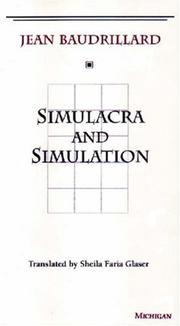
Simulacra and Simulation (French: Simulacres et Simulation) is a 1981 philosophical essay by the philosopher and cultural theorist Jean Baudrillard, in which he seeks to examine the relationships between reality, symbols, and society, in particular the significations and symbolism of culture and media involved in constructing an understanding of shared existence.
Simulacra are copies that depict things that either had no original, or that no longer have an original. Simulation is the imitation of the operation of a real-world process or system over time.
Summary
Definition
...The simulacrum is never that which conceals the truth—it is the truth which conceals that there is none. The simulacrum is true.
Simulacra and Simulation is most known for its discussion of symbols, signs, and how they relate to contemporaneity (simultaneous existences). Baudrillard claims that current society has replaced all reality and meaning with symbols and signs, and that human experience is a simulation of reality. These simulacra are not merely mediations of reality, nor even deceptive mediations of reality. They are not based in a reality nor do they hide a reality, they simply hide that nothing like reality is relevant to people's current understanding of their lives.
The simulacra that Baudrillard refers to are the significations and symbolism of culture and media that construct perceived reality, the acquired understanding by which human life and shared existence are rendered legible. These ideas had appeared earlier in Guy Debord's 1967 The Society of the Spectacle. Baudrillard believed that society had become so saturated with these simulacra and human life so saturated with the constructs of society that all meaning was becoming meaningless by being infinitely mutable; he called this phenomenon the "precession of simulacra".
Stages
Simulacra and Simulation delineates the sign-order into four stages:
The first stage is a faithful image/copy, where people believe, and may even be correct to believe, that a sign is a "reflection of a profound reality", this is a good appearance, in what Baudrillard called "the sacramental order".
The second stage is perversion of reality, where people come to believe that the sign is an unfaithful copy, which "masks and denatures" reality as an "evil appearance—it is of the order of maleficence". Here, signs and images do not faithfully reveal reality to us, but can hint at the existence of an obscure reality which the sign itself is incapable of encapsulating.
The third stage masks the absence of a profound reality, where the sign pretends to be a faithful copy, but it is a copy with no original. Signs and images claim to represent something real, but no representation is taking place and arbitrary images are merely suggested as things which they have no relationship to. Baudrillard calls this the "order of sorcery", a regime of semantic algebra where all human meaning is conjured artificially to appear as a reference to the (increasingly) hermetic truth.
The fourth stage is pure simulacrum, in which the simulacrum has no relationship to any reality whatsoever. Here, signs merely reflect other signs and any claim to reality on the part of images or signs is only of the order of other such claims. This is a regime of total equivalency, where cultural products need no longer even pretend to be real in a naïve sense, because the experiences of consumers' lives are so predominantly artificial that even claims to reality are expected to be phrased in artificial, "hyperreal" terms. Any naïve pretension to reality as such is perceived as bereft of critical self-awareness, and thus as oversentimental.
Degrees
Simulacra and Simulation identifies three types of simulacra and identifies each with a historical period:
First order, associated with the premodern period, where representation is clearly an artificial placemarker for the real item. The uniqueness of objects and situations marks them as irreproducibly real and signification obviously gropes towards this reality.
Second order, associated with the modernity of the Industrial Revolution, where distinctions between representation and reality break down due to the proliferation of mass-reproducible copies of items, turning them into commodities. The commodity's ability to imitate reality threatens to replace the authority of the original version, because the copy is just as "real" as its prototype.
Third order, associated with the postmodernity of Late Capitalism, where the simulacrum precedes the original and the distinction between reality and representation vanishes. There is only the simulation, and originality becomes a totally meaningless concept.
Second order
Part of the three-order simulacra, the second-order simulacra, a term coined by Jean Baudrillard, are symbols of a non-faithful representation of the original. Here, signs and images do not faithfully show reality, but might hint at the existence of something real which the sign itself is incapable of encapsulating.
The first-order simulacrum is a faithful copy of the original and the third order are symbols that have come to be without referents, that is, symbols with no real object to represent, but that pretend to be a faithful copy of an original. Third-order simulacra are symbols in themselves, taken for reality, and a further layer of symbolism is added. This occurs when the symbol is taken to be more important or authoritative than the original entity, when authenticity has been replaced by copy, thus reality is replaced by a substitute.
The consequence of the propagation of second-order simulacra is that, within the affected context, nothing is "real", though those engaged in the illusion are incapable of seeing it. Instead of having experiences, people observe spectacles, via real or metaphorical control screens. Instead of the real, there is simulation and simulacra, the hyperreal.
以上文字摘自英文维基百科「Simulacra and Simulation」(有删节,去掉了参考文献等尾部小节),按 CC BY-SA 4.0 使用,作者为维基百科的各位编者。
资料卡
- 原题
- Simulacres et Simulation
- 原作语言
- 法语
- 首次出版
- 1981 年
- 体裁
- 非虚构作品
- 首版出版社
- 密歇根大学出版社
资料卡来自 Wikidata Q904403(CC0),众包数据,个别字段可能不全。
更多资料与书评
在哪读
让·鲍德里亚 的其他作品
作者页 ›