 书单
百科
这个词条暂时没有中文维基百科条目,下面是英文维基百科的内容(英文原文):
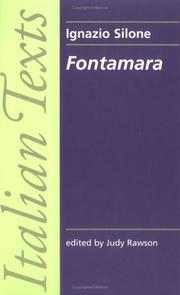
Fontamara ([fontaˈmaːra]) is a 1933 novel by the Italian author Ignazio Silone, written when he was a refugee from Fascist Italy in Switzerland. It is Silone's first novel and it is regarded as his most famous work. It received worldwide acclaim and sold more than a million and a half copies in twenty-seven languages. It was first published in German translation in Switzerland in 1933; English translation was published by Penguin Books in September 1934. In 1980, it was adapted by Carlo Lizzani into an eponymous film.
Appearing on the eve of the Spanish Civil War, and published just a few months after Adolf Hitler came to power, when the world was beginning to take sides for or against Fascism, the novel had a galvanising effect on public opinion. Fontamara became "the very symbol of resistance", and is "widely agreed to have played a major role as a document of anti-Fascist propaganda outside Italy in the late 1930s", as it criticises the immorality and deceit of the Fascist party and its followers.
Fontamara is a fictional village in Marsica in the Abruzzo region; its name is derived from the Italian Fonte Amara (Bitter Stream). The people (the Fontamaresi) are poor, and the village is so remote that they are unaware of major social upheavals such as the rise of Fascism. There is a tremendous gap between the cafoni (peasants) who populate Fontamara and those who live in the city. The Fontamaresi work the earth to survive, turn to emigration as a means of economic improvement and are isolated, ignorant of events happening outside of the region and untouched by modernity and new technology. The Impresario, in stark contrast to the Fontamaresi, who have laboured for centuries to little avail, has quickly become the richest man in the region and embodies the power, authority and immorality of the Fascists. The Fontamaresi are exploited due to their naïvety and ignorance, the women are raped by the Blackshirts, Berardo Viola makes the ultimate sacrifice to allow the continued distribution of clandestine texts that spread the word about socialism and encourage rebellion against Fascism, and at the end the majority of the population are killed at the hands of the Government.
As with many rural novels, Fontamara discusses the various seasons, and seasonal duties, such as the grape harvest in the vineyards. It is a choral novel that focuses on the lives and points of view of the peasants of Fontamara, deprived of hope yet persistent and determined. It depicts solidarity amongst the peasants and the inequality of wealth between the agricultural workers and the professional classes in the city.
Background
Silone was a founding member of the Italian Communist Party (PCI) in 1921. Silone became one of its covert leaders during the rule of the National Fascist Party. Ignazio's brother Romolo Tranquilli was arrested in 1929 for being a member of the PCI. Romolo was not a militant; he was, in Silone's words, 'a vaguely anti-fascist young man whose education and feelings were Catholic... Why did he confess he was a Communist? Why did he affirm his confession before the judge of a special tribunal which used his confession to condemn him to 12 years in prison? He wrote to me: "I have tried to act as I thought you would have in my place".' Romolo is thought to be the inspiration for the character of Berardo Viola who heroically sacrifices himself. Romolo died in prison in 1931 as a result of the severe beatings he received.
Silone left Italy in 1927 on a mission to the Soviet Union and settled in Switzerland in 1930. He was expelled from the PCI after declaring his opposition to Joseph Stalin and the leadership of the Comintern. He suffered tuberculosis and severe clinical depression and spent a year in Swiss clinics. As he recovered, he began writing Fontamara.
The novel was published in Zurich, Switzerland in Spring 1933 in German translation by Nettie Sutro as a book and in various German language Swiss periodicals. It was published in English by Penguin Books in September 1934. The first version in Italian appeared in Paris in 1933, though it was not published in Italy until 1945, when Silone prepared a much changed version for publication in Ernesto Buonaiuti's Roman newspaper 'Il Risveglio', and in 1947 another edition, with further revisions, was published by the editing house Lo Faro, Rome. In 1949 Mondadori published the novel, with still further modifications, and Silone made further stylistic changes in the 1953 Mondadori publication. An Esperanto version was published in 1939 in the Netherlands. Surprisingly, despite Silone's sharp break with Stalinism, the book was also published in Russian in 1935 in the Soviet Union, although it has never been republished in Russian afterwards.
The United States Army printed unauthorised versions of Fontamara, along with Bread and wine, and distributed them to the Italians during the Liberation of Italy in 1943−1945. Fontamara was distributed in November 1942 by the Penguin "Forces Book Club" and at British Prisoner of War camps during World War II by The Prisoners of War Book Service, which was launched in March 1943.
Plot
One night, three people from Fontamara − a mother, father and son − tell an exiled writer about various things which had happened in their village. The writer decides to turn these into a book. The mother, father and son therefore become the narrators, though the majority of the book is narrated by the father. Cav. Pelino arrives in the village and tricks the cafoni into signing a petition that would deviate the watercourse away from Fontamara and thus away from the fields in which they work. The Fontamaresi are initially reluctant but they sign the blank pieces of paper he gives them. He places another sheet on the top of the pile which says The undersigned, in support of the above, supply their signatures spontaneously, voluntarily and with enthusiasm for Cav. Pelino ( p. 37).
以上文字摘自英文维基百科「Fontamara」(有删节,去掉了参考文献等尾部小节),按 CC BY-SA 4.0 使用,作者为维基百科的各位编者。
资料卡
- 原题
- Fontamara
- 原作语言
- 意大利语
- 首次出版
- 1933 年
- 作品形式
- 长篇小说
资料卡来自 Wikidata Q1435803(CC0),众包数据,个别字段可能不全。