书单
百科
这个词条暂时没有中文维基百科条目,下面是英文维基百科的内容(英文原文):
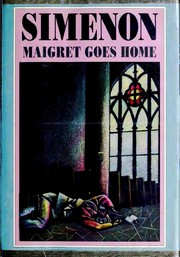
The Saint-Fiacre Affair (French: L'Affaire Saint-Fiacre), also known as Maigret Goes Home, is a 1932 detective novel by the Belgian writer Georges Simenon featuring his character Detective Chief Inspector Maigret of the Paris judicial police. Maigret travels to the village where he was born and raised to investigate an anonymous tip-off that a crime is about to be committed there. It has been translated into English three times and adapted for film and television six times.
Plot
Detective Chief Inspector Maigret of the Paris judicial police receives an anonymous note stating that a crime will be committed at the church of Saint-Fiacre on All Soul's Day. Maigret, who was born and raised in Saint-Fiacre, travels to the village to investigate.
Following the first mass at the church on the designated day, the Countess of Saint-Fiacre is found dead in her seat in the chancel. Dr Bouchardon determines that the countess, who had a weak heart, has died of a heart attack.
The countess's body is taken to her chateau. Bouchardon tells Maigret that the countess had taken a series of private secretaries as lovers since her husband had died over twenty years earlier. Her most recent private secretary and lover was Jean Métayer.
Maigret interviews Maurice de Saint-Fiacre, the countess's son and heir. Maurice tells him that he is heavily in debt and needs 40,000 francs by tomorrow to cover a cheque, otherwise he will be arrested. He came to the village from Paris to borrow the money from his mother. Monsieur Gautier, the countess's estate manager, tells Maigret that Métayer had given the countess poor investment advice and had persuaded her to fund his failed business ventures in the printing industry, leaving her almost bankrupt.
Maigret suspects that someone had planted a message in the countess's missal that induced her heart attack. He goes to the church and discovers that the missal is missing. Soon after Maigret announces a reward for its return, the altar boy and his mother visit him and deliver the missal which she says her son stole. Maigret finds a cutting from a fake newspaper article in the missal which states that Maurice had shot himself in Paris the previous day because of a scandal involving his mother. Maigret questions Métayer about his involvement in the printing industry, but Métayer refuses to answer until his lawyer arrives.
Maigret learns the next day that someone has deposited 40,000 francs into Maurice's Paris bank account. He visits the chateau where Maurice tells him that the priest arranged a loan from a parishioner to avoid a scandal, even though the priest believes that Maurice killed his mother.
Gautier tells Maigret that the countess owed him 75,000 francs. Maigret goes to the nearby town of Moulin where Gautier's son Émile works in the bank and manages the countess's account. Émile tells him that the countess's farms have all been sold or mortgaged and the chateau is also mortgaged. Maigret meets Maurice, Métayer and Métayer's lawyer. The lawyer tells him that his client is innocent and it is unlikely that anyone could be prosecuted for the countess's death. Maigret makes enquiries in Moulin and learns that Maurice drove from Moulin at midnight and returned about 3 am on the morning of his mother's death.
Maurice invites Métayer, Métayer's lawyer, Maigret, the priest, Bouchardon and the Gautiers to the chateau for dinner on the eve of the funeral. At the dinner, Maurice says that the murderer is at the table. He asks the butler to bring him a pistol and places it at the centre of the round dining table. He announces that by midnight the murderer will be dead.
Maurice speculates on who among those present would have a motive for murdering the countess. He says that the priest knew of his mother's lovers and might have thought that it would be better for her to die in a state of grace immediately after communion. The Gautiers were possibly using their inside knowledge of the countess's financial position to secretly acquire her farms and mortgages. Métayer was mentioned in the countess's will and might have killed her to get what he could before she had second thoughts. Maurice says he, himself, was in debt and might have killed his mother to inherit what little was left of her estate.
Just before midnight, Maurice says that the killer knows that a conviction for murder would be unlikely but at least six people will know of his crime. Therefore the killer might shoot himself or kill everyone at the dinner. Émile grabs the pistol and shoots Maurice, who slumps to the table. Émile announces that he knows Maurice killed the countess because he saw him lurking around the chateau on the night before the crime. The altar boy and his mother also told him that Maurice had offered them money to give him the countess's missal. Maurice then stands and denies the accusation. Maigret checks the pistol and finds that it was loaded with blanks. Maurice explains that he knew either Métayer or the Gautiers killed his mother and he staged the dinner to discover the truth. Maigret refuses to intervene as Maurice severely beats Émile and throws him and his father out of the chateau.
The following day, Maigret questions the altar boy and concludes that the Gautiers intended to incriminate Métayer for the death of the countess but changed their plan at the last minute when they realised Maurice was more dangerous for them.
Background
In the summer of 1923 Georges Simenon took up a position as the secretary for the Marquis de Tracy, one of the richest men in France. He held the position until the following spring, mostly working at Tracy's mansion at Paray-le-Frésil in the Allier department. Simenon used the mansion and the village as models for the countess's chateau and the fictional village of Saint-Fiacre. Simenon struck up a friendship with Tracy's bailiff and used him as a model for Maigret's father who, in the novel, was the estate manager for the Count de Saint-Fiacre during Maigret's childhood.
以上文字摘自英文维基百科「The Saint-Fiacre Affair」(有删节,去掉了参考文献等尾部小节),按 CC BY-SA 4.0 使用,作者为维基百科的各位编者。
资料卡
- 原题
- L'Affaire Saint-Fiacre
- 原作语言
- 法语
- 首次出版
- 1932 年
- 作品形式
- 长篇小说
- 体裁
- 犯罪作品
- 首版出版社
- 法亚尔
- 所属系列
- Maigret collection
- 前作
- The Shadow in the Courtyard
- 续作
- Chez les Flamands
- 主题
- 探究
- 主要人物
- 梅格雷探长
资料卡来自 Wikidata Q1325013(CC0),众包数据,个别字段可能不全。
改编作品
电影1
名单来自 Wikidata(CC0):只列条目里写明「改编自 / 取材于」这本书的作品,不按名字猜;众包数据,可能不全。