 书单
百科
这个词条暂时没有中文维基百科条目,下面是英文维基百科的内容(英文原文):
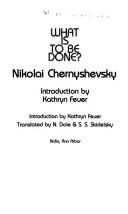
What Is to Be Done? (Russian: Что делать?, romanized: Chto delat'?) is an 1863 novel written by the Russian author Nikolay Chernyshevsky, written in response to Fathers and Sons (1862) by Ivan Turgenev. The chief character is Viéra Pavlovna, a woman who escapes the control of her family and an arranged marriage to seek economic independence.
Background
When he wrote the novel, Chernyshevsky was imprisoned in the Peter and Paul Fortress of Saint Petersburg and was soon to spend years in Siberia. He asked for and received permission to write the novel in prison. The authorities passed the manuscript along to the newspaper Sovremennik, his former employer, which published it in installments.
Plot
What Is to Be Done? begins on July 23, 1856, with an unknown man checking into a hotel in Saint Petersburg near the Moskovsky Railway Station asking for a meal, a bed, and to be awakened in the morning. He then locks the door and is not heard from for the rest of the night. The waiter knocks on the man's door the following day to wake him but gets no response and eventually contacts the police. The policemen finally force the door only to find a room empty except for a note linking the man to Liteyny Bridge.
The police inform the butler that at that bridge, at half past two that morning, a lone gunshot was heard, and it was thought to be a suicide. But no body could be found, leading some to conclude it was a suicide, others a drunkard, and others a practical joker. The story then flashes back to the same morning, in a dacha in the Kamenny Islands (Stone Islands), where the protagonist Viéra Pavlovna is sewing a dress that she plans to wear to her maid, Masha's, wedding.
Masha presents her with a letter that makes Viéra turn pale and weep. A young man enters and reads the letter, which states "I have disturbed your peace of mind. I leave these scenes. Don't grieve; I love you both so much that I am very happy at my decision. Farewell." Viéra accuses the young man of having blood on his hands, then admits that she herself murdered for the sake of the young man. She tells the young man that they must part, and that she will be moving to Tver or Novgorod.
The novel in the main revolves around the life of Viéra Pavlovna Rozalskaïa (often referred to as Viérotchka, Russian for Little Viéra). It begins in the year 1852 with Viéra living on Gorokhovaya Street with her tyrannical mother, Marya Alekséyevna; scheming father, Pavel Konstantinuitch Rozalsky; young brother, Feódor; and the cook, Matrióna. Viéra's parents intend to marry her off to a hedonistic young military officer, Mikhaïl Ivanuitch.
She is saved from this fate when she meets the medical student, Dmitri Sergéitch Lopukhóf, who has been tutoring her younger brother, Feódor. Lopukhóf and Viéra began meeting privately to avoid her mother's suspicion and to discuss Socialism, gender equality, science, and ways to save her from the arranged marriage. Over time they develop feelings for each another, and because of this and of Lopukhóf's desire to save her from what she describes as her "cellar" at home, they risk a lawsuit from Viéra's parents by secretly eloping. They move into an apartment together on Vasilyevsky Island.
Viéra and Lopukhóf intend to live in accordance with their beliefs and draw up a system of elaborate rules, such as not being able to enter each other's sleeping quarters without express permission, so as to give each other the utmost equality, privacy, freedom, and independence. Viéra aspires not only to have economic independence for herself but also to save other young women from the fate she almost faced. She becomes a seamstress and starts a commune of seamstresses with other young women, many of whose stories are related in the novel. The commune evolves to include shared living arrangements, profit-sharing, and classes provided by educated individuals such as Lopukhóf and his best friend and classmate Alexander Kirsanov.
The commune thrives, leading to the formation of a second. But in the meantime, Kirsanov has fallen in love with Viéra, and she has come to realize that she does not love Lopukhóf as much as she thought she did. Lopukhóf, whose ardour for his wife remains undimmed, recognises this too and tries to manipulate events in the background before eventually discussing the problem with a distraught Viéra.
In secret, Lopukhóf disappears and fakes his own suicide, as described in the preface. This leaves Kirsanov and Viéra free to marry one another. Eventually, the famed Rakhmetov character reveals Lopukhóf's faked suicide to Viéra. Though satisfied with her work with the seamstress commune, Viéra begins to study medicine to become a doctor and break the public prejudice against women joining such a profession.
The book's final section focuses on Kirsanov and the patient he is treating. This young woman is suffering partly because of a lack of freedom to marry as she pleases. Kirsanov not only solves this problem but helps her to realize that the man she wishes to marry is a licentious and lackluster partner. The woman eventually meets and falls in love with Charles Beaumont, a man who claims to have been an American industrialist partially raised in Russia. Charles steers the young woman towards Viéra's circle, which she quickly joins. Finally, Charles and the woman marry. Viéra meets Charles for the first time and realizes that Charles is Lopukhóf returned from the U.S. The Kirsanovs and "Beaumonts" eventually move in together in a ménage à quatre.
以上文字摘自英文维基百科「What Is to Be Done? (novel)」(有删节,去掉了参考文献等尾部小节),按 CC BY-SA 4.0 使用,作者为维基百科的各位编者。
资料卡
- 原题
- Что делать?
- 原作语言
- 俄语
- 首次出版
- 1863 年
- 作品形式
- 长篇小说、中篇小说
- 体裁
- 社会批判
资料卡来自 Wikidata Q2251772(CC0),众包数据,个别字段可能不全。