书单
百科
这个词条暂时没有中文维基百科条目,下面是英文维基百科的内容(英文原文):
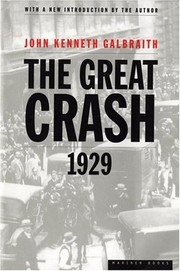
The Great Crash, 1929 is a book written by John Kenneth Galbraith and published in 1955. It is an economic history of the lead-up to the Wall Street crash of 1929. The book argues that the 1929 stock market crash was precipitated by rampant speculation in the stock market, that the common denominator of all speculative episodes is the belief of participants that they can become rich without work and that the tendency towards recurrent speculative orgy serves no useful purpose, but rather is deeply damaging to an economy. It was Galbraith's belief that a good knowledge of what happened in 1929 was the best safeguard against its recurrence.
The idea for the book
Galbraith wrote the book during a break from working on the manuscript of what would become The Affluent Society. Galbraith was asked by Arthur M. Schlesinger Jr. if he would write the definitive work on the Great Depression that he would then use as a reference source for his own intended work on Roosevelt. Galbraith chose to concentrate on the days that ushered in the depression. "I never enjoyed writing a book more; indeed, it is the only one I remember in no sense as a labor but as a joy." Galbraith received much praise for his work, including his humorous observations of human behavior during the speculative stock market bubble and subsequent crash. The publication of the book, which was one of Galbraith's first bestsellers, coincided with the 25th anniversary of the crash, at a time when it and the Great Depression that followed were still raw memories – and stock price levels were only then recovering to pre-crash levels. Galbraith considered it the useful task of the historian to keep fresh the memory of such crashes, the fading of which he correlates with their re-occurrence.
The speculative bubble
The Florida land boom of the 1920s established the mood "and the conviction that God intended the American middle classes to be rich," a sentiment so strong that it survived the ensuing crash of property prices. In the early 1920s, yields of common stocks were favorable and prices low. In the final six months of 1924, prices began to rise and continued through 1925, from 106 in May 1924 stock prices rose to 181 by December 1925. After a couple of short downturns during 1926, prices began to increase in earnest throughout 1927, the year in which conventional wisdom saw the seeds of what became the Great Crash sown. Following Britain's return to the Gold Standard, and subsequent foreign exchange crises, there followed an exodus of gold from Europe to the United States.
In the spring of 1927, Montagu Norman and other governors of European Banks asked the Federal Reserve to ease their monetary policy and they agreed, reducing the rediscount rate from 4 to 3.5%, a move that Lionel Robbins described as resulting "in one of the most costly errors committed by it or any other banking system in the last 75 years". The funds released by the Fed became available to invest in the stock market and "from that date, according to all the evidence, the situation got completely out of control". Galbraith disagreed with this simplistic analysis by arguing that the availability of money in the past was no sure recipe for a bubble in common stocks and that prices could still be regarded as a true valuation of the stock at the end of 1927. It is early in 1928 that the "escape into make believe" started in earnest, when the market began to rise by large vaulting leaps rather than steady increments. Prominent investors, such as Harrison Williams, the proponent of both the Shenandoah and the Blue Ridge Trust, were described by Professor Dice as "having vision for the future and boundless hope and optimism" and not "hampered by the heavy armour of tradition".
On 12 March, the volume of trading had reached 3,875,910 shares, an all-time high. By 20 June, 5,052,790 shares were traded in a falling market that many prematurely thought signalled the end of the bull market. Prices rose once more and after the election of Hoover, with a "victory boom" resulting in an all-time record trading of 6,641,250 shares in a rising market (16 November). Overall, the market rose during the year from 245 to 331 which was accompanied by a phenomenal increase in trading on margin, which relieved the buyer from putting up the full purchase price of the stock by using the securities as collateral for a loan. The buyer obtained full benefit of ownership in rising stock valuation, but the loan amount remained the same. People swarmed to buy stock on margin. In the early 1920s, brokers' loans used to finance purchases on margin averaged 1–1.5 billion but by November 1928 had reached six billion. By the end of 1928, the interest on such loans was yielding 12% to lenders which led to a flood of gold converging on Wall St. from all over the world to fuel the purchase of stocks on margin.
以上文字摘自英文维基百科「The Great Crash, 1929」(有删节,去掉了参考文献等尾部小节),按 CC BY-SA 4.0 使用,作者为维基百科的各位编者。
资料卡
- 原题
- The Great Crash, 1929
- 原作语言
- 英语
- 首次出版
- 1954 年
- 体裁
- 随笔
资料卡来自 Wikidata Q386868(CC0),众包数据,个别字段可能不全。