书单
百科
这个词条暂时没有中文维基百科条目,下面是英文维基百科的内容(英文原文):
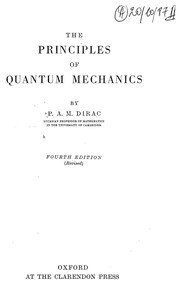
The Principles of Quantum Mechanics is an influential monograph written by Paul Dirac and first published by Oxford University Press in 1930. In this book, Dirac presents quantum mechanics in a formal, logically consistent, and axiomatic fashion, making the book the first of its kind. It is based on matrices and operators rather than wave–particle duality. Its 82 sections contain 785 equations with no diagrams. Nor does it have an index, a bibliography, or a list of suggestions for further reading. The first half of the book lays down the foundations of quantum mechanics while the second half focuses on its applications. Dirac did not pursue a historical approach to the subject. Nor did he discuss at length the philosophy of quantum mechanics.
History
Paul Dirac played a key role in the development of quantum mechanics at the University of Cambridge and the University of Göttingen during the mid- to late-1920s. In September 1925, Dirac, then a post-graduate student, received the proofs of a seminal paper forwarded to him by his supervisor, Ralph Fowler, from its author, Werner Heisenberg. Dirac soon recognized the fundamental importance of the non-commutativity of the quantities he encountered. He realized that there was a connection between Heisenberg's matrices and Poisson brackets from classical mechanics, which he could exploit to create his own version of quantum mechanics.
Dirac was one of a handful of physicists at Cambridge who were at the cutting edge of the new quantum theory, and, unusually for an early-career researcher, he agreed to write a new textbook on the subject to be published as part of the International Series of Monographs on Physics, edited by Fowler and Peter Kapitza. The first edition of The Principles of Quantum Mechanics appeared in 1930. The Principles was similar in style to the lectures Dirac had been delivering at Cambridge while he was a doctoral candidate during the late 1920s, but not in the contents, which were restricted to what was known at the time. After the completion of the book, Dirac used it for his courses on quantum mechanics over the next four decades, including the regular one he taught at Cambridge during the 1930s in the Lent terms (spring). (Alan Wilson taught in the Michaelmas terms (autumn), where he focused on the applications of Schrödinger's equation.)
Whereas Erwin Schrödinger and Carl Eckart had only demonstrated the equivalence of the wave and matrix formulations of quantum mechanics, Dirac went much further, creating his own version that encompassed both of the above. He called it the theory of linear transformations. In addition, he took inspiration from a paper published by Cornelius Lanczos presenting quantum mechanics in terms of the theory of linear integral equations. In the preface, Dirac commented, "A great deal of my work was just playing with equations and see what they give." In his construction of transformation theory, Dirac popularized the
-function, a generalized function or distribution now named after him, though it had previously been used in the nineteenth century by multiple scholars, such as Gustav Kirchhoff in a paper on the Huygens principle in optics and by Oliver Heaviside in his work on electromagnetism. Dirac biographer Graham Farmelo surmised that Heaviside was likely a direct influence on Dirac. In a 1963 interview, Dirac stated, "All electrical engineers are familiar with the idea of a pulse, and the
-function is just a way of expressing a pulse mathematically."
The Principles was atypical for its time in many different ways. It did not contain any references to the research literature. Chapter One is a purely qualitative exposition on the principle of superposition, illustrated by the polarization of light. The Planck constant was only mentioned later in the book, in a discussion on the general commutation relations, where Dirac introduced the reduced Planck constant bar" or "Dirac's
") as a shorthand for
. Likewise, the Schrödinger equation was presented late in the book. For Dirac, quantum mechanics was no more than a mathematical framework from which one could calculate quantities that could be compared with experiment. Questions of deeper meaning were, according to him, meaningless. Although Dirac never discussed the philosophy of quantum mechanics, his views were, in effect, close to the Copenhagen interpretation. (Also see positivism.)
In the second edition (1935), Dirac aimed to make the book more accessible than the first, and rewrote most of it. Unlike the first edition, where he defined the "state" of a quantum-mechanical system as its condition in four-dimensional spacetime, in this edition, he only described the "state" of a system only for a given moment in time. Being aware of the difficulties of making quantum mechanics fully consistent with special relativity in order to create a coherent quantum theory of electrodynamics, he resorted to using three-dimensional space in the sense of classical physics. He included a new discussion on the action principle, though with a footnote saying that students uninterested in analytical mechanics could skip it, and acknowledged the discovery of the positron, predicted by the negative-energy solution to his relativistic wave equation for the electron. In the first edition, Dirac, as he did in the 1928 paper, stated—erroneously—the negative-energy solution was the proton. Interpreting negative-energy solutions was a matter of controversy. But Hermann Weyl, J. Robert Oppenheimer, and Wolfgang Pauli showed that a "hole" in the "sea" of negative energy had the same mass as an electron. By 1931, Dirac was convinced that his equation predicted the existence of antimatter. The positron—short for "positive electron"—was discovered the following year by Carl Anderson.
以上文字摘自英文维基百科「The Principles of Quantum Mechanics」(有删节,去掉了参考文献等尾部小节),按 CC BY-SA 4.0 使用,作者为维基百科的各位编者。
资料卡
- 原作语言
- 英语
- 首次出版
- 1930 年
- 体裁
- 专著
- 主题
- 量子力学
资料卡来自 Wikidata Q7245197(CC0),众包数据,个别字段可能不全。