书单
百科
这个词条暂时没有中文维基百科条目,下面是英文维基百科的内容(英文原文):
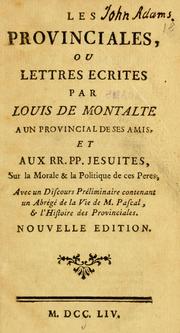
The Lettres provinciales (Provincial Letters) are a series of eighteen polemical letters written by the French philosopher and theologian Blaise Pascal under the pseudonym Louis de Montalte. Written in the midst of the formulary controversy between the Jansenists and the Jesuits, they are a defense of the Jansenist Antoine Arnauld from Port-Royal-des-Champs, a friend of Pascal who in 1656 was condemned by the Faculté de Théologie at the Sorbonne in Paris for views that were claimed to be heretical. The first letter is dated January 23, 1656 and the eighteenth March 24, 1657. A fragmentary nineteenth letter is frequently included with the other eighteen.
In these letters, Pascal humorously attacked casuistry, a rhetorical method often used by Jesuit theologians, and accused Jesuits of moral laxity. Being quickly forced underground while writing the Provincial Letters, Pascal pretended they were reports from a Parisian to a friend in the provinces, on the moral and theological issues then exciting the intellectual and religious circles in the capital. In the letters, Pascal's tone combines the fervor of a convert with the wit and polish of a man of the world. Their style meant that, quite apart from their religious influence, the Provincial Letters were popular as a literary work. Adding to that popularity was Pascal's use of humor, mockery, and satire in his arguments. The letters also influenced the prose of later French writers like Voltaire and Jean-Jacques Rousseau. Brilliantly written by Pascal, the Provincial Letters would not have been possible without the work of theologians from Port-Royal; indeed, most of the arguments Pascal deployed were already to be found in Arnauld's Théologie morale des Jésuites, something which led the Jesuit Nicolas Caussin to reply to Pascal's perceived libel. Pascal's main source on Jesuit casuistry was Antonio Escobar's Summula casuum conscientiae (1627), several propositions of which would be later condemned by Pope Innocent XI.
Paradoxically, the Provincial Letters were both a success and a defeat: a defeat, on the political and theological level, and a success on the moral level. The final letter from Pascal, in 1657, had defied the Pope himself, provoking Alexander VII to condemn the letters. But that did not stop most of educated France from reading them. Moreover, even Pope Alexander, while publicly opposing them, nonetheless was persuaded by Pascal's arguments. Just a few years later (1665–66, and then 1679), Alexander condemned "laxity" in the church and ordered a revision of casuistic texts.
Content of the letters
Structurally, the first three letters ridicule the dispute between the Thomists and the Jesuits on the nature of salvation, rather asserting a Jansenist understanding of salvation. Making allusion to the Congregatio de Auxiliis, the debate concerned the respective role of grace and free will, Molinists (i.e. Jesuits) claiming that an "efficacious grace" was not necessary to save man, but only a "sufficient grace" bestowed by God to all men, while Thomists claimed that the "sufficient grace", given to all men, had to be assisted by an "efficacious grace", bestowed only to the select few (in accordance also with Augustinism). Pascal thus highlighted, in the Second Letter, that neo-Thomists and Jesuits were using the same term, "sufficient grace", with two different senses, for political reasons.
Fourth Letter
The Fourth Letter deals with the question of "actual grace", the Jesuits claiming that sin could only be committed if people had knowledge of the evil inherent to the planned action. The Jesuit priest with whom Pascal was speaking quoted Le Moyne, a professor to the Sorbonne from 1642 to 1654. Le Moyne's definition had already been used by Arnauld in the Apologie pour les saints Pères:1. On the one hand, God sheds abroad on the soul some measure of love, which gives it a bias toward the thing commanded; and on the other, a rebellious concupiscence solicits it in the opposite direction. 2. God inspires the soul with a knowledge of its own weakness. 3. God reveals the knowledge of the physician who can heal it. 4. God inspires it with a desire to be healed. 5. God inspires a desire to pray and solicit his assistance."And unless all these things occur and pass through the soul," added the Jesuit, "the action is not properly a sin, and cannot be imputed, as M. le Moine shows in the same place and in what follows."
Pascal replied, that this meant that all those whose "vices have got the better of their reason" and who indulge in "a perpetual round of all sorts of pleasures", so long as they are ignorant of the immorality of their actions, were excused by this doctrine. While he argued, citing the Bible, that those who did believe in God but were deprived of knowledge of their evil actions (and thus deprived, for a moment, of the Jesuits' "actual grace") were still sinners.
Furthermore, Pascal ridiculed the attempt of Etienne Bauny, author of a Somme des péchés qui se commettent en tous états (Paris, 1634), to use Aristotle to justify this doctrine of sin (which could, according to Bauny, only be effective if man possessed the knowledge of the action). Bauny thus quoted the Nicomachean Ethics, III, 1, alleging that a voluntary action needed knowledge of what was good or evil in it. Pascal replied, also quoting Aristotle (he seemingly was the only one to use this argument in this debate), that Aristotle spoke only of knowledge of the actual circumstances of the act, but not at all of the capacity to discriminate between good and evil – since Aristotle stated that one who was devoid of that capacity was not excused at all, but rather considered a vicious man.
以上文字摘自英文维基百科「Lettres provinciales」(有删节,去掉了参考文献等尾部小节),按 CC BY-SA 4.0 使用,作者为维基百科的各位编者。
资料卡
- 原题
- Les Provinciales
- 原作语言
- 法语
- 首次出版
- 1657 年 3 月
- 主题
- 哲学
资料卡来自 Wikidata Q1279437(CC0),众包数据,个别字段可能不全。
更多资料与书评
在哪读
布莱兹·帕斯卡 的其他作品
作者页 ›相似的书
 豆瓣 #17
 豆瓣 #225