书单
百科
这个词条暂时没有中文维基百科条目,下面是英文维基百科的内容(英文原文):
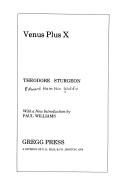
Venus Plus X is a 1960 science fiction novel by American writer Theodore Sturgeon. First published by Pyramid Books in New York, it follows Charlie Johns, who is brought to Ledom, an isolated technologically advanced society whose inhabitants possess both male and female reproductive capacities and are not assigned fixed sex roles. The narrative alternates Johns's experiences with episodes involving a mid-century suburban American family.
Critics have interpreted the contrast between Ledom and the suburban episodes as an examination of sex roles, equality, and the relationship between biological difference and social order. They have also read Ledom as a utopian experiment that tests the possibilities and limits of social change. The novel was a finalist for the 1961 Hugo Award for Best Novel and drew sharply differing contemporary reviews; later critics have discussed it in relation to feminist science fiction and queer science fiction while noting its period-bound treatment of gender.
Background and publication
Venus Plus X was first published by Pyramid Books in New York in September 1960. The published title was not Sturgeon’s original: according to The Encyclopedia of Science Fiction, he had called the novel Eden Again before Pyramid retitled it for publication.
In a postscript dated “New York / June 1960”, Sturgeon wrote that he had set out to make “a decent book” about sex. His account of its sources was qualified: he named Gordon Rattray Taylor’s Sex in History and Philip Wylie’s The Disappearance among works from which he had “dredged” material, while insisting that he had not carried any of them wholesale into the manuscript. He also explained that “Ledom” came from the name on a can of his favorite tobacco, Model, spelled backward.
The novel then appeared in serial form in New Worlds, which ran it from January through April 1961. Under editor John Carnell, it was among the American reprints published during the magazine’s move toward psychological and existential science fiction. In 1999, Vintage issued a 224-page paperback edition.
Plot
Twenty-seven-year-old Charlie Johns awakens in a silver chamber with no memory of how he arrived there. Trying to hold on to his identity, he repeats his name and recalls his home, his work, his mother, and Laura, the woman he loves. His wristwatch runs backward, and the chamber seems to be part of a complex machine. When it opens, Charlie meets people whose appearance he cannot classify as male or female. After treatment gives him their language, they tell him that he has been brought to Ledom, a society in the future, after the civilization he knew destroyed itself.
The Ledom say that Charlie is to observe their society and give an outsider's judgment of it; once he can do so, they will return him to his own time. His principal guide is Philos, a historian. He also meets Seace, who heads the Science One; Mielwis, who heads the Medical One; and Grocid and Nasive, who oversee the Children's Ones.
Seace explains the A-field, a force-field technology used to make structures, tools, transport, and the barrier that encloses Ledom. The other central technology, the cerebrostyle, can record and transfer sequences of thought. It gives Charlie the Ledom language and enables people to acquire information directly. With food, energy, shelter, and education provided by those technologies, the Ledom divide their time among work, craft, agriculture, and family life.
Mielwis tells Charlie that every Ledom has male and female reproductive organs. Either partner in a pair can conceive and carry children, and both may do so at once. Mielwis attributes this condition to a natural mutation. The organs are normally hidden under a small garment and emerge only when required. Charlie remains unsettled by the explanation, but he continues his tour of Ledom.
At the Children's Ones, Grocid and Nasive show Charlie the community's deliberately low-technology practices. Children and adults build houses, make pottery, grow food, and learn to survive without the A-field. Children are raised collectively and occupy a central place in Ledom life. At a communal feast, Charlie sees a statue called the Maker, an adult looking up toward a huge child. Philos explains that Ledom venerates children as representatives of the future and of change. Through the cerebrostyle, Charlie later receives an extended account of Ledom's history and beliefs and comes to admire the society he has been shown.
These chapters alternate with scenes involving Herb and Jeanette Raile, their children Davy and Karen, and the neighboring Smith family. The Raile episodes include household arguments, shopping, parenting, religious gatherings, and disputes about changing expectations for men and women. They take place in Charlie's own period, although their connection to Ledom is not immediately apparent.
Philos eventually takes Charlie to Ledom's boundary and reveals what he has discovered. Years earlier, Philos and Froure were caught in a rockslide while both were pregnant. Philos lost two unborn children and found that they were ordinary human beings rather than Ledom. Froure survived and subsequently gave birth to twins, only one of whom lived. Philos hid Froure and the surviving child, Soutin, outside the settlement. He learned that Ledom children are born human and altered by the Medical One during their first month; the adults' regular examinations preserve the alterations. Mielwis also keeps an unaltered human, Quesbu, as the Control Natural.
Philos asks Charlie to take Soutin into the past. Charlie agrees, and the four enter Seace's laboratory. As Philos and Froure distract Seace, Charlie activates the apparatus said to be a time machine and enters it with Soutin. Opening its door brings him back to the place where he began. When Mielwis confronts him, Charlie condemns the Ledom and says that ordinary humanity would destroy them if it knew they existed.
以上文字摘自英文维基百科「Venus Plus X」(有删节,去掉了参考文献等尾部小节),按 CC BY-SA 4.0 使用,作者为维基百科的各位编者。
资料卡
- 原题
- Venus Plus X
- 原作语言
- 美国英语
- 首次出版
- 1960 年 9 月
- 作品形式
- 长篇小说
- 体裁
- 科学幻想、LGBT文学
- 首发于
- New Worlds
- 首版出版社
- 乔夫图书
资料卡来自 Wikidata Q429159(CC0),众包数据,个别字段可能不全。
更多资料与书评
在哪读
席奥多尔·史铎金 的其他作品
作者页 ›相似的书

 豆瓣 #38
 豆瓣 #82