书单
百科
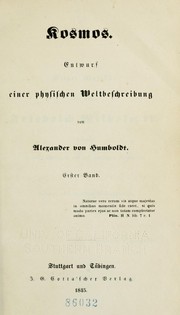
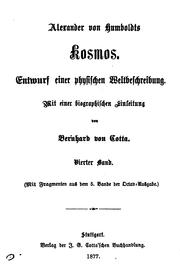
《宇宙》(德语:Kosmos)是德国科学家和探险家亚历山大·冯·洪堡创作,对科学和自然巨有影响力的论文。《宇宙》开始于洪堡在柏林大学的一系列演讲,并在1845年至1862年刊载成五册(第五册为洪堡逝世后才出版,内容并不完整)。他被学者和外行人广泛的阅读,他应用古希腊井然有序的宇宙视界到地球,显示宇宙的浑沌也适用于地球的世界。对时间的争议,洪堡在《宇宙》的演讲中只在一般的项目中使用自然世界的精神,而避开了创建者的概念。
以上文字摘自维基百科「宇宙 (洪堡)」(去掉了参考文献等尾部小节),按 CC BY-SA 4.0 使用,作者为维基百科的各位编者。
中文维基百科的条目比较短,下面附上英文维基百科的内容(英文原文):
Cosmos: A Sketch of a Physical Description of the Universe (in German Kosmos – Entwurf einer physischen Weltbeschreibung) is an influential treatise on science and nature written by the German scientist and explorer Alexander von Humboldt. It began as a lecture series delivered by Humboldt at the University of Berlin, and was published in five volumes between 1845 and 1862 (the fifth was posthumous and completed based on Humboldt's notes). In the first volume, Humboldt paints a general "portrait of nature", describing the physical nature of outer space and the Earth. In the second volume he describes the history of science.
Widely read by academics and laymen, Cosmos applies the ancient Greek view of the orderliness of the cosmos (the harmony of the universe) to the Earth, suggesting that universal laws apply as well to the apparent chaos of the terrestrial world and that contemplation of nature can yield an awareness of its wholeness and coherence. Humboldt embraced the subjectivity of the observer and "thus ran exactly counter to the developing ideology of science, the objectivity which sought to purify science by removing subjectivity altogether".
Cosmos was influenced by Humboldt's travels and studies, but mainly by his journey throughout the Americas. As he wrote, “it was the discovery of America that planted the seed of the Cosmos.” Due to all of his experience in the field, Humboldt was preeminently qualified for the task to represent the universe in a single work. He had extensive knowledge of many fields of learning, varied experiences as a traveler, and the resources of the scientific and literary world at his disposal.
Cosmos was highly popular when it was released, with the first volume selling out in two months, and the work translated into most European languages. Humboldt wrote in his journal further sketches of volumes of Cosmos titled as Cosmos 1 through 9. These volumes were left with only their draft titles and half-written till Humboldt's death in 1859. Although the natural sciences have diverged from the romantic perspective Humboldt presented in Cosmos, the work is still considered a substantial scientific and literary achievement, having influenced subsequent scientific progress and imparted a unifying perspective to the studies of science, nature and mankind.
Background and influences
Since the early years of the nineteenth century, Humboldt had been a world-famous figure, second in renown only to Napoleon. As the son of an aristocratic family in Prussia, he received the best education available at the time in Europe, studying under famous thinkers at the universities of Frankfurt and Göttingen. By the time he wrote Cosmos, Humboldt was an esteemed explorer, cosmographer, biologist, diplomat, engineer, and citizen of the world. While considered a geographer, he is accredited with contributing to most of the sciences of the natural world environment found today.
Humboldt in the Americas
Probably more than any other factor, Humboldt's career was shaped by his travels in South and Central America in the five years from 1799 to 1804. Humboldt said that his Cosmos was born on the slopes of the Andes. Beginning in Venezuela, he explored the Orinoco and upper Amazon valleys, climbed the volcanic mountain Chimborazo in Ecuador — then believed to be the world's highest mountain — investigated changing vegetation from the tropical jungles to the top of the Andes, collected thousands of plant specimens, and accumulated a vast collection of animals, insects, and geological fragments. From the notes he gathered on this journey, Humboldt was able to produce at least thirty volumes based on his observations. His studies related to many scientific fields, including botany, zoology, geology, and geography, as well as narratives of popular travel and discussions of political, economic, and social conditions.
以上文字摘自英文维基百科「Cosmos (Humboldt book)」(有删节,去掉了参考文献等尾部小节),按 CC BY-SA 4.0 使用,作者为维基百科的各位编者。
资料卡
- 原题
- Kosmos
- 原作语言
- 德语
- 首次出版
- 1845 年
- 体裁
- 随笔
- 主题
- 大众科学、地理学
资料卡来自 Wikidata Q584294(CC0),众包数据,个别字段可能不全。