书单
百科
这个词条暂时没有中文维基百科条目,下面是英文维基百科的内容(英文原文):
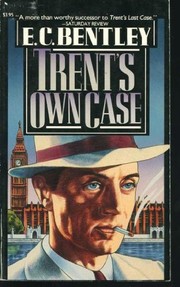
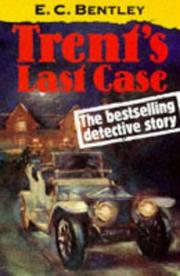
Trent's Last Case is a detective novel written by E. C. Bentley and first published in 1913. Despite the title, it is in fact the first work in which its central character, the artist and amateur detective Philip Trent, appears: he subsequently reappeared in the novel Trent's Own Case (1936), and the short-story collection Trent Intervenes (1938).
The novel is a whodunit with a place in detective fiction history because it is the first major send-up of that genre. Not only does Trent fall in love with one of the primary suspects – usually considered off-limits – he also, after painstakingly collecting all the evidence, draws all the wrong conclusions.
The novel was published as The Woman in Black in the United States, later in 1913.
Plot summary
Sigsbee Manderson, a wealthy American plutocrat, is found shot dead in the grounds of his English country house. Philip Trent, an artist, freelance journalist, and amateur detective, is commissioned by Sir James Molloy, a Fleet Street press magnate, to investigate and report on the case. Trent receives the co-operation of the police – the investigating officer, Inspector Murch of Scotland Yard, is an old acquaintance – and is able to view the body, examine the house and grounds, and interview those involved. Other members of the household include Manderson's wife, Mabel; his two secretaries, Calvin Bunner, an American, and John Marlowe, an Englishman; Martin, a manservant; and Célestine, a lady's maid. Nathaniel Cupples, Mabel's uncle-by-marriage and another old friend of Trent, is staying at a hotel in the village.
Trent pursues his enquiries, and learns that the Mandersons' marriage was in difficulties and that the couple had grown distant from each other. In the course of his investigation, he falls in love with Mabel Manderson. The coroner's inquest finds that Manderson was killed by a person or persons unknown: the suggestion is that he was the victim of a business vendetta. Trent, however, concludes that Manderson was shot by Marlowe, who then returned to the house wearing some of Manderson's outer clothing in order to give the impression that Manderson was at that point still alive, before driving to Southampton to provide himself with an alibi. Trent believes that Marlowe's motive was his own love for Mabel, but is unclear as to how far she may have reciprocated in these feelings. He writes down his ideas in the form of a dispatch for Molloy, but before sending it presents it to Mabel and asks whether there had been anything between her and Marlowe. Her reaction persuades him that there had been, and he leaves the dispatch unsent.
Six months later Trent re-establishes contact with Mabel in London and finally extracts her version of events. She tells him that there had never been any sort of intimacy between her and Marlowe, but that her husband's suspicions had been the cause of their marital rift, and that in his jealousy he may have plotted an act of revenge. Trent sends Marlowe his original dispatch and arranges a meeting at which Cupples is also present. At the meeting, Marlowe explains that Manderson fabricated a web of incriminating evidence to implicate Marlowe in his apparent "murder" and then shot himself. Having realised what was happening, and having discovered Manderson's body, Marlowe had attempted to cover his tracks and give himself an alibi – this much of Trent's analysis had been correct.
Following this meeting, Trent and Cupples have dinner together, and Cupples reveals that while the majority of Marlowe's story had been accurate, it was in fact he who had fired the fatal shot. He had chanced upon Manderson pointing a pistol at himself, probably meaning only to cause a self-inflicted wound. Suspecting a suicide attempt, Cupples had intervened, and in the ensuing struggle had accidentally shot Manderson in the face.
The book ends with Trent vowing that he will never again attempt to dabble in crime detection.
Reception
G. K. Chesterton, author of the Father Brown mysteries, felt that this novel was "The finest detective story of modern times". (Bentley and Chesterton were close personal friends, and Bentley dedicated the book to Chesterton.) The book was influential in the postwar "Golden Age" of detective stories: Agatha Christie called Trent's Last Case "One of the three best detective stories ever written". Dorothy L. Sayers wrote that "It shook the little world of the mystery novel like a revolution ... Every detective writer of today owes something, consciously or unconsciously, to its liberating and inspiring influence." It was still admired in the second half of the century; literary critic Jacques Barzun, co-author of A Catalogue of Crime (1971), included it in his top ten mystery novels, as did mystery novelists Reginald Hill and Peter Straub.
In his critique of the mystery genre, The Simple Art of Murder, Raymond Chandler said that it was frequently called "the perfect story" before ridiculing some plot points that he considered preposterous: "I have known relatively few international financiers, but I rather think the author of this novel has (if possible) known fewer."
According to Aaron Marc Stein in his introduction to the 1977 edition, published by University Extension of UCSD: "At the risk of bringing down on his memory the wrath of the Baker Street Irregulars it must be recorded that Bentley had reservations about even the Conan Doyle originals. He deplored the great detective's lack of humor and he was irritated by the Sherlockian eccentricities.... Bentley had the idea of doing a detective who would be a human being and who would know how to laugh."
Adaptations
Film
The novel was adapted into a silent film directed by Richard Garrick in 1920. A second adaptation (released in both a silent version and a sound version) was made by Howard Hawks in 1929.
A third film adaptation was directed by Herbert Wilcox in 1952. It starred Michael Wilding as Trent, Orson Welles as Sigsbee Manderson, and Margaret Lockwood as Margaret Manderson (the equivalent of Mabel).
以上文字摘自英文维基百科「Trent's Last Case (novel)」(有删节,去掉了参考文献等尾部小节),按 CC BY-SA 4.0 使用,作者为维基百科的各位编者。
资料卡
- 原作语言
- 英国英语
- 首次出版
- 1913 年
- 作品形式
- 长篇小说
- 体裁
- 犯罪作品、悬疑
- 首版出版社
- 托马斯·尼尔森出版社
- 续作
- Trent's Own Case
资料卡来自 Wikidata Q3824759(CC0),众包数据,个别字段可能不全。
改编作品
电影3
- Trent's Last Case
- Trent's Last Case
- 《赔了夫人又折兵》Trent's Last Case
名单来自 Wikidata(CC0):只列条目里写明「改编自 / 取材于」这本书的作品,不按名字猜;众包数据,可能不全。