书单
百科
这个词条暂时没有中文维基百科条目,下面是英文维基百科的内容(英文原文):
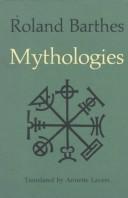
Mythologies (French: Mythologies) is a 1957 book by Roland Barthes. It contains a collection of fifty-three short essays written between 1954 to 1956, most of which were first published in the French literary review Les Lettres nouvelles. In these essays, Barthes examines the tendency of contemporary social value systems (specifically that of the bourgeoisie) to create modern myths. In the book Barthes also analyzes the semiology of the process of myth creation itself, updating Ferdinand de Saussure's system of sign analysis by adding a second level where signs are elevated to the level of myth.
Mythologies was first published in English in abridged form in 1972. In 2012, Hill & Wang published a new English language edition of the book, Mythologies: The Complete Edition, in a New Translation, translated by Richard Howard (Part I: Mythologies) and Annette Lavers (Part II: Myth Today).
Mythologies
Mythologies is divided into two parts: Mythologies and Myth Today, with the first section consisting of a collection of short essays on selected modern myths, and the second section offering an extended analysis of the concept. Each of the "mythologies" describes a modern cultural phenomena, ranging from "Einstein's Brain" to "Soap Powders and Detergents," chosen for their status as modern myths and for the meaning that has been conferred upon them.
In a typical example, Barthes describes the image that has been built up around red wine and how it has been adopted as a French national drink, how it is seen as a social equaliser and the drink of the proletariat, partly because it is seen as blood-like (as in Holy Communion) and points out that very little attention is paid to red wine's harmful effects to health, but that it is instead viewed as life-giving and refreshing — 'in cold weather, it is associated with all the myths of becoming warm, and at the height of summer, with all the images of shade, with all things cool and sparkling.'
In another chapter, Barthes explores the myth of professional wrestling. Unlike boxing, he writes, the aim of theatrical stunt fighting is not the winner's 'demonstration of excellence'. It is instead a staged spectacle, acting out society's basic concepts of good and evil (of 'Suffering, Defeat and Justice'). The actors pretending to be wrestlers, like characters in a pantomime, portray grossly exaggerated stereotypes of human weakness: the traitor, the conceited, the 'effeminate teddy-boy'. The audience expects to watch them suffer and be punished for their own transgressions of wrestling's rules in a theatrical version of society's ideology of justice.
Essays in the original English translation of Mythologies
"The World of Wrestling" (professional wrestling)
"The Romans in Films" (the 1953 American film Julius Caesar)
"The Writer on Holiday" (an article in Le Figaro about André Gide's travels in the Congo)
"The 'Blue Blood' Cruise" (a yacht cruise taken by European royalty to celebrate the coronation of Queen Elizabeth II)
"Blind and Dumb Criticism"
"Soap-powders and Detergents" (advertisements for Omo and Persil detergents)
"The Poor and the Proletariat" (Charlie Chaplin)
"Operation Margarine" (From Here to Eternity; the Jules Roy play Les Cyclones; Graham Greene's The Living Room; advertisements for Astra brand margarine)
"Dominici, or the Triumph of Literature" (the Dominici Affair)
"The Iconography of the Abbé Pierre"
"Novels and Children" (Elle magazine on women novelists)
"Toys"
"The Face of Garbo" (Greta Garbo in Queen Christina)
"Wine and Milk"
"Steak and Chips"
"The Nautilus and the Drunken Boat" (the novels of Jules Verne)
"The Brain of Einstein"
"The Jet-man"
"The Blue Guide"
"Ornamental Cookery" (food photography in Elle magazine)
"Neither-Nor Criticism"
"Striptease"
"The New Citroën" (the Citroën DS 19)
"Photography and Electoral Appeal" (photographs of French politicians)
"The Lost Continent"
"Astrology"
"Plastic"
"The Great Family of Man" (the touring photography exhibition known in English-speaking countries as The Family of Man)
"The Lady of the Camellias"
Myth today
In the second half of the book Barthes addresses the question of "What is a myth, today?" with the analysis of ideas such as: myth as a type of speech, and myth as a type of politics.
Following on from the first section, Barthes justifies and explains his choices and analysis. He calls upon the concepts of semiology developed by Ferdinand de Saussure, who described the connections between an object (the signified) and its linguistic representation (such as a word, the signifier) and how the two are connected. Working with this structure Barthes continues to show his idea of a myth as a further sign, with its roots in language, but to which something has been added. So with a word (or other linguistic unit) the meaning (apprehended content) and the sound come together to make a sign. To make a myth, the sign itself is used as a signifier, and a new meaning is added, which is the signified. But according to Barthes, this is not added arbitrarily. Although we are not necessarily aware of it, modern myths are created with a reason. As in the example of the red wine, mythologies are formed to perpetuate an idea of society that adheres to the current ideologies of the ruling class and its media.
以上文字摘自英文维基百科「Mythologies (book)」(有删节,去掉了参考文献等尾部小节),按 CC BY-SA 4.0 使用,作者为维基百科的各位编者。
资料卡
- 原题
- Mythologies
- 原作语言
- 法语
- 首次出版
- 1957 年
- 首版出版社
- 门槛出版社
- 主题
- 符号学
资料卡来自 Wikidata Q1396027(CC0),众包数据,个别字段可能不全。