 书单
百科
这个词条暂时没有中文维基百科条目,下面是英文维基百科的内容(英文原文):
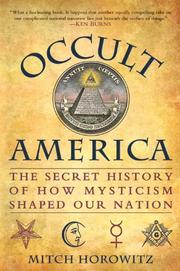
Occult America: The Secret History of How Mysticism Shaped Our Nation is a 2009 book by Mitch Horowitz published by Bantam Books. The book is focused on the role that new religious movements play in the history of the United States; Horowitz argues that these movements, often marginalized or ignored by mainstream culture, played a substantial role in shaping American society. Occult America covers a wide range of individuals, movements, and beliefs from the eighteenth through twentieth centuries, with Horowitz paying particular attention to figures such as Manly P. Hall, Henry A. Wallace, and Edgar Cayce, as well as the Spiritualist movement and its element of greatest mainstream popularity, the Ouija board.
The book received mixed to positive reviews. Critics praised the writing style and depth of research, but described the scope as exceptionally broad, limiting the work's ability to cover individual subjects. Occult America won the 2010 PEN Oakland Josephine Miles Award and established Horowitz's ongoing writing career.
Synopsis
The central thesis of Occult America is that esoteric religious movements were a founding element of both spiritual and secular American culture. The early chapters focus on an array of figures in eighteenth- and nineteenth-century American religious movements, such as Ann Lee, Henry Steel Olcott, Helena Blavatsky, Joseph Smith, and the Public Universal Friend. The first chapter particularly focuses on the Burned-Over District, a region of Upstate New York with an especially dense prevalence of Christian religious movements such as the Shakers and Latter Day Saint movement.
The second chapter focuses on elements of American occultism less associated with Christianity, such as Theosophy and Western Buddhism. Horowitz particularly focuses on Spiritualism's focus on communication with the dead and its popularity during the American Civil War; the popularity of mediums soared during the Civil War, as the families of deceased soldiers sought the possibility of reconnecting with their lost relatives. He describes the example of Abraham and Mary Todd Lincoln, whose interests in Spiritualism were spurred by the death of their son William Wallace Lincoln in 1862 at the age of eleven. Though Mary Todd Lincoln's interest in Spiritualism was well-covered by contemporary and later sources, often to discredit her alongside discussion of her mental health, Horowitz suggests Abraham Lincoln may have been similarly interested in the phenomenon; he analyses contemporary reports of séances in the White House and the 1891 publication Was Abraham Lincoln a Spiritualist?, controversial memoir of the medium Nettie Colburn Maynard.
Following this general overview, Horowitz focuses on Ouija boards, a Spiritualist invention that became part of mainstream popular culture in the twentieth century. He discusses myths surrounding their origins, such as the idea they trace back to classical figures such as Pythagoras. Horowitz covers the origins of the Ouija board in the mid-nineteenth century; its later commercialization by William Fuld, a Presbyterian businessman who openly disclaimed the object's supernaturalism; and its influence on popular culture, such as its inspiration of the Pulitzer-winning epic poem The Changing Light at Sandover. The book then moves to cover movements, such as Christian Science and New Thought, that focus on the concept of manifestation. Horowitz presents this as a uniquely American-origin form of esotericism, juxtaposed with earlier movements with greater European influence, and chronicles its rise in popularity.
Later sections of Occult America cover African diaspora religions such as Louisiana Voodoo. Horowitz first covers figures such as Black Herman and the pseudonymous Henri Gamache before addressing specifically black nationalist figures and movements, such as Marcus Garvey, the Nation of Islam, and the Moorish Science Temple of America. The seventh chapter—the first to deal exclusively with a specific individual—biographizes Manly P. Hall, founder of the Philosophical Research Society. Occult America's eighth chapter deals with the role of esotericism in twentieth-century politics, particularly through Franklin D. Roosevelt's vice president Henry A. Wallace. Wallace, a high-ranking Freemason and self-described "practical mystic", took credit for the inclusion of the Eye of Providence on the dollar bill. Horowitz depicts Wallace's contemporaries as increasingly suspicious of his philosophy and motives, eventually ousting him from the vice presidential position in 1944.
The final chapters of Occult America discuss differences between European and American occult practices. Horowitz argues that while European mysticism in the 19th and 20th centuries "could seem to cling to secrecy almost as an end in itself", with a focus on initiation into underground occult orders, American mysticism was far more open. By discussing supernatural or esoteric beliefs openly, practitioners in the United States brought such ideas into the mainstream, inspiring the twentieth-century popularity of phenomena such as astrology and numerology. The book closes with a chapter-long biography of Edgar Cayce, who Horowitz presents as a metonym for the persistent popularity of mysticism in American culture; by spreading a message of "hope and dignity" to people who felt disaffected or abandoned by mainstream society, Cayce encapsulated the practices that, Horowitz argues, made large sectors of the population open to such concepts.
以上文字摘自英文维基百科「Occult America」(有删节,去掉了参考文献等尾部小节),按 CC BY-SA 4.0 使用,作者为维基百科的各位编者。