书单
百科
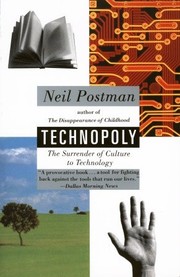
《技术垄断:文化向技术投降》(英语:Technopoly: The Surrender of Culture to Technology)是尼尔·波兹曼创作的一本书,1992年出版,书中描述了“技术垄断”的发展和特征。
以上文字摘自维基百科「技术垄断」(去掉了参考文献等尾部小节),按 CC BY-SA 4.0 使用,作者为维基百科的各位编者。
中文维基百科的条目比较短,下面附上英文维基百科的内容(英文原文):
Technopoly: The Surrender of Culture to Technology is a book by Neil Postman published in 1992 that describes the development and characteristics of a "technopoly". He defines a technopoly as a society in which technology is deified, meaning "the culture seeks its authorisation in technology, finds its satisfactions in technology, and takes its orders from technology". It is characterised by a surplus of information generated by technology, which technological tools are in turn employed to cope with, in order to provide direction and purpose for society and individuals.
Postman considers technopoly to be the most recent of three kinds of cultures distinguished by shifts in their attitude towards technology – tool-using cultures, technocracies, and technopolies. Each, he says, is produced by the emergence of new technologies that "compete with old ones…mostly for dominance of their worldviews".
Tool-using culture
According to Postman, a tool-using culture employs technologies only to solve physical problems, as spears, cooking utensils, and water mills do, and to "serve the symbolic world" of religion, art, politics and tradition, as tools used to construct cathedrals do. He claims that all such cultures are either theocratic or "unified by some metaphysical theory", which forced tools to operate within the bounds of a controlling ideology and made it "almost impossible for technics to subordinate people to its own needs".
Technocracy
In a technocracy, rather than existing in harmony with a theocratic world-view, tools are central to the "thought-world" of the culture. Postman claims that tools "attack culture…[and] bid to become culture", subordinating existing traditions, politics, and religions. Postman cites the example of the telescope destroying the Judeo-Christian belief that the Earth is the centre of the Solar System, bringing about a "collapse…of the moral centre of gravity in the West".
Postman characterises a technocracy as compelled by the "impulse to invent", an ideology first advocated by Francis Bacon in the early 17th Century. He believed that human beings could acquire knowledge about the natural world and use it to "improve the lot of mankind", which led to the idea of invention for its own sake and the idea of progress. According to Postman, this thinking became widespread in Europe from the late 18th Century.
However, a technocratic society remains loosely controlled by social and religious traditions, he clarifies. For instance, he states that the United States remained bound to notions of "holy men and sin, grandmothers and families, regional loyalties and two-thousand-year-old traditions" at the time of its founding.
Technopoly
Postman defines technopoly as a "totalitarian technocracy", which demands the "submission of all forms of cultural life to the sovereignty of technique and technology". Echoing Jacques Ellul's 1964 conceptualisation of technology as autonomous, "self-determinative" independently of human action, and undirected in its growth, technology in a time of Technopoly actively eliminates all other ‘thought-worlds’. Thus, it reduces human life to finding meaning in machines and technique.
This is exemplified, in Postman's view, by the computer, the "quintessential, incomparable, near-perfect" technology for a technopoly. It establishes sovereignty over all areas of human experience based on the claim that it "'thinks' better than we can".
Values of "technological theology"
A technopoly is founded on the belief that technique is superior to lax, ambiguous and complex human thinking and judgement, in keeping with one of Frederick W. Taylor’s ‘Principles of scientific management’. It values efficiency, precision, and objectivity.
It also relies upon the "elevation of information to a metaphysical status: information as both the means and end of human creativity". The idea of progress is overcome by the goal of obtaining information for its own sake. Therefore, a technopoly is characterised by a lack of a cultural coherence or a "transcendent sense of purpose or meaning".
以上文字摘自英文维基百科「Technopoly」(有删节,去掉了参考文献等尾部小节),按 CC BY-SA 4.0 使用,作者为维基百科的各位编者。
资料卡
- 原题
- Technopoly
- 原作语言
- 英语
- 首次出版
- 1992 年
- 主题
- 科技与社会
资料卡来自 Wikidata Q7692649(CC0),众包数据,个别字段可能不全。