 书单
百科
这个词条暂时没有中文维基百科条目,下面是英文维基百科的内容(英文原文):
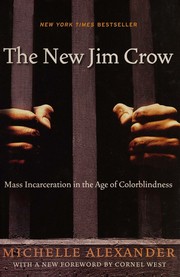
The New Jim Crow: Mass Incarceration in the Age of Colorblindness is a 2010 book by Michelle Alexander, a civil rights litigator and legal scholar. The book discusses race-related issues specific to African-American males and mass incarceration in the United States, but Alexander noted that the discrimination faced by African-American males is prevalent among other minorities and socio-economically disadvantaged populations. Alexander's central premise, from which the book derives its title, is that "mass incarceration is, metaphorically, the New Jim Crow".
Overview
Though the conventional point of view holds that systemic racial discrimination mostly ended with the civil rights movement reforms of the 1960s, Alexander posits that the U.S. criminal justice system uses the war on drugs as a primary tool for enforcing traditional, as well as new, modes of discrimination and oppression. These new modes of racism have led to not only the highest rate of incarceration in the world, but also a disproportionately large rate of imprisonment for African American men. Were present trends to continue, Alexander writes, the United States would imprison one third of its African American population. When combined with the fact that whites are more likely to commit drug crimes than people of color, the issue becomes clear for Alexander: "the primary targets of [the penal system's] control can be defined largely by race".
This ultimately leads Alexander to argue that mass incarceration is "a stunningly comprehensive and well-disguised system of racialized social control that functions in a manner strikingly similar to Jim Crow". The culmination of this social control is what Alexander calls a "racial caste system", a type of stratification wherein people of color are kept in an inferior position. Its emergence, she believes, is a direct response to the civil rights movement. It is because of this that Alexander argues for issues with mass incarceration to be addressed as issues of racial justice and civil rights. To approach these matters as anything but would be to fortify this new racial caste. Thus, Alexander aims to mobilize the civil rights community to move the incarceration issue to the forefront of its agenda and to provide factual information, data, arguments and a point of reference for those interested in pursuing the issue. Her broader goal is the revamping of the prevailing mentality regarding human rights, equality and equal opportunities in America, to prevent future cyclical recurrence of what she sees as "racial control under changing disguise". According to the author, what has been altered since the collapse of Jim Crow is not so much the basic structure of US society, as the language used to justify its affairs. She argues that when people of color are disproportionately labeled as "criminals", this allows the unleashing of a whole range of legal discrimination measures in employment, housing, education, public benefits, voting rights, jury duty, and so on.
Alexander explains that it took her years to become fully aware and convinced of the entanglements she describes, despite her professional civil rights background. She expects similar reluctance and disbelief on the part of many of her readers. She believes that the problems besetting African American communities are not merely a passive, collateral side effect of poverty, limited educational opportunity or other factors, but a consequence of purposeful government policies. Alexander has concluded that mass incarceration policies, which were swiftly developed and implemented, are a "comprehensive and well-disguised system of racialized control that functions in a manner strikingly similar to Jim Crow".
Alexander contends that in 1982 the Reagan administration began an escalation of the war on drugs, purportedly as a response to a crack cocaine crisis in black ghettos, which was (she claims) announced well before crack cocaine arrived in most inner city neighborhoods. During the mid-1980s, as the use of crack cocaine increased to epidemic levels in these neighborhoods, federal drug authorities publicized the problem, using scare tactics to generate support for their already-declared escalation. The government's successful media campaign made possible an unprecedented expansion of law enforcement activities in America's urban neighborhoods, and this aggressive approach fueled widespread belief in conspiracy theories that posited government plans to destroy the black population (Black genocide)
In 1998, the Central Intelligence Agency (CIA) acknowledged that during the 1980s the Contra faction—covertly supported by the US in Nicaragua—had been involved in smuggling cocaine into the US and distributing it in US cities. Drug Enforcement Administration efforts to expose these illegal activities were blocked by Reagan officials, which contributed to an explosion of crack cocaine consumption in America's urban neighborhoods. More aggressive enforcement of federal drug laws resulted in a dramatic increase in street level arrests for possession. Disparate sentencing policies (the crack cocaine vs. powdered cocaine penalty disparity was 100–1 by weight and remains 18–1 even after recent reform efforts) meant that a disproportionate number of inner city residents were charged with felonies and sentenced to long prison terms, because they tended to purchase the more affordable crack version of cocaine, rather than the powdered version commonly consumed in the suburbs.
Alexander argues that the war on drugs has a devastating impact on inner city African American communities, on a scale entirely out of proportion to the actual dimensions of criminal activity taking place within these communities.
以上文字摘自英文维基百科「The New Jim Crow」(有删节,去掉了参考文献等尾部小节),按 CC BY-SA 4.0 使用,作者为维基百科的各位编者。
资料卡
- 原题
- The New Jim Crow
- 原作语言
- 英语
- 首次出版
- 2010 年
- 体裁
- 非虚构作品、随笔
- 首版出版社
- 新出版社
- 主题
- 刑事司法体系、监狱工业复合体、美国监禁制度
资料卡来自 Wikidata Q7753648(CC0),众包数据,个别字段可能不全。