 书单
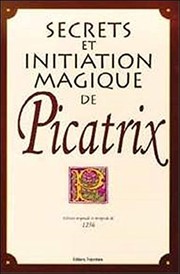
Picatrix
- 作者
- Maslama Ibn al-Qāsim Ibn Ibrāhīm Ibn ʿAbd Allāh Ibn Ḥātim al-Qurṭubī al-Zayyāt
- 国家/地区
- 西班牙
- Open Library
- 22 个版本
百科
这个词条暂时没有中文维基百科条目,下面是英文维基百科的内容(英文原文):
Picatrix (Arabic: غاية الحكيم, romanized: Ghāyat al-Ḥakīm or Ghayat al-hakim wa-ahaqq al-natijatayn bi-altaqdim lit. 'The Aim of the Sage' or 'The Goal of The Wise') is a 400-page Arabic book of magic and astrology, which most scholars assume was originally written in the middle of the 11th century, though an argument for composition in the first half of the 10th century has been made. The work was translated into Spanish and then into Latin during the 13th century, at which time it got the Latin title Picatrix. The title Picatrix is also sometimes used to refer to the book's author.
Picatrix is a composite work that synthesizes older works on magic and astrology. One of the most influential interpretations suggests it is to be regarded as a "handbook of talismanic magic". Another researcher summarizes it as "the most thorough exposition of celestial magic in Arabic", indicating the sources for the work as "Arabic texts on Hermeticism, Sabianism, Ismailism, astrology, alchemy and magic produced in the Near East in the ninth and tenth centuries A.D." Eugenio Garin declares, "In reality the Latin version of the Picatrix is as indispensable as the Corpus Hermeticum or the writings of Albumasar for understanding a conspicuous part of the production of the Renaissance, including the figurative arts." It has significantly influenced West European esotericism from Marsilio Ficino in the 15th century, to Thomas Campanella in the 17th century. The manuscript in the British Library passed through several hands: Simon Forman, Richard Napier, Elias Ashmole and William Lilly.
According to the prologue of the Latin translation, Picatrix was translated into Spanish from the Arabic by order of Alphonso X of Castile at some time between 1256 and 1258. The Latin version was produced sometime later, based on translation of the Spanish manuscripts. It has been attributed to Maslama ibn Ahmad al-Majriti (an Andalusian mathematician), but many have called this attribution into question. Consequently, the author is sometimes indicated as "Pseudo-Majriti".
The Spanish and Latin versions were the only ones known to Western scholars until Wilhelm Printz discovered an Arabic version in or around 1920.
Content and sources
The work is divided into four books, which exhibit a marked absence of systematic exposition. Jean Seznec observed, "Picatrix prescribes propitious times and places and the attitude and gestures of the suppliant; he also indicates what terms must be used in petitioning the stars." As an example, Seznec then reproduces a prayer to Saturn from the work, noting that Fritz Saxl has pointed out that this invocation exhibits "the accent and even the very terms of a Greek astrological prayer to Kronos. This is one indication that the sources of Picatrix are in large part Hellenistic.":
O Master of sublime name and great power, supreme Master; O Master Saturn: Thou, the Cold, the Sterile, the Mournful, the Pernicious; Thou, whose life is sincere and whose word sure; Thou, the Sage and Solitary, the Impenetrable; Thou, whose promises are kept; Thou who art weak and weary; Thou who hast cares greater than any other, who knowest neither pleasure nor joy; Thou, the old and cunning, master of all artifice, deceitful, wise, and judicious; Thou who bringest prosperity or ruin, and makest men to be happy or unhappy! I conjure thee, O Supreme Father, by Thy great benevolence and Thy generous bounty, to do for me what I ask [...]
According to Garin:
The work's point of departure is the unity of reality divided into symmetrical and corresponding degrees, planes or worlds: a reality stretched between two poles: the original One, God the source of all existence, and man, the microcosm, who, with his science (scientia) brings the dispersion back to its origin, identifying and using their correspondences.According to the Prologue, the author researched over two hundred works in the creation of Picatrix. However, there are three significant Near/Middle Eastern influences: Jabir ibn Hayyan, the Brethren of Purity, and ibn Wahshiyya's Nabataean Agriculture. The influence of Jabir ibn Hayyan comes in the form of a cosmological background that removes magical practices from the context of diabolical influences and reasserts these practices as having a divine origin. The author of Picatrix utilizes Neoplatonic theories of hypostasis that mirror the work of Jabir ibn Hayyan.
The lunar mansions (mansiones Lunae) constitute one of the central organizing principles of the Picatrix, underpinning much of its electional astrology, talismanic image magic, and ritual operations. Throughout the work, the Moon’s passage through the twenty-eight mansions determines the timing, construction, and intended effects of magical images, suffumigations, and planetary rituals. The Latin text devotes substantial attention to the virtues of the lunar mansions, including an entire chapter on “the properties and compositions of the heavens for making images in the twenty-eight mansions of the Moon” (De generibus, proprietatibus et compositionibus caeli ad faciendum imagines in XXVIII mansionibus Lunae), followed by numerous practical operations organized according to the mansions.
以上文字摘自英文维基百科「Picatrix」(有删节,去掉了参考文献等尾部小节),按 CC BY-SA 4.0 使用,作者为维基百科的各位编者。
资料卡
- 原作语言
- 拉丁语
资料卡来自 Wikidata Q596932(CC0),众包数据,个别字段可能不全。