 书单
百科
这个词条暂时没有中文维基百科条目,下面是英文维基百科的内容(英文原文):
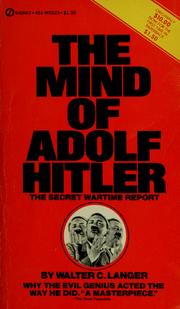
The Mind of Adolf Hitler: The Secret Wartime Report, published in 1972 by Basic Books, is based on a World War II report by psychoanalyst Walter C. Langer which probed the psychology of Adolf Hitler from the available information. The original report was prepared for the United States' Office of Strategic Services (OSS) and submitted in late 1943 or early 1944; it is officially entitled A Psychological Analysis of Adolph Hitler: His Life and Legend. The report is one of two psychoanalytic reports prepared for the OSS during the war in an attempt to assess Hitler's personality; the other is Analysis of the Personality of Adolph Hitler by the psychologist Henry A. Murray who also contributed to Langer's report.
The book contains not only a version of Langer's original report but also a foreword by his brother, historian William L. Langer, who was Chief of Research and Analysis at the OSS during the war, an introduction by Langer himself, and an afterword by the psychoanalytic historian Robert Sherly.L. Waite.
The report made several predictions about Hitler's future which proved to be accurate:
As the war turns against him, his emotions will intensify and will have outbursts more frequently. His public appearances will become much rarer, because he is unable to face a critical audience.
There might be an assassination attempt on him by the German aristocracy, the Wehrmacht officers or the Oberkommando der Wehrmacht, because of his superhuman self-confidence in his military judgment.
There will be no surrender, capitulation, or peace negotiations. The course he will follow will almost certainly be the road to ideological immortality, resulting in the greatest vengeance on a world he despises.
From what we know of his psychology, the most likely possibility is that he will commit suicide in the event of defeat. It is probably true he has an inordinate fear of death, but possibly being a psychopath he would undoubtedly "screw himself up" into the superman character and perform the deed.
History of the report
The wartime report was commissioned by the head of the OSS, William J. "Wild Bill" Donovan. The research and investigation for it was done in collaboration with three other clinicians – Professor Henry A. Murray of the Harvard Psychological Clinic, Dr. Ernst Kris of the New School for Social Research, and Dr. Bertram D. Lewin of the New York Psychoanalytic Institute – as well as research associates. Langer notes in his introduction to the book that one of the three essentially dropped out of the project because he was too busy with other work, but he gives no names. "He promised, however, to write down his views and conclusions and submit them ... Unfortunately, not a word was ever received from him" although he did apparently confirm to Langer by telephone that he agreed with the diagnosis of Hitler's pathology.
Historian Hans W. Gatzke and others have suggested that Langer borrowed extensively from prior work by Murray without properly crediting him, such as his lurid sexual analysis and his prediction of suicide; Langer has disputed some of the claims although the texts show similarities. In addition, similarities have been noted to perhaps the earliest published psychological profile of Hitler developed by Murray and influential psychologist Gordon Allport for Harvard seminars on 'Civilian Morale' (1941), intended to be distributed to private organisations throughout the US to prepare a consensus for war. The Harvard University Archives register stated that Murray started work on this profile in 1938 upon request from the Roosevelt administration.
The Langer report was classified as "Secret" by the OSS, but was eventually declassified in 1968. After receiving some encouragement from fellow scholars, particularly Professor Henderson Braddick of the Department of International Relations at Lehigh University, Langer decided to publish the report in book form. The original report is in the public domain and is available on the Internet on a number of sites. Numerous substantial unexplained differences were noted by Gatzke, however, between the report as published in 1972 and a separate copy of the 1943/44 report. Gatzke writes "Recent correspondence with the publisher...has revealed that the original [OSS report] manuscript was changed and edited several times by Dr. Langer and others, both in 1943 and again before publication.
Content and conclusions
The report used many sources to profile Hitler, including a number of informants, including Hitler's nephew, William Patrick Hitler, his family physician, Dr. Eduard Bloch, Ernst Hanfstaengl, Hermann Rauschning, Princess Stephanie von Hohenlohe, Otto Strasser, Friedlinde Wagner, and Kurt Ludecke. The so-called "Hitler Source Book" which was appended to the wartime report, ran over one thousand pages and was indexed against the report. The groundbreaking study was the pioneer of offender profiling and political psychology, today commonly used by many countries as part of assessing international relations.
In addition to predicting that if defeat for Germany was near, Hitler would most likely choose suicide, Langer's report stated that Hitler was "probably impotent" as far as heterosexual relations were concerned and that there was a possibility that Hitler had participated in a homosexual relationship. The report stated that:
[t]he belief that Hitler is homosexual has probably developed (a) from the fact that he does show so many feminine characteristics, and (b) from the fact that there were so many homosexuals in the Party during the early days and many continue to occupy important positions. It is probably true that Hitler calls Foerster "Bubi", which is a common nickname employed by homosexuals in addressing their partners. This alone, however, is not adequate proof that he has actually indulged in homosexual practices with Foerster, who is known to be a homosexual.
以上文字摘自英文维基百科「The Mind of Adolf Hitler」(有删节,去掉了参考文献等尾部小节),按 CC BY-SA 4.0 使用,作者为维基百科的各位编者。
资料卡
- 首次出版
- 1972 年
- 主题
- 阿道夫·希特勒
资料卡来自 Wikidata Q7751523(CC0),众包数据,个别字段可能不全。