书单
百科
这个词条暂时没有中文维基百科条目,下面是英文维基百科的内容(英文原文):
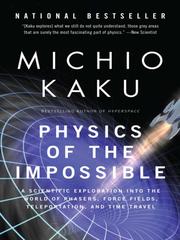
Physics of the Impossible: A Scientific Exploration Into the World of Phasers, Force Fields, Teleportation, and Time Travel is a book by theoretical physicist Michio Kaku. Kaku uses discussion of speculative technologies to introduce topics of fundamental physics to the reader.
The topic of invisibility becomes a discussion on why the speed of light is slower in water than in vacuum, that electromagnetism is similar to ripples in a pond, and Kaku discusses newly developed composite materials.
The topic of Star Trek phasers becomes a lesson on how lasers work and how laser-based research is conducted. The cover of his book depicts a TARDIS, a device used in the British science fiction television show Doctor Who to travel in space and time, in its disguise as a police box, continuously passing through a time loop. With each discussion of science fiction technology topics he also "explains the hurdles to realizing these science fiction concepts as reality".
Concept
According to Kaku, technological advances that we take for granted today were declared impossible 150 years ago. William Thomson Kelvin (1824–1907), a mathematical physicist and creator of the Kelvin scale said publicly that “heavier than air” flying machines were impossible: “He thought X-rays were a hoax, and that radio had no future.” Likewise, Ernest Rutherford (1871–1937), a physicist who experimentally described the atom, thought the atom bomb was impossible and he compared it to moonshine (a crazy or foolish idea). Televisions, computers, and the Internet would seem incredibly fantastic to the people of the turn of the 20th century. Black holes were considered science fiction and even Albert Einstein showed that black holes could not exist. 19th century science had determined that it was impossible for the earth to be billions of years old. Even in the 1920s and 1930s, Robert Goddard was scoffed at because it was believed that rockets would never be able to go into space.
Such advances were considered impossible because the basic laws of physics and science were not understood as well as they would subsequently be. Kaku writes: "As a physicist I learned that the impossible is often a relative term.” By this definition of "impossible", he poses the question "Is it not plausible to think that we might someday build space ships that can travel distances of light years, or think that we might teleport ourselves from one place to the other?"
Types of impossibilities
Each chapter is named by a possible, or improbable, technology of the future. After a look at the development of today's technology, there is discussion as to how this advanced technology might become a reality. Chapters become somewhat more general toward the end of the book. Some of our present day technologies are explained, and then extrapolated into futuristic applications. In the future, current technologies are still recognizable, but in a slightly altered form. For example, when discussing force fields of the future, Dr. Kaku writes about cutting edge laser technology, and newly developed plasma windows. These are two of several technologies, which he sees as required for creating a force field. To create a force field these would be combined in a slightly altered form, such as more precise or more powerful. Furthermore, this discussion on force fields, as well as on the pantheon of highly advanced technologies, remains as true to the original concepts (as in how the public generally imagines advanced technologies) as possible, while remaining practical. Kaku concludes his book with a short epilogue detailing the newest frontiers in physics and how there is still much more to be learned about physics and our universe.
Kaku writes that since scientists understand the basic laws of physics today they can imagine a basic outline of future technologies that might work: "Physicists today understand the basic laws [of physics] extending over a staggering forty three orders of magnitude, from the interior of the proton out to the expanding universe." He goes on to say that physicists can discern between future technologies that are merely improbable and those technologies that are truly impossible. He uses a system of Class I, Class II, and Class III to classify these science-fictional future technologies that are believed to be impossible today.
Class I
Class I Impossibilities are "technologies that are impossible today, but that do not violate the known laws of physics". Kaku speculates that these technologies may become available in some limited form in a century or two.
Force fields are vital for surviving battles in science fiction, but a repulsive force does appear impossible to make in a laboratory. Gravity appears in the four force list in Kaku's book. Gravity acts as the exact opposite of a force field, but has many similar properties. The whole planet keeps us standing on the ground and we cannot counter the force by jumping.
A future technology that may be seen within a lifetime is a type of advanced stealth technology. This is a Class I impossibility. In 2006, Duke University and Imperial College bent microwaves around an object so that it would appear invisible in the microwave range. The object is like a boulder in a stream. Downstream the water has converged in such a way that there is no evidence of a boulder upstream. Likewise, the microwaves converge in such a way that, to an observer from any direction, there is no evidence of an object. In 2008, two groups, one at Caltech and the other at Karlsruhe Institute of Technology, bent red light and blue-green of the visible spectrum. This made the object appear invisible in the red and blue green light range at the microscopic level.
以上文字摘自英文维基百科「Physics of the Impossible」(有删节,去掉了参考文献等尾部小节),按 CC BY-SA 4.0 使用,作者为维基百科的各位编者。
资料卡
- 原题
- Physics of the Impossible
- 原作语言
- 英语
- 首次出版
- 2008 年
- 体裁
- 非虚构作品
- 首版出版社
- 双日出版社
- 前作
- 平行世界
- 续作
- 2100科技大未来:从现在到2100年,科技将如何改变我们的生活
资料卡来自 Wikidata Q7189705(CC0),众包数据,个别字段可能不全。