书单
百科
这个词条暂时没有中文维基百科条目,下面是英文维基百科的内容(英文原文):
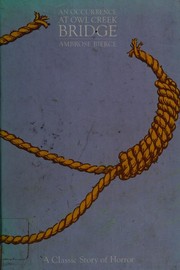
"An Occurrence at Owl Creek Bridge" is an 1890 short story by American writer and American Civil War veteran Ambrose Bierce, described as "one of the most famous and frequently anthologized stories in American literature". It was originally published by the San Francisco Examiner on July 13, 1890, and was first collected in Bierce's book Tales of Soldiers and Civilians (1891). Bierce's abandonment of strict linear narration in favor of the internal mind of the protagonist is an early example of the stream-of-consciousness narrative mode, also called the liminal, distended time flash forward.
Plot
Peyton Farquhar, a wealthy civilian planter and slave owner, is being prepared for execution by hanging from an Alabama railroad bridge during the American Civil War. Six military men and a company of infantrymen are present, guarding the bridge and carrying out the sentence. Farquhar thinks of his wife and children and is then distracted by a noise that sounds like an unbearably loud clanging, but is actually the ticking of his watch. He considers the possibility of jumping off the bridge and swimming to safety if he can free his tied hands, but the soldiers drop him from the bridge before he can act on the idea.
In a flashback, Farquhar and his wife are relaxing at home one evening when a soldier dressed in Confederate gray rides up to the gate. Farquhar, a supporter of the Confederacy, learns from him that Union troops have seized the Owl Creek railroad bridge and repaired it. The soldier suggests that Farquhar might be able to burn the bridge down if he can slip past its guards. He then leaves, but doubles back after nightfall to return north the way he came. The soldier is actually a disguised Union scout who has lured Farquhar into a trap, as any civilian caught interfering with the railroads will be hanged.
The rope breaks, and Farquhar falls into the creek. He frees his hands, pulls the noose away and rises to the surface to begin his escape. His senses now greatly sharpened, he dives and swims downstream to avoid rifle and cannon fire. Once he is out of range, he leaves the creek to begin the journey to his home, thirty miles (48 kilometers) away. Farquhar walks all day through a seemingly endless forest; that night he begins to hallucinate, seeing strange constellations and hearing whispered voices in an unknown language. He travels on, urged by the thought of his wife and children despite the pains caused by his ordeal. The next morning, after having apparently fallen asleep while walking, he finds himself at the gate of his plantation. He rushes to embrace his wife, but before he can do so he feels a heavy blow upon the back of his neck. There is a loud noise and a flash of white and "then all is darkness and silence!"
Farquhar's dead body hangs from the Owl Creek bridge. He never escaped at all; he imagined his escape and journey home during the time between being dropped and the noose breaking his neck.
Publication and reception
"An Occurrence at Owl Creek Bridge" was first published in the July 13, 1890, issue of the San Francisco Examiner, and later included in Bierce's short fiction anthology Tales of Soldiers and Civilians (1891).
Editors of a modern compilation described the story as "one of the most famous and frequently anthologized stories in American literature". Kurt Vonnegut wrote in 2005: "I consider anybody a twerp who hasn't read the greatest American short story, which is '[An] Occurrence at Owl Creek Bridge,' by Ambrose Bierce. It isn't remotely political. It is a flawless example of American genius, like 'Sophisticated Lady' by Duke Ellington or the Franklin stove."
Analysis
The real Owl Creek Bridge is in Tennessee. Bierce likely changed the setting to northern Alabama because the actual bridge did not have a railroad near it at the time of the story.
The story explores the concept of "dying with dignity". It shows the reader that the perception of "dignity" provides no mitigation for the deaths that occur in warfare. It further demonstrates psychological escape right before death. Farquhar experiences an intense delusion to distract him from his inevitable death. The moment of horror that the reader experiences at the end of the piece reflects the distortion of reality that Farquhar encounters.
Influence
The plot device of a long period of subjective time passing in an instant, such as the imagined experiences of Farquhar while falling, has been explored by several authors. An early literary antecedent appears in the Tang dynasty tale The Governor of Nanke, by Li Gongzuo. Another medieval antecedent is Don Juan Manuel's Tales of Count Lucanor, Chapter XII (c. 1335), "Of that which happened to a Dean of Santiago, with Don Illan, the Magician, who lived at Toledo," in which a life happens in an instant. Charles Dickens's essay "A Visit to Newgate", wherein a man dreams he has escaped his death sentence, has been speculated as a possible source for the story. Bierce's story, in turn, may have influenced "The Snows of Kilimanjaro" by Ernest Hemingway and Pincher Martin by William Golding.
以上文字摘自英文维基百科「An Occurrence at Owl Creek Bridge」(有删节,去掉了参考文献等尾部小节),按 CC BY-SA 4.0 使用,作者为维基百科的各位编者。
资料卡
- 原题
- An Occurrence at Owl Creek Bridge
- 原作语言
- 英语
- 首次出版
- 1890 年
- 作品形式
- 短篇小说
- 体裁
- 恐怖作品
- 主要人物
- Peyton Farquhar
资料卡来自 Wikidata Q2943621(CC0),众包数据,个别字段可能不全。
改编作品
舞台剧 / 歌剧 / 芭蕾1
名单来自 Wikidata(CC0):只列条目里写明「改编自 / 取材于」这本书的作品,不按名字猜;众包数据,可能不全。