书单
百科
这个词条暂时没有中文维基百科条目,下面是英文维基百科的内容(英文原文):
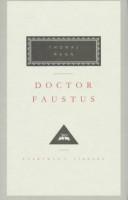
Doctor Faustus is a German novel written by Thomas Mann, begun in 1943 and published in 1947 as Doktor Faustus: Das Leben des deutschen Tonsetzers Adrian Leverkühn, erzählt von einem Freunde ("Doctor Faustus: The Life of the German Composer Adrian Leverkühn, Told by a Friend"). It has been translated into English three times, most recently in 2026.
Outline
The novel is a re-shaping of the Faust legend set in the context of the first half of the 20th century and the turmoil of Germany in that period. The story centers on the life and work of the (fictitious) composer Adrian Leverkühn. The narrator is Leverkühn's childhood friend Serenus Zeitblom, who writes in Germany between 1943 and 1946.
Leverkühn's extraordinary intellect and creativity as a young man mark him as destined for success, but his ambition is for true greatness. He strikes a Faustian bargain for creative genius: he intentionally contracts syphilis, which deepens his artistic inspiration through madness. He is subsequently visited by a Mephistophelean being (who says, in effect, "that you can only see me because you are mad, does not mean that I do not really exist"), and, renouncing love, bargains his soul in exchange for twenty-four years of genius. His madness – his daemonic inspiration – leads to extraordinary musical creativity (which parallels the actual innovations of Arnold Schoenberg).
Leverkühn's last creative years are increasingly haunted by his obsession with the Apocalypse and the Last Judgment. He feels the inexorable progress of his neuro-syphilitic madness leading towards complete breakdown. As in certain of the Faust legends, he calls together his closest friends to witness his final collapse. At a chamber-reading of his cantata "The Lamentation of Doctor Faust", he ravingly confesses his demonic pact before becoming incoherent. His madness reduces him to an infantile state in which he lives under the care of his relatives for another ten years.
Leverkühn's life unfolds in the context of, and in parallel with, the German cultural and political environment which led to the rise and downfall of Nazi Germany. But the predisposing conditions for Leverkühn's pact with the devil are set in character in the artistic life and processes themselves, not merely as political allegory. The interplay of layers between the narrator's historical situation, the progress of Leverkühn's madness, and the medieval legends with which he consciously connects himself make for an overwhelmingly rich symbolic network, an ambiguous complexity that cannot be reduced to a single interpretation.
Plot
The origins of the narrator and the protagonist in the fictitious small town of Kaisersaschern on the Saale, the name of Zeitblom's apothecary father, Wohlgemut, and the description of Adrian Leverkühn as an old-fashioned German type, with a cast of features "from a time before the Thirty Years' War", evoke the old post-medieval Germany. In their respective Catholic and Lutheran origins, and theological studies, they are heirs to the German Renaissance and the world of Dürer and Bach, but sympathetic to, and admired by, the "keen-scented receptivity of Jewish circles".
They are awakened to musical knowledge by Wendell Kretzschmar, a German American organist, lecturer, and musicologist in Kaisersaschern. After schooling together, both boys study at Halle – Adrian studies theology; Zeitblom does not, but participates in discussions with the theological students – but Adrian becomes absorbed in musical harmony, counterpoint and polyphony as a key to metaphysics and mystic numbers, and follows Kretzschmar to Leipzig to study with him.
Zeitblom describes "with a religious shudder" Adrian's embrace with the woman who gave him syphilis (whom Adrian names "Esmeralda" after the butterfly that fascinates his father), how he worked her name in note-ciphers into his compositions, and how the medics who sought to heal him were all prevented from effecting a cure by mysterious and deadly interventions. Zeitblom begins to perceive the demonic, as Adrian develops other friendships, first with the translator Rüdiger Schildknapp, and then after his move to Munich with the handsome young violinist Rudi Schwerdtfeger, Frau Rodde and her doomed daughters Clarissa and Ines, a numismatist named Dr. Kranich, and two artists named Leo Zink and Baptist Spengler.
Zeitblom insists, however, on the unique closeness of his own relationship to Adrian, for he remains the only person whom the composer addresses by the familiar pronoun. Adrian meets the Schweigestill family at Pfeiffering in the country an hour from Munich, which later becomes his permanent home and retreat. While a fictional town, Mann based Pfeiffering on the actual Bavarian town of Polling.
He lives at Palestrina in Italy with Schildknapp in 1912, and Zeitblom visits them. It is there that Adrian, working on music for an operatic adaptation of Shakespeare's Love's Labour's Lost, has his long dialogue with a Mephistopheles figure who appears either objectively or out of his own afflicted soul. In these central pages, the fulcrum of the story, Zeitblom presents Adrian's manuscript of the conversation. The demon, speaking in archaic German, claims Esmeralda as the instrument by which he entraps Adrian and offers him twenty-four years' life as a genius – the supposed incubation period of his syphilis – if he will now renounce the warmth of love. The dialogue reveals the anatomy of Leverkühn's thought.
Adrian then moves permanently to Pfeiffering, and in conversations with Zeitblom confesses a darker view of life. Figures of a demonic type appear, such as Dr. Chaim Breisacher, to cast down the idols of the older generation.
以上文字摘自英文维基百科「Doctor Faustus (novel)」(有删节,去掉了参考文献等尾部小节),按 CC BY-SA 4.0 使用,作者为维基百科的各位编者。
资料卡
- 原题
- Doktor Faustus
- 原作语言
- 德语
- 首次出版
- 1947 年
- 作品形式
- 长篇小说
- 体裁
- 社会小说
- 首版出版社
- Bermann-Fischer Verlag
- 故事发生地
- 魏森费尔斯、莱比锡、慕尼黑、意大利、Pfeiffering、Kaisersaschern 等 7 项
- 故事年代
- 1880年代、1890年代、1900年代 等 5 项
资料卡来自 Wikidata Q386431(CC0),众包数据,个别字段可能不全。
改编作品
电影1
名单来自 Wikidata(CC0):只列条目里写明「改编自 / 取材于」这本书的作品,不按名字猜;众包数据,可能不全。