书单
数学从何而来 (2000)
百科
这个词条暂时没有中文维基百科条目,下面是英文维基百科的内容(英文原文):
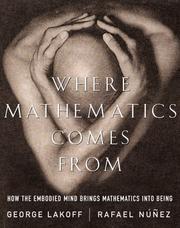
Where Mathematics Comes From: How the Embodied Mind Brings Mathematics into Being (hereinafter WMCF) is a book by George Lakoff, a cognitive linguist, and Rafael E. Núñez, a psychologist. Published in 2000, WMCF seeks to found a cognitive science of mathematics, a theory of embodied mathematics based on conceptual metaphor.
WMCF definition of mathematics
Mathematics makes up that part of the human conceptual system that is special in the following way:
It is precise, consistent, stable across time and human communities, symbolizable, calculable, generalizable, universally available, consistent within each of its subject matters, and effective as a general tool for description, explanation, and prediction in a vast number of everyday activities, [ranging from] sports, to building, business, technology, and science. - WMCF, pp. 50, 377
Nikolay Lobachevsky said "There is no branch of mathematics, however abstract, which may not some day be applied to phenomena of the real world." A common type of conceptual blending process would seem to apply to the entire mathematical procession.
Human cognition and mathematics
Lakoff and Núñez's avowed purpose is to begin laying the foundations for a truly scientific understanding of mathematics, one grounded in processes common to all human cognition. They find that four distinct but related processes metaphorically structure basic arithmetic: object collection, object construction, using a measuring stick, and moving along a path.
WMCF builds on earlier books by Lakoff (1987) and Lakoff and Johnson (1980, 1999), which analyze such concepts of metaphor and image schemata from second-generation cognitive science. Some of the concepts in these earlier books, such as the interesting technical ideas in Lakoff (1987), are absent from WMCF.
Lakoff and Núñez hold that mathematics results from the human cognitive apparatus and must therefore be understood in cognitive terms. WMCF advocates (and includes some examples of) a cognitive idea analysis of mathematics which analyzes mathematical ideas in terms of the human experiences, metaphors, generalizations, and other cognitive mechanisms giving rise to them. A standard mathematical education does not develop such idea analysis techniques because it does not pursue considerations of A) what structures of the mind allow it to do mathematics or B) the philosophy of mathematics.
Lakoff and Núñez start by reviewing the psychological literature, concluding that human beings appear to have an innate ability, called subitizing, to count, add, and subtract up to about 4 or 5. They document this conclusion by reviewing the literature, published in recent decades, describing experiments with infant subjects. For example, infants quickly become excited or curious when presented with "impossible" situations, such as having three toys appear when only two were initially present.
The authors argue that mathematics goes far beyond this very elementary level due to a large number of metaphorical constructions. For example, the Pythagorean position that all is number, and the associated crisis of confidence that came about with the discovery of the irrationality of the square root of two, arises solely from a metaphorical relation between the length of the diagonal of a square, and the possible numbers of objects.
Much of WMCF deals with the important concepts of infinity and of limit processes, seeking to explain how finite humans living in a finite world could ultimately conceive of the actual infinite. Thus much of WMCF is, in effect, a study of the epistemological foundations of the calculus. Lakoff and Núñez conclude that while the potential infinite is not metaphorical, the actual infinite is. Moreover, they deem all manifestations of actual infinity to be instances of what they call the "Basic Metaphor of Infinity", as represented by the ever-increasing sequence 1, 2, 3, ...
WMCF emphatically rejects the Platonistic philosophy of mathematics. They emphasize that all we know and can ever know is human mathematics, the mathematics arising from the human intellect. The question of whether there is a "transcendent" mathematics independent of human thought is a meaningless question, like asking if colors are transcendent of human thought—colors are only varying wavelengths of light, it is our interpretation of physical stimuli that make them colors.
WMCF (p. 81) likewise criticizes the emphasis mathematicians place on the concept of closure. Lakoff and Núñez argue that the expectation of closure is an artifact of the human mind's ability to relate fundamentally different concepts via metaphor.
WMCF concerns itself mainly with proposing and establishing an alternative view of mathematics, one grounding the field in the realities of human biology and experience. It is not a work of technical mathematics or philosophy. Lakoff and Núñez are not the first to argue that conventional approaches to the philosophy of mathematics are flawed. For example, they do not seem all that familiar with the content of Davis and Hersh (1981), even though the book warmly acknowledges Hersh's support.
Lakoff and Núñez cite Saunders Mac Lane (the inventor, with Samuel Eilenberg, of category theory) in support of their position. Mathematics, Form and Function (1986), an overview of mathematics intended for philosophers, proposes that mathematical concepts are ultimately grounded in ordinary human activities, mostly interactions with the physical world.
Examples of mathematical metaphors
Conceptual metaphors described in WMCF, in addition to the Basic Metaphor of Infinity, include:
Arithmetic is motion along a path, object collection/construction;
Change is motion;
Sets are containers, objects;
Continuity is gapless;
Mathematical systems have an "essence," namely their axiomatic algebraic structure;
Functions are sets of ordered pairs, curves in the Cartesian plane;
Geometric figures are objects in space;
Logical independence is geometric orthogonality;
Numbers are sets, object collections, physical segments, points on a line;
Recurrence is circular.
以上文字摘自英文维基百科「Where Mathematics Comes From」(有删节,去掉了参考文献等尾部小节),按 CC BY-SA 4.0 使用,作者为维基百科的各位编者。
资料卡
- 原题
- Where Mathematics Comes From
- 首次出版
- 2000 年
- 体裁
- 非虚构作品
- 主题
- 数学认知科学
资料卡来自 Wikidata Q3700692(CC0),众包数据,个别字段可能不全。